49 works in this view — arrow keys or swipe to move between them.
Dance in Art
The Lurline Quadrille
Hart-Talbot Printers
- Dance:
- Quadrille
- Era:
- Mid 1800s (Polka Era)
- Source:
- Victoria and Albert Museum
- Rights:
- Rights vary by item — check the source record before reusing this image. Source record ↗
- Recorded as:
- Check V&A creditLine
This print reveals the commercial circulation of opera as visual spectacle in the 19th century and the aesthetic conventions that shaped how movement was represented in Romantic-era theatre. For dance historians, it documents the theatrical context in which ballroom forms like the quadrille existed and how they were translated into operatic performance and visual art.
What you are looking at
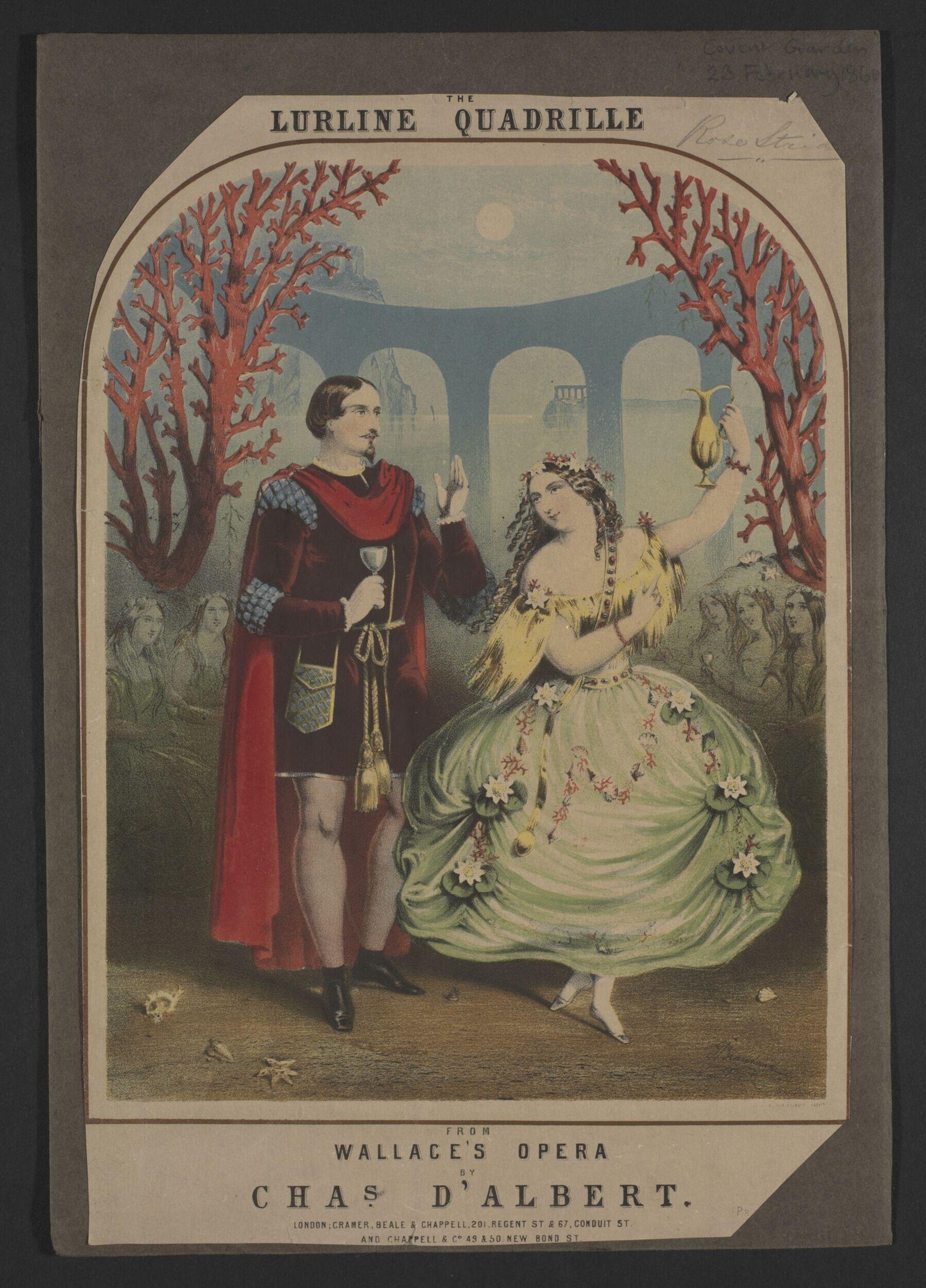
A man and woman in Romantic-era dress stand in a garden setting framed by stylized red coral trees. The woman wears a pale yellow-green ball gown with a fitted bodice, short puffed sleeves, and an enormous gathered skirt decorated with small floral sprigs and draped swags. Her dark hair is crowned with flowers and she holds a golden goblet aloft in her right hand, gazing upward with an expression of theatrical rapture. The man wears a deep crimson tunic with blue-checked sleeves and a long red cloak, holding a wine glass; he regards her with profile intensity. Between them lies the emotional pivot of the scene: the woman's gesture of elevation and ecstasy meets his grounded, observant stance. Behind them, a viaduct with multiple arches recedes into pale sky, and small figures of an audience or chorus populate the middle distance. The entire composition is rendered in hand-colored lithographic style typical of mid-19th-century theatrical prints.
The dancing
The two figures occupy a classical theatrical tableau vivant pose rather than active dance position. The woman's raised arm and uplifted gaze create a vertical lift through her upper body, her posture open and expansive; the man maintains a more contained, turned profile stance. Neither figure shows the characteristic hold or frame of ballroom dance—there is no contact between them, and their body angles suggest dramatic presentation rather than partnered movement. The woman's pose reads as an aria moment: legs hidden beneath voluminous fabric, weight stable, arms deployed for visual effect.
The dance depicted
This is a theatrical illustration from Chas. d'Albert's opera *Lurline* (1847), not a depiction of actual quadrille dancing. The quadrille appears in the title as a musical form—a quadrille was a four-part orchestral piece popularized in opera and ballet during this period—rather than as the social dance form. The scene captures a moment of romantic drama in operatic staging, likely a duet or dramatic confrontation between principal characters. The print documents operatic spectacle and costume design rather than ballroom choreography.
How it was made
This is a hand-colored lithographic print produced by Hart-Talbot Printers (London: Cramer, Beale & Chappell; Chappell & Co). The lithography allowed for soft tonal gradations in the sky and foliage, while hand-coloring added the brilliant crimsons, yellows, and blues characteristic of theatrical souvenirs. The technique was standard for opera and theatrical memorabilia, designed for wide circulation among theatregoers as affordable keepsakes. The arched framing device echoes the proscenium arch, directly referencing the stage.
About this work
This print documents not a dance but an operatic moment from d'Albert's *Lurline*, published as a theatrical souvenir in the mid-19th century. It captures the visual spectacle of Romantic opera—the elaborate costume, the dramatic gesture, the idealized female beauty—rather than the mechanics of dance. The quadrille in the title refers to the musical structure of the scene, not its choreography. As a record of theatrical production design and operatic staging conventions, it sits at the intersection of dance history and operatic history, showing what kinds of movement and gesture were considered dramatically compelling on the mid-Victorian stage.
How to look at it
Attend to the woman's raised arm and upward gaze: this is the organizing principle of the image, the moment of maximum emotional and visual drama. The print captures not movement but an arrested gesture—a pose held for visual impact rather than transitional. Notice how the costume, not the body, dominates: the enormous skirt and decorative detail fill the frame, making the figure iconic rather than kinetic. The man's profile and contained posture create a visual contrast that structures the romantic dynamic. This is how operatic spectacle was visualized and sold: as moments of heightened, statuesque beauty rather than flowing motion.
The artist
Hart-Talbot was a London printing firm active in the mid-19th century, specializing in hand-colored lithographic theatrical prints and operatic memorabilia. They produced affordable, widely-distributed colour prints of popular operas, making theatrical imagery accessible to a broad middle-class audience. These prints typically captured iconic moments of spectacle rather than detailed choreographic documentation.
The period
The 1840s-1860s saw the peak of Romantic opera across Europe, with composers like d'Albert creating works that emphasized emotional extremity, supernatural themes, and elaborate visual spectacle. The quadrille itself was at the height of its popularity as both a social dance and a musical form in this period. Operatic prints like this one were key consumer goods—souvenirs that allowed audiences to relive and circulate theatrical moments within their homes. The theatrical costume shown here reflects the extravagant, historically-inflected dress favored in Romantic opera, which bore limited relation to actual historical garment but was designed for maximum visual impact under stage lighting.
Where it lives
This is a theatrical souvenir print from the Victoria and Albert Museum collection, part of the broader archive of 19th-century operatic ephemera. The print was produced by Hart-Talbot Printers and published in London, dating to the period shortly after d'Albert's opera premiere.
Questions about this work
Is this actually a picture of the quadrille dance?
No. This is a theatrical print illustrating a scene from an opera called 'The Lurline Quadrille,' but the characters are not performing a quadrille. The 'quadrille' in the title refers to the musical structure of the operatic number, not a dance form. The scene shows dramatic singing poses, not ballroom choreography.
What was the quadrille in the 1860s?
The quadrille was a four-part square dance popular in ballrooms from the 1830s through the 19th century, performed by four couples. It was also a musical form used in operas and ballets. By the time this print was made, the quadrille was firmly established as both a social dance and a compositional convention.
Who was Chas. d'Albert?
Charles d'Albert (1809-1884) was a French-Belgian composer known for operas and operettas. Lurline (1847) was one of his popular works, blending Romantic themes of magic, nature, and doomed love with elaborate spectacle designed to showcase singers and visual production values.
Why are theatrical prints colored by hand?
Hand-coloring was standard for theatrical prints in the 19th century because it allowed printers to highlight the brilliant costume colors and dramatic lighting effects of stage performance. Lithography could capture tone and detail, but hand-coloring added the vivid hues necessary to convey theatrical spectacle and make prints commercially appealing as souvenirs.
More Quadrille artwork