47 works in this view — arrow keys or swipe to move between them.
Dance in Art
The Dundreary Quadrille
Packer, Thomas
- Dance:
- Quadrille
- Era:
- Mid 1800s (Polka Era)
- Source:
- Victoria and Albert Museum
- Rights:
- Rights vary by item — check the source record before reusing this image. Source record ↗
- Recorded as:
- Check V&A creditLine
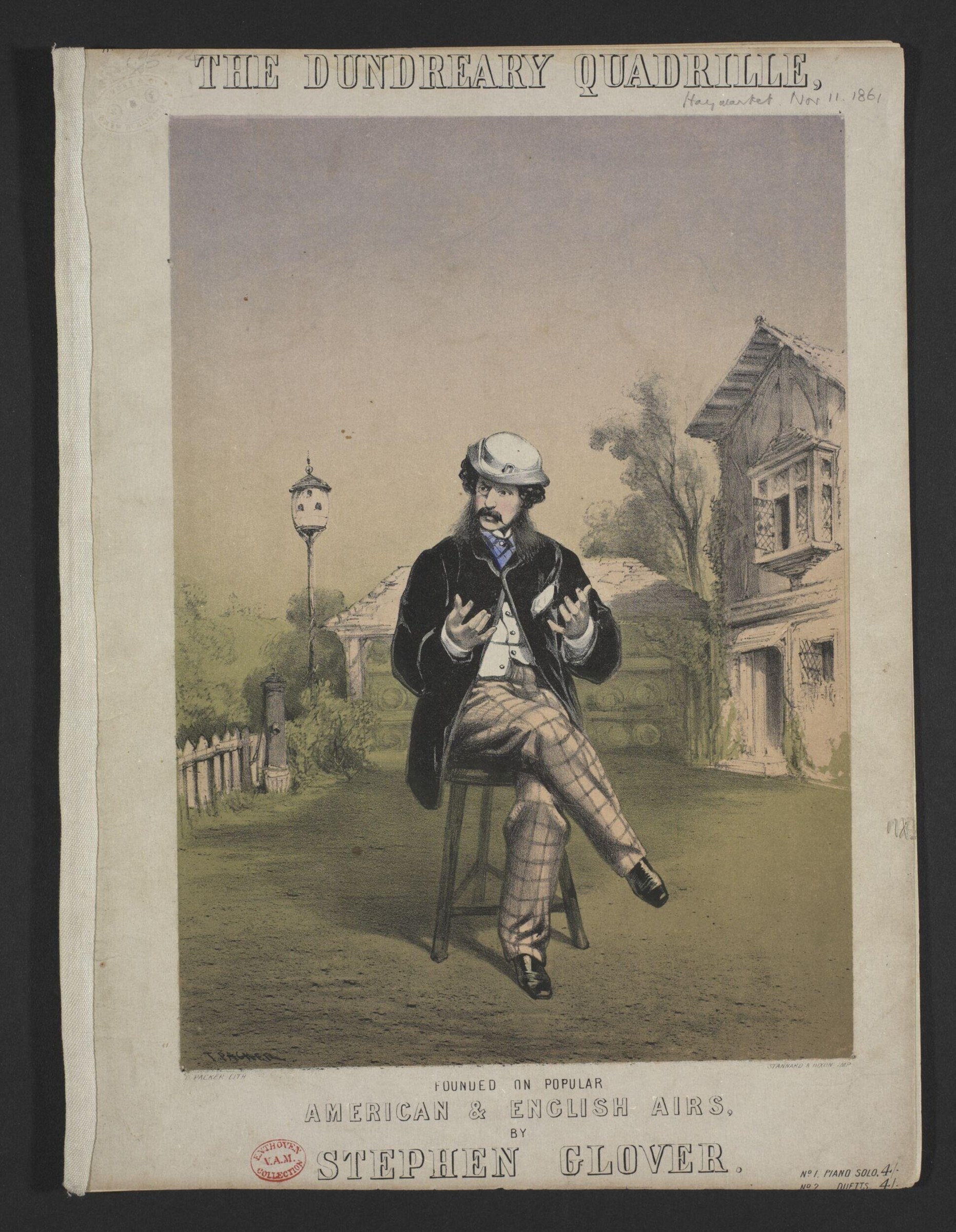
This print reveals the close relationship between ballroom dance and theatrical entertainment in the 1860s, showing how published dance imagery could serve promotional and comic purposes rather than instructional ones. The figure's exaggerated physicality—his refusal of ballroom decorum—demonstrates that dance was a contested and often satirized social practice, and that popular prints were a medium through which theatrical personalities and comic performance reached mass audiences.
What you are looking at
A single male figure stands in the center of what appears to be a suburban or village street, dressed in fashionable mid-Victorian attire: a dark jacket, light waistcoat, checked trousers, and a rounded bowler hat. He adopts an exaggerated theatrical pose with one leg raised high and bent, his body leaning back slightly, both arms spread wide in a gesture of expansive delight or exuberance. The setting is a peaceful, orderly street lined with trees and domestic architecture—a decorative lamp post stands to the left, and a cottage or small house with prominent chimneys appears to the right. The sky is rendered in pale washes suggesting overcast light. The figure's pose is entirely artificial and performative, frozen in a moment of deliberately comic self-presentation that has nothing to do with the domestic tranquility around him.
The dancing
The single dancer presents a highly stylized, exaggerated posture: one leg is raised and bent acutely at the knee, thrust upward almost to hip height; the supporting leg is straight but the torso leans back at an angle, creating an unstable, almost falling-backward quality. Both arms are extended outward and slightly upward in an open, expansive gesture. The posture is unbalanced and intentionally awkward—no ballroom hold or partner is present. The figure commands the entire composition through sheer comedic contrast between his theatrical contortion and the orderly, respectable setting. This is not the contained posture of ballroom dance but the exaggerated physical comedy of music-hall or vaudeville performance.
The dance depicted
This is a music-hall or vaudeville comic solo rather than ballroom dance in any conventional sense. The title references the Dundreary Quadrille, which was likely an actual quadrille—a formal four-couple parlor dance—that existed in 1861, but the figure depicted performs no quadrille steps. The theatrical pose and the inscription 'Founded on Popular American & English Airs' suggest this is illustration of a comic character or dance number, possibly from a theatrical production or musical entertainment. The figure's name and characteristics are lost to us, but the exaggerated physical comedy—the high-kicked leg, the sprawling arms, the uncontrolled leaning back—indicates a performer mining laughter from physical absurdity rather than executing steps with ballroom precision.
How it was made
This is a hand-colored chromolithograph or similar color printing process, evidenced by the carefully registered color fields (pale sky, green grass, flesh tones, and fabric patterns) that sit discretely alongside drawn lines rather than blending optically. The technique allowed rapid reproduction and wide distribution of theatrical imagery to a popular audience. The inscription and printed text are integral to the design, not added after printing. The quality of reproduction and the subject matter suggest this was a commercial theatrical print, likely sold as sheet music cover art or as a separate theatrical poster-print, targeting audiences interested in popular entertainment and music-hall culture.
About this work
This is a theatrical comedy print from 1861 depicting a figure performing an exaggerated, unbalanced pose—one leg kicked high, body leaning back, arms spread—in contradiction of the formal quadrille dance named in the title. The work combines the emerging chromolithographic color-printing technology with popular entertainment culture: it documents not ballroom technique but rather the physical comedy of mid-Victorian theatrical performance. The Dundreary Quadrille, likely an actual dance piece set to popular American and English melodies, is represented here not as instruction or record but as visual advertising for a comic musical entertainment—a piece of the visual and theatrical culture surrounding ballroom dance rather than a document of ballroom dance itself.
How to look at it
Attend to the deliberate awkwardness of the pose: the artist has chosen a moment of maximum ungainliness—the leg thrust high, the body off-balance—precisely to register comic effect. This is not a ballroom position frozen in elegance but a theatrical moment of exaggerated physical comedy. The contrast between the figure's theatrical abandon and the calm, orderly domestic street behind him is the print's entire meaning: he is a disruptive force of comic excess in a respectable setting. The chromolithographic color registers this contrast through tone—the pale, orderly street versus the figure's vivid, assertive clothing and posture.
The artist
Thomas Packer was a mid-Victorian illustrator and lithographer working in the theatrical and popular-print trade. Little is documented of his individual practice, but his work demonstrates the commercial integration of theatrical imagery, music publishing, and chromolithographic printing. Artists of his type produced the visual culture surrounding popular entertainment—sheet music covers, theatrical posters, and promotional prints—working quickly and in high volume to supply a growing market for illustrated entertainment materials.
The period
The early 1860s saw the height of Victorian music-hall and theatrical culture, and a rapid expansion of color-printing technologies that made theatrical imagery widely accessible and affordable. Ballroom dance itself was in transition: the quadrille remained the foundational social dance, but newer waltzes and polkas were gaining ground, and theatrical versions of dances were increasingly popular. The print culture of the era often blurred distinctions between instructional, documentary, and comic representations of dance. Comic and satirical imagery of dancers and dance culture proliferated, reflecting both the social importance of dance and middle-class anxiety about bodily display and feminine participation in public leisure.
Where it lives
The work is held in the Victoria and Albert Museum, a major repository of Victorian theatrical and print culture. It is cataloged with a handwritten inscription indicating an acquisition or cataloging date of November 11, 1861, the year of its publication. As a theatrical print, it would have been produced in quantity and circulated commercially, but individual copies have survived primarily in institutional collections.
Dance in this work
Questions about this work
What is a quadrille?
A quadrille is a formal square dance for four couples in a fixed set. It was the dominant social ballroom dance from the late 18th century through the Victorian era, typically performed to a sequence of short musical movements. The dance involved a prescribed sequence of figures executed by couples in specified positions, and it required no special skill or athleticism—it was a structured, geometric dance accessible to broad social participation.
Why is this figure doing nothing like a quadrille?
The title references the music—the quadrille was likely a musical composition set to 'popular American & English airs'—rather than the dance itself. This is a theatrical comic figure performing for entertainment, not a ballroom dancer. The exaggerated, unbalanced pose is physical comedy designed to make audiences laugh, not to instruct or document actual dance technique.
What does 'Dundreary' mean?
Dundreary was likely the name of a comic character or theatrical personality associated with this musical number, but the specific reference is now obscure. The name may refer to a character in a theatrical production of the 1850s–1860s. Without access to contemporary theatrical records, the exact meaning cannot be confirmed.
Is this a painting or a print?
This is a chromolithograph—a color print made by lithographic process. It was mechanically reproduced and commercially distributed, not a unique painted object. The technique was new in the 1860s and made theatrical and popular imagery affordable and widely available.
More Quadrille artwork