28 works in this view — arrow keys or swipe to move between them.
Dance in Art · 1850
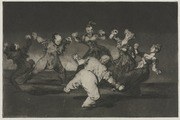
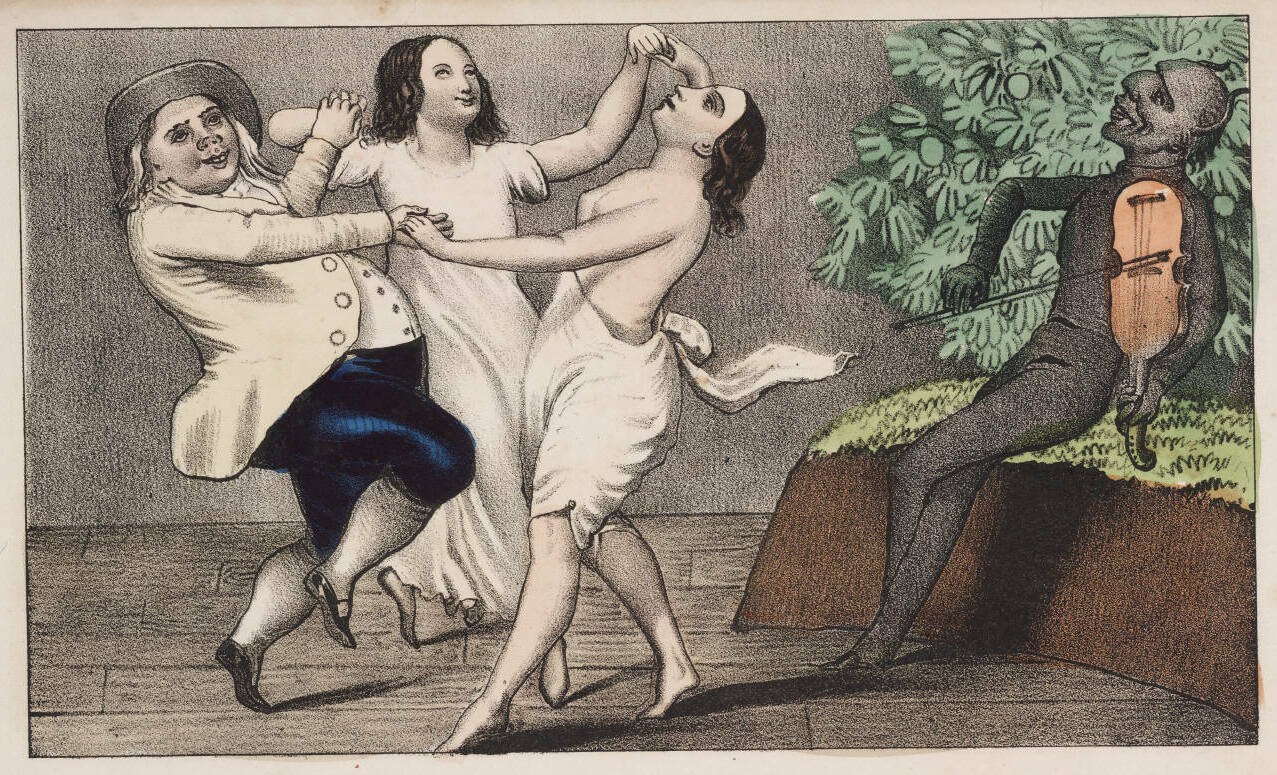
A Mormon and his wives dancing to the devil's tune 1850 (cropped)
McGee Van Dusen
- Medium:
- Lithograph
- Era:
- Mid 1800s (Polka Era)
- Source:
- Wikimedia Commons
- Rights:
- Public domain — free to use, share and adapt.
- Recorded as:
- Public Domain
This print demonstrates how dance and bodily movement were deployed in nineteenth-century American political satire to encode moral judgment. For historians of both dance and American religious controversy, it shows how depictions of dancing bodies functioned as ideological argument, making claims about sexuality, religion, and social order visible and shareable across a wide public.
What you are looking at
A lithograph presents a satirical scene of four figures in a parlor or domestic interior. Three women in classical draped white garments occupy the center and right of the composition, their bodies intertwined in an energetic, playful embrace. A man at left, wearing a coat with visible buttons and dark breeches, reaches toward them with apparent urgency or desire. The figures are rendered in the neoclassical style with careful attention to musculature and drapery. At far right, partially obscured by foliage, a darker-skinned figure plays a stringed instrument—identifiable by its shape as a violin or similar instrument. The setting is sparse: a plain floor, architectural elements suggesting interior walls, and leafy vegetation at the composition's right edge that frames the musical accompaniment. The title inscribed on the work identifies this as a Mormon and his wives dancing to diabolic music, establishing the image's satirical intent: the dance is presented as illicit, transgressive, and morally compromised.
The dancing
The three women's bodies are closely grouped, with arms raised and intertwined, suggesting a collective, exuberant movement rather than partnered dance in the ballroom sense. Their weight appears lifted and mobile, with legs visible in active positions beneath the classical drapery. The man at left is depicted in a lunge or approach, his body leaning forward dynamically. There is no formal closed or open ballroom hold; instead the grouping reads as spontaneous, intimate contact. The musician, positioned apart and partially hidden, observes and accompanies rather than participates. The overall impression is of playful, uninhibited physical contact rather than codified dance technique.
The dance depicted
This is not a depiction of recognizable ballroom or theatrical dance of the period. The composition invokes classical or neoclassical imagery—the draped garments, the musculature, the grouping—but applies it to a scene of domestic revelry presented as morally transgressive. The title's reference to 'the devil's tune' and the insertion of a musician suggest vernacular or social dancing, possibly inspired by accounts of Shaker or other communal religious movements. The exuberant, unstructured contact among the figures distinguishes this from the formal partnering of waltz, quadrille, or cotillion. The work functions as political satire rather than documentary of actual dance practice.
How it was made
This is a hand-colored lithograph, a medium that allowed rapid mass production and wide circulation. The technique combines drawn line work (visible in the careful rendering of fabric and musculature) with tinted color—flesh tones, blue breeches, green foliage—applied after printing. Lithography's relative affordability and speed made it the preferred medium for satirical prints, broadsheets, and illustrated books in the nineteenth century. The colored areas are applied broadly rather than with fine detail, consistent with commercial print production of the 1840s–50s.
About this work
This lithograph is a satirical illustration from an 1850 American publication attacking Mormon plural marriage and domestic practice. It uses the visual language of classical dance—energetic, uninhibited contact among multiple figures—to mock and condemn what the publishers framed as transgressive sexuality disguised in religious ceremony. The work sits at the intersection of anti-Mormon polemic, dance imagery, and nineteenth-century American visual satire. It belongs in a dance gallery not because it documents actual dance practice, but because it weaponizes the visual vocabulary of embodied pleasure and movement to make a political argument: the dancing bodies here are presented as evidence of moral corruption. The image reveals how dance imagery circulated in nineteenth-century American public discourse as a marker of acceptable versus transgressive physicality.
How to look at it
Attend to the absence of ballroom convention in the grouping. There is no lead and follow, no frame, no separation of bodies into discrete couples. Instead, the figures are compressed and overlapping, with multiple points of contact—arms, hands, torsos. The artist has chosen a moment of maximum physical engagement and exuberance. Note also the positioning of the musician at the composition's edge: the music appears to drive the action, but the musician is not part of the dancing community. This compositional choice enforces the satire's claim that the dancing is illicit, driven by external (diabolical) influence rather than emerging from proper social practice.
The artist
McGee Van Dusen, author and illustrator, and Maria Van Dusen, co-author, published this work as part of a sensationalist exposé titled Startling Disclosures of the Wonderful Ceremonies of the Mormon Spiritual-Wife System (1850). The Van Dusens' illustrated book was one of many anti-Mormon publications circulating in the American Northeast during the period of conflict between the Church of Jesus Christ of Latter-day Saints and mainstream Protestant America. The work belongs to a genre of illustrated polemic in which visual satire reinforced textual argument.
The period
The work dates to 1850, a moment of intense public controversy over Mormon settlement, theology, and domestic practice in the United States. The illustration of plural marriage as exotic, sensual, and morally disordered was a standard rhetorical move in anti-Mormon discourse of the era. At the same time, this is the height of the Romantic era in dance, when waltz and other closed-partner dances were still subjects of moral anxiety in conservative circles—though directed at different targets. The lithograph's invocation of classical imagery (the draped garments, the idealized bodies) contrasts deliberately with its subject matter, using high artistic convention to mock and condemn.
Where it lives
The work is part of an illustrated book published by Blake & Jackson of New York in 1850. The source record indicates the image comes from the Yale Collection of Western Americana, though the specific accession information is not provided.
Questions about this work
Did Mormons actually dance like this?
No. This is a satirical exaggeration designed to mock and condemn Mormon practice. The image uses classical artistic language and deliberately uninhibited physicality to make a political argument, not to document actual Mormon ceremony or dance. Anti-Mormon publications of the era regularly distorted accounts of religious practice for rhetorical effect.
What is the significance of the musician?
The title references 'the devil's tune,' and the musician's position at the composition's edge, partially hidden, suggests that the music—and by extension, the dance—is external, driving, even demonic. This compositional choice reinforces the satire's moral claim: the dancing bodies are presented as puppets or victims of corrupting influence.
Why is this a dance image?
While it is fundamentally a political satire, the work deploys dance and bodily movement as its primary visual argument. The dancing bodies are the evidence of moral transgression. For historians of how dance has been represented and used in visual culture, this print shows how depictions of dancing—or quasi-dancing, uninhibited physicality—functioned as political and moral commentary.
What does the classical style mean here?
The neoclassical rendering—idealized bodies, draped garments, references to Greco-Roman art—creates ironic tension with the image's satirical content. Using the visual language of high art to depict what the publisher frames as moral degradation was a common strategy in nineteenth-century satire, heightening the accusation through artistic contrast.
More dance artwork