40 works in this view — arrow keys or swipe to move between them.
Dance in Art · 1909
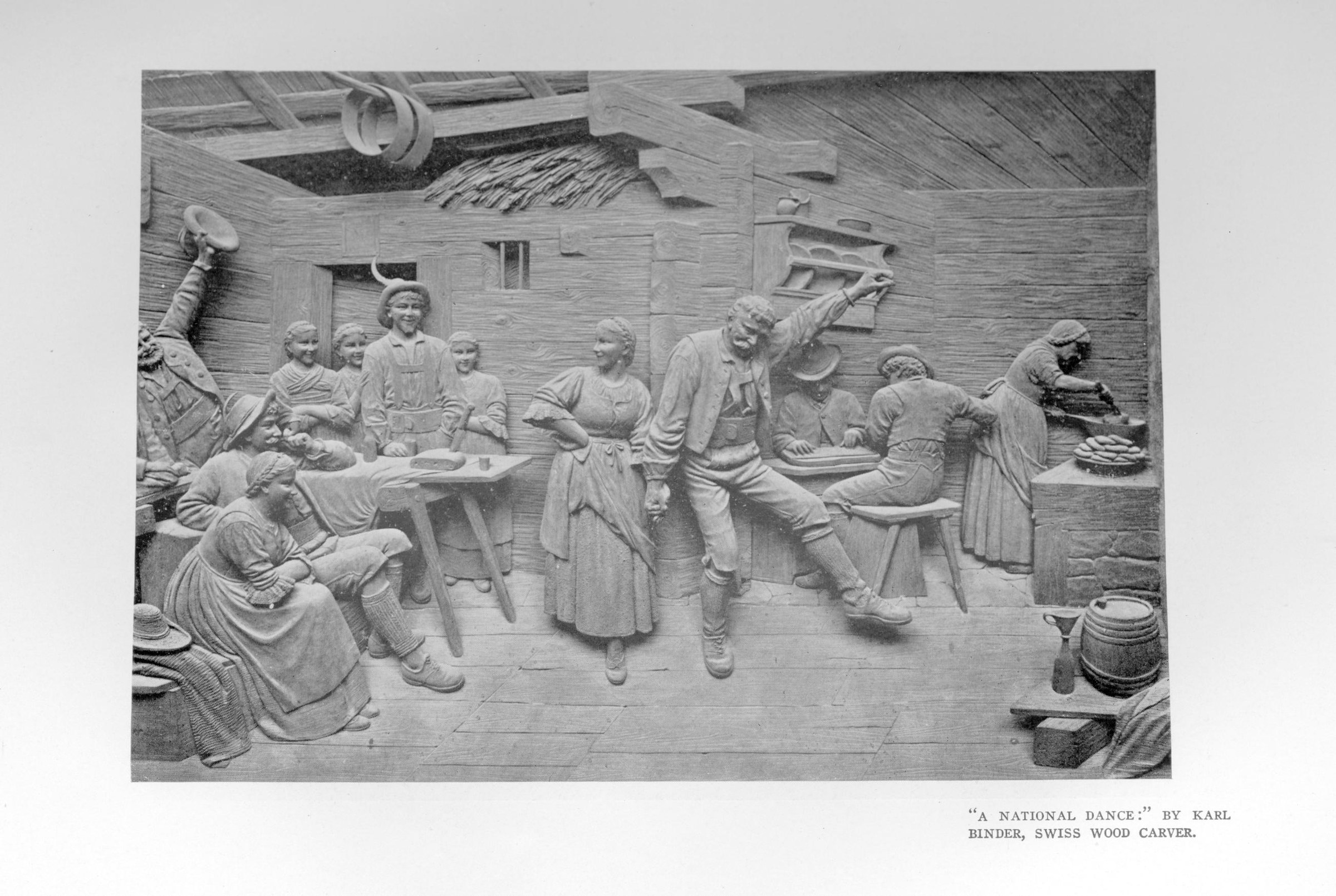
A National Dance by Karl Binder, Swiss Wood Carver
Karl Binder
- Medium:
- Oil Painting
- Era:
- 1900-1920 (Ragtime/Early Jazz)
- Source:
- Wikimedia Commons
- Rights:
- Public domain — free to use, share and adapt.
- Recorded as:
- Public Domain
For historians of folk dance and social history, this carving preserves a material record of how village celebration was imagined and represented by a trained artist in the early 20th century. For dancers, it offers evidence of an older vocabulary of open-frame, celebratory movement—unpolished, unselfconscious, and rooted in community rather than training.
What you are looking at
A wood-carved relief depicts a lively village or communal celebration indoors, with figures arranged across a wooden floor beneath exposed timber beams and hanging tools. The scene shows approximately twelve figures of varied ages in period dress—women in long skirts and simple garments, men in breeches and shirts—engaged in what appears to be a social gathering centred on dancing. At the composition's heart, a couple in the foreground performs an energetic step: the man, in mid-gesture with one arm raised and a broad posture, partners a woman in a long dress. Around them, seated and standing figures watch, converse, or participate—some clapping or gesturing encouragement. The carving's shallow relief creates a frieze-like quality, with figures overlapping slightly to suggest depth. Details visible include a barrel in the lower right, baskets and household goods scattered about, and the warm, even light of interior wood sculpture, which renders both foreground dancers and background observers with the same tactile attention to drapery and posture.
The dancing
The central male dancer displays an exuberant, open frame: legs in a wide stance, one arm raised in celebration, the other extended toward his partner. His posture conveys both vigour and social confidence—not a trained ballroom hold but an animated, spontaneous gesture. The woman opposite him stands in a simple, upright position, her long skirt and formal dress suggesting a restrained bearing compared to his energy. Around them, other figures display the vocabulary of social dance observation: seated women lean forward with interest, standing men adopt casual poses, and several raise their hands in what may be clapping or encouragement. The composition reads as a moment of social participation rather than formal technique—a celebration in which multiple bodies acknowledge and share the central action.
The dance depicted
This appears to depict a village or folk dance of central or northern European origin, most likely from Switzerland or the Alpine region, given both the artist's Swiss identity and the rustic interior setting with its timber construction and household character. The energetic, open-framed movement and the mixed-age group participation suggest a social dance rather than courtly or staged choreography. The exact dance form cannot be identified with certainty from the carving alone, but the rural indoor setting, the costume, and the moment of celebration suggest a mazurka, polka, or similar 19th-century folk or country dance that would have been performed at village gatherings. The title 'A National Dance' implies the artist intended this as a representation of a specific cultural practice, though without inscription or documentation it remains a type rather than a named form.
How it was made
The work is a wood carving in shallow relief—a technique requiring patient, additive carving that emphasizes silhouette, drapery, and facial expression while maintaining a unified, readable composition. The shallow depth allows multiple overlapping figures to remain legible within a single plane, ideal for a narrative scene. Wood carving of this scale and finish suggests a work made for display or exhibition rather than functional decoration, and the precision of the figural work and costume detail indicates Binder's trained skill. The monochromatic, textured surface and the way light falls across the carved planes create a tactile quality that invites close examination of individual bodies and gestures.
About this work
This wood relief by Swiss carver Karl Binder presents a snapshot of communal village celebration, capturing a folk dance at its moment of greatest energy. The work sits at the intersection of ethnographic interest, social history, and sculptural craft: it documents a 'national' cultural practice while demonstrating the artist's ability to render human movement and social interaction in wood. The carving's title suggests Binder intended it as a cultural statement—a celebration of Alpine or Swiss folk tradition—at a moment when European artists and patrons were increasingly interested in peasant life, regional identity, and the preservation of vanishing customs. The work belongs in a dance archive because it captures not just the posture of a single step, but the entire social apparatus of village dance: the participation of multiple generations, the relationship between performer and observer, and the exuberance of a community gathered around shared movement.
How to look at it
Examine the central couple first: the man's raised arm and open posture, and the woman's more contained stance, reveal a social dance vocabulary in which one partner initiates and the other responds. Then look outward to the surrounding figures—notice how seated observers lean inward, how standing figures gesture or position themselves, and how the composition creates a sense of concentric attention focused on the dancers. The uniformity of the carved surface and the way Binder has rendered drapery folds, fabric weight, and facial expression suggest he worked from observation or strong memory of actual village gatherings. The shallow relief means the entire scene remains in a single register, giving equal visual weight to dancers and observers—a compositional choice that emphasizes community participation over individual virtuosity.
The artist
Karl Binder (dates not established) was a Swiss wood carver working in the early 20th century. The precision and narrative sophistication of this relief suggest formal training in sculpture or applied arts, and the work's exhibition or publication history (as suggested by its inclusion in archival records) indicates that Binder worked at a level of public visibility. The choice of folk celebration as subject matter aligns with early modernist interest in vernacular culture and national identity, common among Swiss and Alpine artists of the 1900s–1920s period.
The period
This carving was made during a period of intense European interest in folk traditions and 'national' identity. In the early 20th century, ethnographic documentation, folk revival movements, and nationalist political movements created demand for artistic representations of peasant life and regional custom. Swiss artists in particular were engaged in documenting Alpine culture as both a cultural treasure and a source of national distinctiveness. Simultaneously, the formal innovations of modernism were beginning to incorporate the simplified forms and direct carving methods associated with folk and non-Western sculpture. Binder's choice to represent a moment of social dance—rather than a formal ball or stage performance—reflects this interest in 'authentic' popular culture as opposed to the dance of elite or urban society.
Where it lives
The work is known through Wikimedia Commons, indicating it has entered public digital circulation; the holding collection is not recorded. It may exist as a physical object in a Swiss museum, craft collection, or private holding, but current location is not established.
Dance in this work
Questions about this work
What dance is being performed?
The specific dance form cannot be identified with certainty from the image alone. The open frame, rural setting, mixed-age participation, and Alpine context suggest a folk or country dance such as a mazurka, polka, or regional variant common to Switzerland or the surrounding Alpine region in the 19th and early 20th centuries. The title 'A National Dance' implies Binder intended it to represent a form of cultural significance, but without additional documentation, only the type—not the name—can be established.
Why did a Swiss wood carver choose this subject?
In the early 20th century, European artists were increasingly interested in folk traditions and regional identity as sources of cultural authenticity and national pride. For Swiss artists, Alpine village life and peasant custom held particular importance. By carving this scene, Binder participated in a broader cultural movement to document and celebrate traditional practices before they were lost to modernization and urbanization.
How does the wood carving technique shape what we see?
Wood carving in shallow relief allows multiple overlapping figures to remain visually legible and readable as a unified scene. This technique naturally favors silhouette, drapery, and gesture over anatomical precision or detailed expression, and creates a tactile, textured surface that invites close examination. The method also suggests this is a finished artwork made for exhibition or display rather than functional decoration.
Is this documentary or artistic interpretation?
It is both. Binder has composed a narrative scene with theatrical sophistication—the arrangement of figures, the moment chosen, the framing—suggesting artistic intention beyond mere recording. At the same time, the specificity of costume, the precision of figural work, and the artist's identity as a Swiss observer suggest he was working from knowledge of actual practice. The work sits between ethnographic documentation and romantic artistic vision, common for this period and genre.
More dance artwork