49 works in this view — arrow keys or swipe to move between them.
Dance in Art · 1750
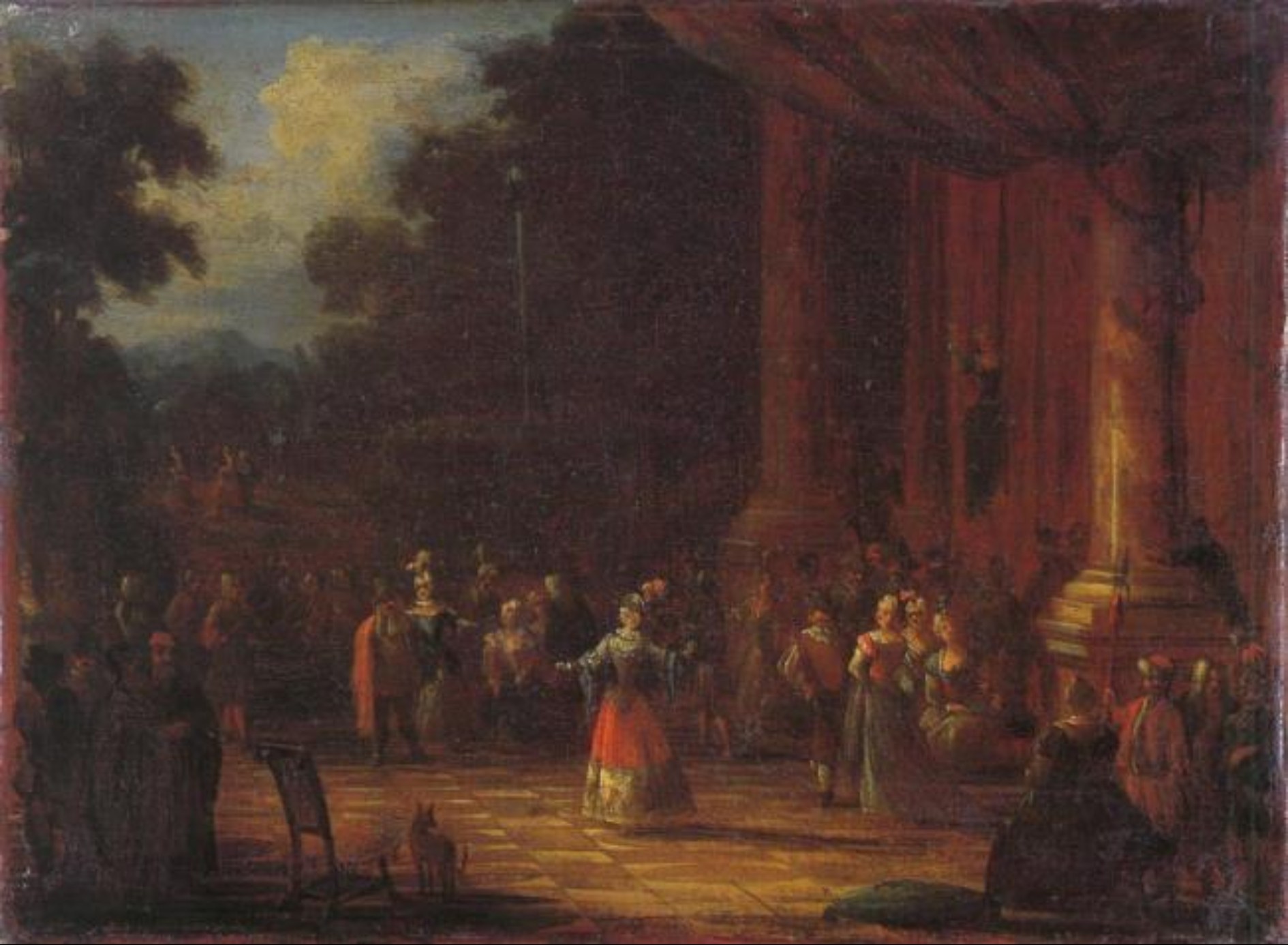
A Popular Pleasure Pavilion
Unknown
- Medium:
- Oil Painting
- Era:
- 1700s (Enlightenment/Minuet Era)
- Source:
- Wikimedia Commons
- Rights:
- Public domain — free to use, share and adapt.
- Recorded as:
- Public Domain
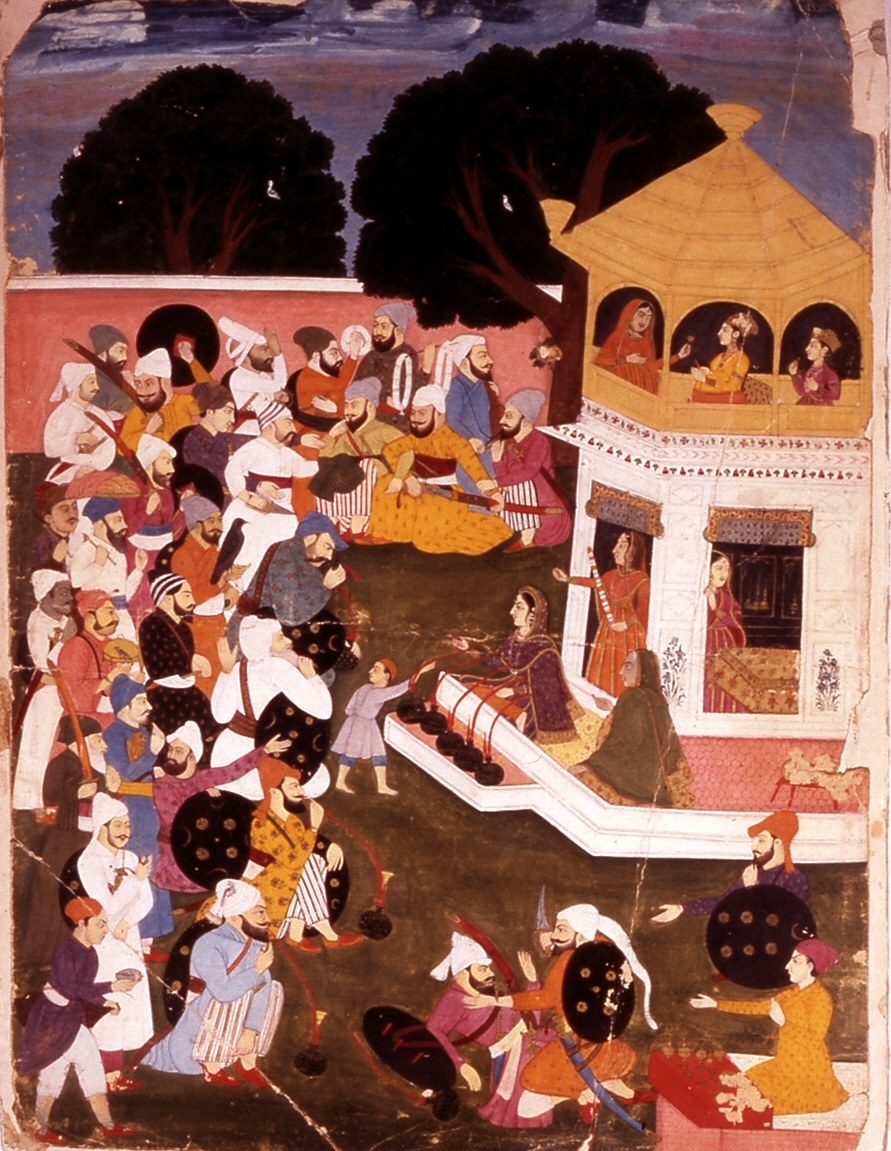
The painting offers rare visual documentation of Mughal courtly entertainment and social ceremony in the eighteenth century, showing how music, gesture, costume, and spatial hierarchy organized festive occasions. It demonstrates that in Indo-Persian contexts, what we might call 'dance' was embedded in ritual, ceremony, and music-making rather than existing as a distinct performance category, and this work makes that integration visible. For dance historians, it challenges the presumption that 'dance' as a discrete activity appears in every culture in the same form, and instead shows how movement, music, and social performance were fused in the contexts that mattered most.
What you are looking at
A festive outdoor gathering at a pleasure pavilion in what appears to be Mughal India, painted in the Indo-Persian manuscript tradition. A large crowd—perhaps fifty figures—clusters in the courtyard before an ornate yellow-roofed structure with arched openings, where musicians and attendants are visible. The left side of the composition is dense with revelers: men and women in vibrant silks, many holding umbrellas in reds, yellows, and whites as sun shades. In the center foreground, a figure lies recumbent on a white platform or bier, attended by several standing figures. The background shows two large dark trees and a purple evening sky. The palette throughout is warm—ochres, reds, deep blues in clothing, with white and yellow architectural elements—and the painting displays the flattened perspective and jewel-like detail typical of Indo-Persian court art. The scene captures a moment of social festivity and performance, with multiple simultaneous activities: music-making, attendance, crowd movement, and what may be a formal reception or ceremonial event.
The dancing
The human figures are rendered in profile and three-quarter view typical of Indo-Persian convention, with graceful elongated forms and expressive hand gestures. Most figures stand or move freely through the space; many hold objects (umbrellas, fans, instruments). The attendants around the central recumbent figure adopt postures of formal service—standing, bending, gesturing with apparent deference. Women are depicted in full-length fitted gowns and headscarves; men wear turbans, coats, and draped garments. There is no evidence of partnered social dancing in closed hold. The movement is largely processional, gestural, and individuated rather than choreographed as a unified dance; the bodies suggest music-making, conversation, service, and courtly ceremony rather than formal partnered or group dance steps.
The dance depicted
This appears to be a court or courtly entertainment scene rather than a depiction of formal dance in the Western sense. The gathering is likely a musical soirée, a reception, or a festive celebration in a Mughal or Indo-Persian courtly context. Music-making is evident (musicians are visible in the pavilion), and the umbrella-bearers and attendants suggest a formal occasion with ranked social roles. Some figures appear to be gesturing expressively or moving with grace, which in the Indo-Persian tradition could indicate dance or performance, but the primary activity appears to be social assembly, musical performance, and courtly display rather than choreographed dance. The reclining figure may be a dignitary receiving courtesies. Without evidence of specific dance steps, holds, or formations, the work should be understood as depicting the social and musical context in which dance occurred, rather than depicting dance itself.
How it was made
This is a gouache or opaque watercolor painting on paper in the Indo-Persian or Mughal manuscript tradition, likely from a formal court album or historical manuscript. The technique allows for fine detail, vivid color, and the flattened spatial composition characteristic of Indo-Persian art. The gold leaf accents visible in the architectural details and the refined execution suggest this was made for a patron of high status—a ruler, noble, or wealthy merchant. The small scale and paper support, combined with the elevated perspective and narrative subject matter, indicates this belonged to a compiled manuscript or album rather than being a standalone work intended for display on a wall. Circulation would have been restricted to the patron's court or intimate circle.
About this work
This painting documents social practice and entertainment in Mughal India around the mid-eighteenth century. It depicts a formal gathering at an outdoor pavilion, with music-making, attendants, and the regalia of a courtly occasion. While not a representation of formal choreographed dance, the scene captures the aesthetic context in which Indo-Persian courtly dance and music occurred: a world of refined gesture, hierarchical social roles, musical performance, and visual splendor. The work sits at the intersection of social history, courtly culture, and visual documentation of performance contexts. For historians of dance in India and the Islamic world, it provides evidence of how music, ceremony, and movement were integrated into elite social practice, and how gender, rank, and performance were visualized in Mughal art.
How to look at it
Attend to the layering of activity: the musician in the pavilion, the standing attendants, the crowd filling the courtyard, the central recumbent figure. Note how the artist has used scale, position, and costume to indicate social hierarchy and role—the umbrella-bearers and the dignitary are rendered with care and given prominent positioning. Observe the colors: they are not naturalistic but decorative and symbolic, with rich blues, reds, and yellows creating rhythm across the composition. The gold roof and architectural ornament draw the eye upward. The artist chose to freeze a moment of formal assembly and service, not of active performance; this tells us that for the patron, the interest lay in documenting the occasion, the gathering, and the social order, rather than in capturing a specific musical or dance act.
The period
This work dates to the mid-eighteenth century, a period of continued Mughal cultural refinement despite political fragmentation. The Mughal court maintained traditions of courtly music, poetry, and visual arts even as imperial power declined. Pleasure pavilions, musical soirées, and formal receptions were central to elite culture. Indo-Persian manuscript painting, though rooted in earlier traditions, reached high levels of technical refinement in this era. In Europe, rococo courtly society was similarly organized around music, dance, and spectacular display, but the aesthetic and social codes were entirely different. This painting reflects the cosmopolitan taste and refined leisure of Indian and Persian court circles.
Where it lives
The work entered the Walters Art Museum collection; the catalogue record notes no date of acquisition or prior ownership. The source here is Wikimedia Commons, accessed from the Walters' online collection. The painting was likely part of an Indo-Persian manuscript or album compiled in India in the eighteenth century and later acquired by a Western collector.
Questions about this work
Is this a dance scene?
It depicts a courtly musical gathering and entertainment occasion, not a formal choreographed dance performance. Dancers and musicians may have been present, but the primary subject is the social occasion, the ceremony, and the music-making. In Indo-Persian courtly culture, music, poetry, gesture, and movement were woven together rather than separated into distinct categories.
What is that figure lying down in the foreground?
The reclining figure appears to be a dignitary or patron being attended to by courtiers and servants. This could indicate a formal reception, a moment of rest during the festivities, or a ceremonial posture. The surrounding figures' attentive stances suggest formality and rank.
Who would have seen this painting originally?
This was likely part of a manuscript album owned by a Mughal noble, ruler, or wealthy merchant. It would have been viewed in a private or semi-private courtly setting, not publicly displayed. Viewers would have been educated in Indo-Persian artistic and courtly conventions and would have understood the social and musical references.
What do the umbrellas mean?
In Indo-Persian courtly imagery, umbrellas or parasols held by attendants are marks of rank and ceremony—they shade and honor the dignitary beneath them. They are functional (protection from sun) but also deeply symbolic of power and status. Their presence indicates a formal, high-status occasion.
More dance artwork