28 works in this view — arrow keys or swipe to move between them.
Dance in Art · 1710
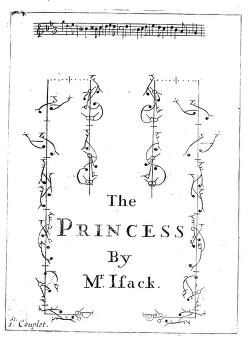
The princess : Mr. Isaac's new dance made for Her Majestys birth day ; engraven in characters & figu
Unknown artist
- Era:
- 1700s (Enlightenment/Minuet Era)
- Source:
- Library of Congress
- Rights:
- Public domain — free to use, share and adapt.
- Recorded as:
- public_domain
This is a primary document in the history of dance notation and the cultural status of dance in the early modern court. It proves that by 1710, European dance had achieved the institutional recognition and technical apparatus to be recorded, printed, and transmitted—a watershed moment. For dancers and historians, it demonstrates how choreography was actually preserved and taught before film, and offers a window into the movement vocabulary and compositional logic of baroque court dance.
What you are looking at
This is a printed dance notation document from the early 18th century, not a pictorial representation of dancers in action. The page shows the title "The Princess: By M: Isaac's new dance made for Her Majesty's birth day" in decorative lettering at the center, surrounded by a delicate ornamental border of scrolling vines and flourishes. Above the title runs a single line of musical notation in staff format. Below and flanking the title are four vertical columns of abstract symbols and figures—these are choreographic characters or notation marks representing the steps, timing, and patterns of the dance. The layout is typical of Feuillet notation, the standardized system for recording baroque dances that emerged in France around 1700. The marks are small, precise, and would be read only by trained dancers and dancing masters familiar with the notation system.
The dancing
There are no depicted human figures or physical bodies in this image. The 'figures' are abstract notational symbols—curves, lines, dots, and directional marks—that stand for movement concepts rather than representing actual movement visually. This is a technical score, not a representation of dancers executing steps. A reader trained in Feuillet notation would 'see' the dance through these symbols the way a musician reads a musical score, but the uninitiated see only marks.
The dance depicted
This is a record of a theatrical court dance composed by Michel Isaac (or Isaacs), the prominent French dancing master and choreographer active in London in the late 17th and early 18th centuries. The dance was created for a royal birthday celebration—almost certainly that of Queen Anne (reigned 1702–1714), given the date of circa 1710. Isaac was known for creating elaborate dances for court occasions. The notation system records the track of the dancer(s) on the floor, the timing of steps relative to musical measures, and the style of movement. Without access to the notation key, the specific choreography cannot be reconstructed from the image alone, but the document attests to a multi-part structured dance (the four parallel columns suggest either four dancers or distinct sections).
How it was made
This is a printed engraving, as stated in the catalogue record. The notation characters and ornamental border have been cut into a plate and printed from that engraving, allowing multiple copies to circulate. The precision and regularity of the marks suggest professional engraving by someone trained in cutting fine detail. Engraved notation documents were the primary method of disseminating choreography among the dancing masters and educated gentry of Europe; they could be distributed, studied, and taught from copies. The high quality of this printing indicates it was produced for a patron of means—the royal court or a wealthy subscriber.
About this work
This document is a printed choreographic score using Feuillet notation, recording a theatrical court dance by the celebrated dancing master Michel Isaac. It was created to commemorate a royal birthday, likely Queen Anne's, around 1710. Rather than depicting dancers in action, it is a technical recording that translates human movement into a standardized written language—as musical notation does for sound. It is an example of a major technological and cultural shift: the moment when dance became a notatable, preservable, and shareable art form in Europe.
The work sits at a crucial turning point in dance history. Before Feuillet notation (developed by Beauchamp and Feuillet circa 1700), dance choreography existed only in the body and the memory of trained practitioners. This engraved score is evidence of dance entering the world of print, intellectual property, and circulation—the same world occupied by music and literature. It also attests to the high status of dance in the court culture of the period: royal occasions warranted commissioned choreography by celebrated masters, and that choreography was prestigious enough to be formally recorded and printed.
How to look at it
To understand this image, recognize that it is a language, not a picture. The ornamental border and title page signal that this is a valued, formally published work. The four columns of notation indicate a multi-part structure; read the marks as instructions rather than representations. The musical staff at the top links the dance to its musical accompaniment—essential information, since baroque court dances were inseparable from their music. What is remarkable about seeing this document is not the visual beauty of individual gestures (there are none shown) but the evidence it provides that choreography, once purely ephemeral, had become a thing that could be fixed, printed, and preserved.
The artist
Michel Isaac (fl. 1680s–1720s) was one of the most celebrated dancing masters of his era, active in London and continental Europe. He trained in the French tradition under or alongside the founders of the Beauchamp-Feuillet notation system. He composed numerous dances for court occasions and is one of the few baroque choreographers whose work survives in notated form. Isaac was known for blending French and Italian movement idioms and for creating technically demanding dances for aristocratic patrons. Several of his dances appear in surviving notation manuals, making him one of the most documented choreographers of the baroque period.
The period
The early 18th century saw the codification of baroque court dance and the emergence of notation as a tool for preserving and teaching choreography. The Beauchamp-Feuillet notation system, published in detail by Raoul-Auger Feuillet in 1700, revolutionized how dance was transmitted and gave dancing masters a written language equivalent to that available to composers and writers. This democratized access to choreography: a dance could now be learned from a printed book rather than only through direct transmission from a master. At the same time, court dance itself was becoming more virtuosic and formally structured, moving toward the theatrical and balletic traditions of the 18th century. The commissioning of named choreographies for royal occasions reflected the prestige of dance as a courtly art and the celebrity status of master choreographers like Isaac.
Where it lives
The work is held in the Library of Congress. Such printed notation documents were typically produced in small runs for subscribers and patrons of the court; surviving copies are rare, making them valuable primary sources in dance history.
Dance in this work
Questions about this work
Can I learn the dance from this image?
Not from the image alone. Feuillet notation is a specialized language that requires training in the system to decode. The four columns of marks represent choreographic information (steps, timing, spatial patterns) but are meaningless without the legend that explains each symbol. A trained baroque dance specialist could reconstruct the dance from this notation, but the untrained eye sees only abstract marks.
Who was Michel Isaac?
Isaac was one of the most celebrated dancing masters of the late 17th and early 18th centuries, active in London and Europe. He was a composer of court dances and one of the few baroque choreographers whose work was formally notated and published, making him one of the best-documented figures in baroque dance history.
What is Feuillet notation?
It is a system for writing down choreography using abstract symbols to represent steps, timing, and floor patterns. Developed around 1700 by Beauchamp and Feuillet, it allowed dances to be recorded and transmitted in print, much as musical notation does for music. It was the dominant system for recording European court and theatrical dance in the 18th century.
How do we know this was for a royal birthday?
The title explicitly states 'made for Her Majestys birth day.' Given the date (circa 1710) and the reference to 'Her Majesty' without a name, it most likely refers to Queen Anne of England, who reigned 1702–1714. Court occasions were the primary commissions for celebrated choreographers.
More dance artwork