49 works in this view — arrow keys or swipe to move between them.
Dance in Art · 1780
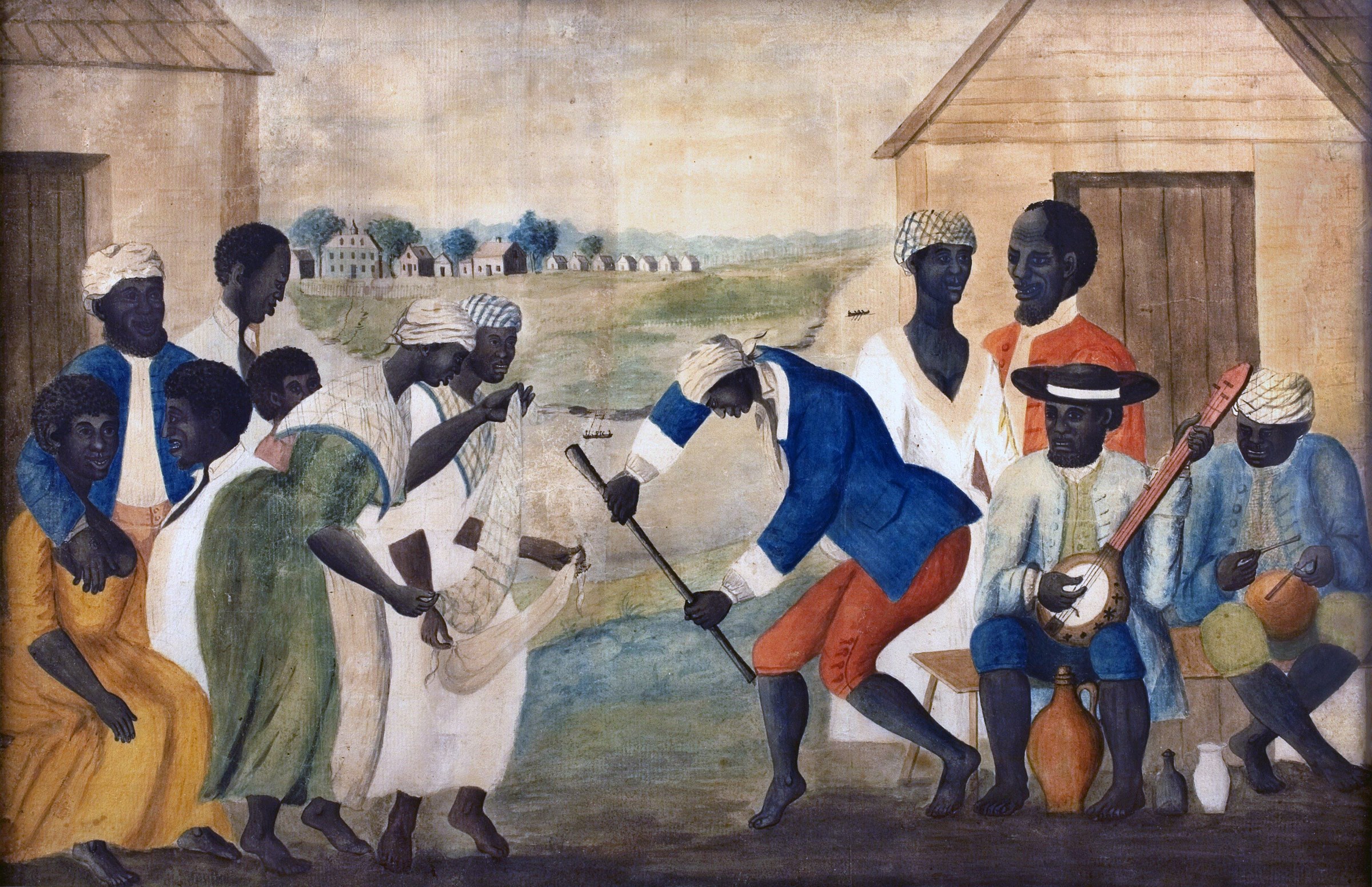
Gullah s carolina 1790
John Rose
- Medium:
- Oil Painting
- Era:
- 1700s (Enlightenment/Minuet Era)
- Source:
- Wikimedia Commons
- Rights:
- Public domain — free to use, share and adapt.
- Recorded as:
- Public Domain
This is one of the earliest visual records of African-derived dance and music-making in North America, and the shegureh identification demonstrates how careful visual and contextual analysis can recover specific West African cultural practices within the diaspora. For dancers and historians, the painting offers evidence that enslaved Gullah communities maintained and performed distinctly African musical and movement traditions even under colonial conditions, challenging narratives that erase or homogenize Black diasporic practice.
What you are looking at
A colonial-era plantation scene shows two groups of figures separated compositionally: on the left, enslaved people in wrapped head cloths and simple dress; on the right, a European man in formal blue coat and breeches performs a dynamic movement while musicians and onlookers surround him. The setting is ambiguous—the figures occupy a foreground terrace or courtyard defined by two wooden structures with pitched roofs, while a distant landscape with a row of buildings stretches across the middle ground under pale sky. The palette is muted earth tones with touches of blue, orange, and white. The painting appears to document a moment of cultural encounter or performance, with the European figure's posture suggesting active participation in or observation of music-making and movement.
The dancing
The central European figure leans forward at the waist with one arm extended, his body weight shifted as if mid-step or mid-gesture—the posture suggests either participation in dance or close observation with physical engagement. The enslaved figures on the left stand in looser formations; several hold or gesture toward objects (possibly the shegureh rattles mentioned in the existing description). Two women in the center-left appear to hold instruments at chest or hand height. The musician on the right holds what appears to be a stringed instrument (possibly a banjo or similar). The composition distributes attention across multiple figures rather than emphasizing a single dancer, suggesting a communal rather than spectatorial framing.
The dance depicted
The existing catalogue description identifies this as depicting Gullah slaves dancing and playing African-derived instruments. The specific identification of shegureh (women's rattles characteristic of Mende and neighboring Sierra Leonean peoples) suggests West African musical and movement practices preserved in the enslaved community. The painting likely documents social dance or celebratory movement rather than a formal dance genre, representing the syncretism and cultural persistence of enslaved people in colonial South Carolina. However, the precise dance form remains difficult to identify from visual evidence alone; the figures' postures do not clearly demarcate a recognizable European or codified African dance form, but rather suggest improvised movement in response to music-making.
How it was made
Oil painting on canvas (as stated in the catalogue record). The technique employs flat color blocking and linear perspective to structure the scene, with relatively little modeling or chiaroscuro. The execution appears careful but not highly refined, consistent with 18th-century colonial portraiture or documentary painting. Oil on canvas allowed for the preservation of this visual record on a scale and in a medium that could circulate among educated colonists, though the painting's current holding location is unrecorded, limiting certainty about its historical audience.
About this work
This painting documents a moment of cultural encounter on a colonial South Carolina plantation, capturing enslaved Gullah people in musical and movement practice alongside a European observer or participant. The work is historically significant as visual evidence of African musical instruments and movement practices in the American enslaved diaspora, and as a rare instance of colonial-era visual documentation of enslaved people's own cultural expression rather than European fantasies about them. The painting serves as both an artistic artifact and a historical document, offering researchers insight into how 18th-century colonists perceived—or chose to record—the performance and music-making of the people they enslaved.
How to look at it
Attend first to the spatial separation between the left and right sides of the composition: the painting does not center a single performer but distributes attention across multiple figures engaged in different activities—music-making, movement, observation. The central European figure's forward-leaning posture and extended arm are the most dynamically rendered bodies in the scene; consider whether this reflects the painter's investment in documenting European participation or observation. The instruments, particularly the rattles held by the women, are rendered small and somewhat unclear, yet their inclusion suggests documentary intent. The distant landscape and architectural framing (the two pitched-roof structures) establish this as a specific place rather than a generic colonial scene.
The artist
The catalogue attributes this work to John Rose, a colonial-era artist, with a date of 1780. Rose's broader practice and training are not well documented, and the attribution itself may merit reconsideration. The painting's style and subject matter are consistent with late 18th-century colonial documentary portraiture, a genre that often recorded colonial life without the rhetorical polish of formal history painting.
The period
The painting dates to 1780, during the American Revolutionary period and at the height of the transatlantic slave trade. In this era, European and colonial visual culture rarely centered the everyday practices and cultural expression of enslaved people; most depictions of slavery either stylized it allegorically or rendered enslaved bodies as property rather than as practitioners of their own cultural traditions. The painting thus sits at the intersection of two historical moments: the flourishing of West African cultural practice among Gullah communities (who arrived as skilled workers and maintained strong cultural continuities), and a rare moment when a colonial artist chose to document rather than allegorize this cultural expression. The shegureh and other instruments visible in the painting are part of the broader preservation of Mende, Yoruba, Ewe, and other West African musical and movement traditions in the Gullah lowcountry.
Where it lives
The painting is recorded as oil on canvas, dated 1780, attributed to John Rose. The current holding location is unrecorded; the work is known primarily through Wikimedia Commons, suggesting it may be in a public collection but with limited cataloguing information available.
Dance in this work
Questions about this work
Is this the famous 'Old Plantation' painting?
Yes. The painting is widely known by this title in scholarship on slavery and Black cultural history. It is one of the most cited visual documents of Gullah life and enslaved African cultural practice in colonial America.
What is a shegureh and how do we know that is what the women are holding?
A shegureh is a women's rattle characteristic of Mende and neighboring Sierra Leonean peoples. Scholars familiar with Sierra Leonean material culture can recognize it in the objects held by the women in the painting, whereas earlier interpreters misidentified them as props for a 'scarf dance.' This identification recovers specific West African cultural knowledge encoded in the painting.
Who are the people depicted and what is the context of the scene?
The painting depicts enslaved Gullah people on a South Carolina plantation, likely in the lowcountry region. The scene appears to document a moment of music-making and social dance, possibly a gathering or celebration. The European figure's role—whether participant, observer, or commissioned recorder—is ambiguous from the visual evidence alone.
How does this painting change our understanding of dance history?
The work provides rare 18th-century visual evidence that enslaved African communities maintained and performed their own musical and movement traditions in the Americas, rather than passively adopting European forms. It suggests that Gullah dance practice was rooted in specific West African traditions and performed within community rather than solely for European consumption or amusement.
More dance artwork