33 works in this view — arrow keys or swipe to move between them.
Dance in Art
Solo Dancer — Plate 14
Gregorio Lambranzi
- Medium:
- Copper-plate engraving
- Dance:
- Notation/Choreography
- Era:
- 1700s (Enlightenment/Minuet Era)
- Collection:
- Nuova e curiosa scuola de' balli theatrali (1716)
- Source:
- Library of Congress
- Rights:
- Public domain — free to use, share and adapt.
- Recorded as:
- Public Domain
Lambranzi's manual is one of the earliest and most complete surviving records of how early 18th-century theatrical dance actually moved. For dancers and choreographers studying the history of movement, notation, and the codification of technique, this work is primary evidence: it shows not only what steps were performed but also how they were notated, taught, and understood. The presence of musical notation paired with the visual image demonstrates the intimate relationship between music and dance at this historical moment, and the detail of the figures themselves—their dress, their posture, their spatial placement—preserves physical knowledge that would otherwise have been lost.
What you are looking at
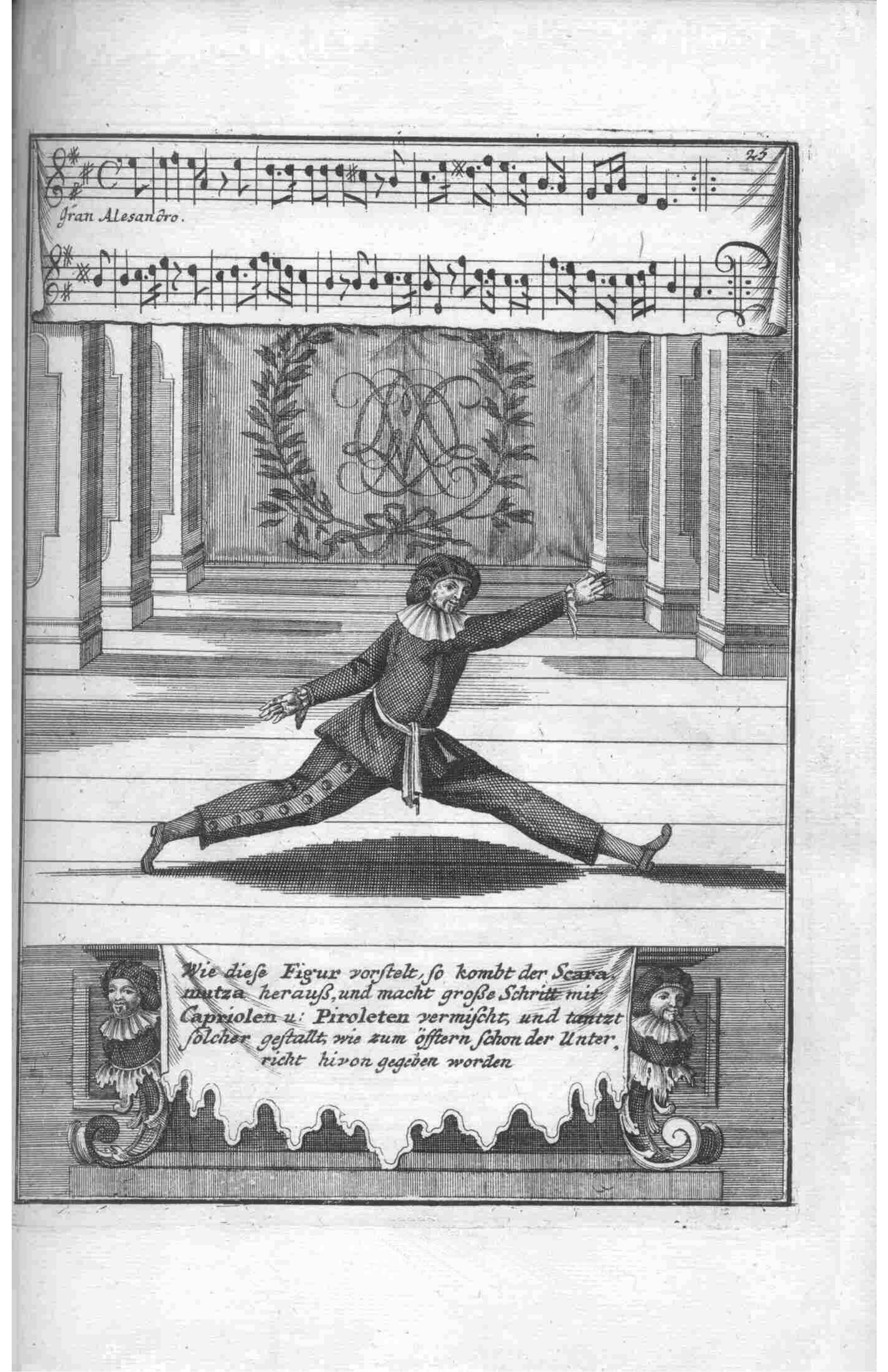
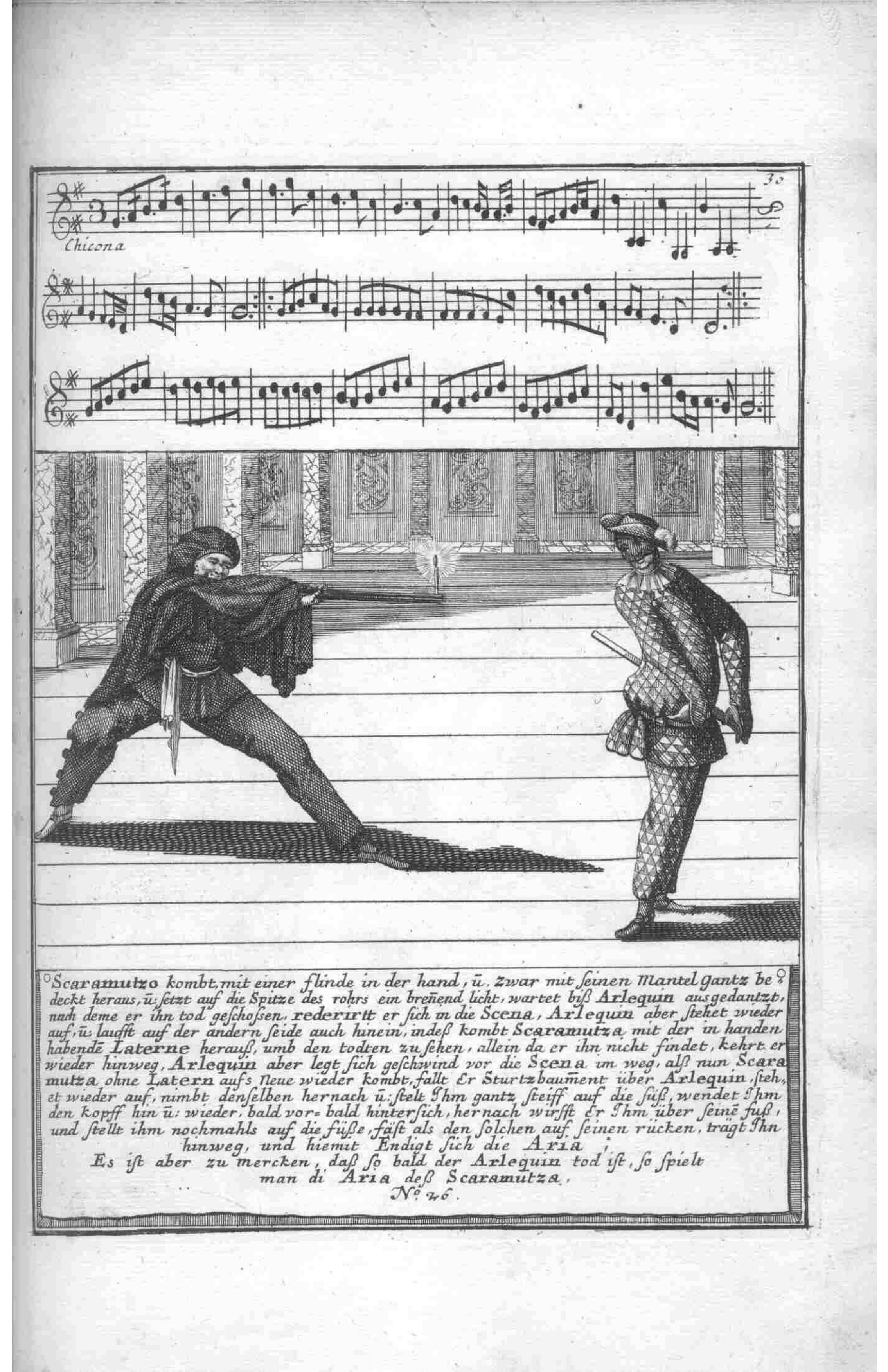
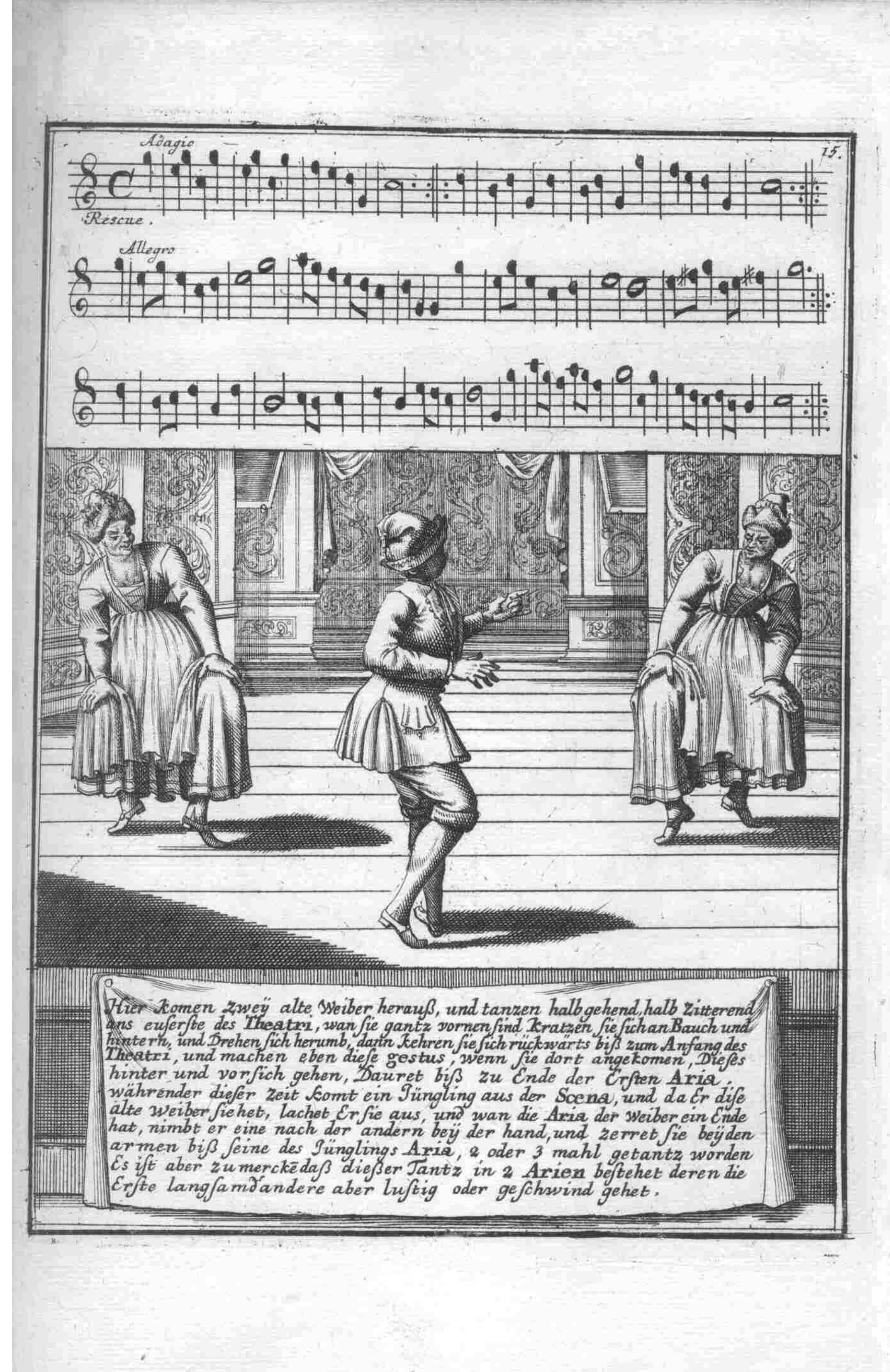
A solo male dancer in courtly dress performs on a shallow stage framed by ornate curtains and classical architecture. The figure is captured mid-motion, leaning into a rapid forward stride or running step, with one leg extended and the body in a dynamic forward tilt that conveys speed and theatrical energy. He wears a fitted doublet with short skirts, stockings, and shoes—the standard dress of early 18th-century male court dancers—and his posture is alert and athletic. The stage setting is formal and contained: paneled walls with decorative swags frame the dancer on either side, creating an intimate theatrical box. The copper-plate engraving is finely detailed, with careful cross-hatching establishing volume in the fabric and shadow beneath the figure. Below the stage scene runs German text in italic script, and above it appear three systems of musical notation—the choreography's notational equivalent and proof that this dance was prescribed and repeatable, not improvised.
The dancing
The dancer's weight is driven forward onto his right leg, which bears the full impetus; his left leg trails in a supporting or recovering position. His torso leans sharply forward from the hips, a posture that signals forward momentum and suggests the traveling steps of the period's theatrical vocabulary. His arms are positioned naturally at his sides, neither rigidly held nor dramatically raised—a restraint typical of male courtly dance before the mid-18th century. The head faces forward and slightly downward, following the diagonal of the body. There is no partner; the solo format emphasizes the individual dancer's control, speed, and the legibility of the prescribed step pattern.
The dance depicted
This is a theatrical dance step or sequence from the early 18th-century European court-dance tradition, most likely from the French or Italian theatrical canon that Lambranzi codified. The running or striding quality visible here—a forward-traveling step executed at speed—belongs to the vocabulary of the *corrente*, *passacaille*, or other traveling figures in theatrical dances of this era. The presence of musical notation above the figure signals that this step was part of a precisely notated choreography, not a social-dance variation. The male courtly dancer's costume, the theatrical setting, and the notation system all confirm this is theatrical dance instruction material rather than documentation of social-dance practice. The specific step name cannot be determined from the image alone, but Lambranzi's manual is organized by step type and characteristic motion, and this forward-driving posture is consistent with steps designed to travel across the stage.
How it was made
This is a copper-plate engraving, a medium that allowed for precise linear detail and wide circulation in the early 18th century. Engraving required the image to be incised into the copper plate's surface, then inked and printed—a labor-intensive but reproducible process. The fineness of the cross-hatching and the clarity of the notational staves above indicate a plate of high technical execution. This technique made Lambranzi's manual reproducible and distributable to dance masters across Europe; the same plate could yield dozens or hundreds of impressions. The combination of image and notation in a single print was itself innovative: the reader could see the step executed and read its musical timing simultaneously, making the manual a practical teaching tool rather than mere illustration.
About this work
This is a page from Gregorio Lambranzi's *Nuova e curiosa scuola de' balli theatrali* (Nuremberg, 1716), one of the most influential choreographic manuals of the early Enlightenment. Each plate pairs a musical score with an engraved image of a solo dancer performing a specific step or sequence on a theatrical stage. The format—figure, notation, and descriptive text in German—represents an early systematic attempt to codify and transmit theatrical dance across language and geography. Lambranzi's manual was used by dance masters throughout Europe and remained influential well into the 18th century, making it a foundational document in the history of theatrical-dance notation and pedagogy.
The work belongs to the historic-baroque tradition, specifically to the theatrical repertoire that emerged from the Italian court and was developed and refined in France. It documents a moment when theatrical dance was becoming professionalized, standardized, and deliberately recorded—when dance was beginning to be treated as a literature rather than an ephemeral courtly accomplishment. The manual is less concerned with the social dances of the ballroom than with the vocabulary and spectacle of the theatrical stage.
How to look at it
Attend to the forward momentum and the urgency of the figure's posture—Lambranzi has chosen to freeze the dancer mid-stride, not at a moment of stillness or extension, but in the act of traveling across the stage. This choice tells us something about what mattered to early 18th-century theatrical dance: not the held, display-pose of social dancing, but the continuous, energetic traversal of space. Look also at the restraint of the arms and the carriage of the head: the dancer is not in a dramatic attitude but in the controlled, economical posture of the trained performer. The formality of the stage setting—the classical architecture, the curtains, the contained rectangular space—establishes this as theatrical dance, not ballroom dancing. Finally, note how the notation above the figure is not decorative but functional: a reader with access to the key could translate the musical lines back into steps and timing.
The artist
Gregorio Lambranzi (dates unknown, active early 18th century) was an Italian choreographer and dance master based in Nuremberg. He is known almost exclusively through his two surviving manuals: the *Nuova e curiosa scuola de' balli theatrali* (1716) and a subsequent Italian-language edition. These works represent an ambitious synthesis of Italian and French dance traditions and were intended as practical teaching materials. Lambranzi appears to have been influenced by the French notation system developed by Pierre Beauchamp and Raoul-Auger Feuillet, though his own approach is distinctive. Little is known of his life or career beyond what the manuals reveal; his significance lies entirely in his work as a codifier and transmitter of theatrical-dance technique at a crucial moment in its history.
The period
The early 18th century was a period of rapid professionalization and standardization in theatrical dance. The French court under Louis XIV had established ballet as a courtly and theatrical art form, and by the 1690s, French notation systems (particularly the Feuillet system) had begun to make dances repeatable and transmissible in printed form. Lambranzi's manual appeared at the moment when this notational revolution was spreading beyond France into the German-speaking world and Italy. At the same time, the nature of theatrical dance was changing: the ornamental, virtuosic steps of the *danse d'école* were becoming more refined and codified, and male dancers were increasingly valued for speed, elevation, and technical precision. Lambranzi's manual captures this moment of transition, when dance was becoming a learned and teachable discipline rather than an aristocratic pastime.
Where it lives
This print comes from the *Nuova e curiosa scuola de' balli theatrali*, published in Nuremberg in 1716. The work is held in the Library of Congress and survives in multiple copies in institutional collections across Europe and North America. It is one of approximately 80 engraved plates in the complete manual, each paired with a step name, notation, and brief description.
Dance in this work
Questions about this work
What dance is this figure performing?
The specific step cannot be definitively identified from the image alone without consulting Lambranzi's text. However, the forward-traveling posture and the speed implied by the lean suggest one of the quick, traveling steps in the theatrical repertoire—possibly a *corrente* or a variant step. The musical notation above the figure would have provided the precise timing and duration of the step for a reader with knowledge of the Feuillet notation system.
Why does this plate show only one dancer?
Lambranzi's manual includes plates showing solo dancers, couples, and groups, each organized to teach a specific step or combination. The solo format isolates the individual dancer's technique and makes the movement pattern legible without the visual complexity of interaction with a partner. Teaching the steps individually first, then in combination, was standard pedagogical practice.
Who would have used this manual?
Dance masters and professional dancers in theaters and courts throughout Europe. The work was designed as a practical teaching tool, not as a historical record or coffee-table book. A dance master could study the plates, learn the steps from the notation and images, and teach them to students. The work's influence extended well into the later 18th century.
What does the German text below the figure say?
The text provides a brief description of the step and its execution, as well as notes on variations or performance details. Without translation, the precise content cannot be stated here, but such texts were typical in dance manuals of the period, functioning as extended captions to the notation and image.
More Notation/Choreography artwork