49 works in this view — arrow keys or swipe to move between them.
Dance in Art · 1740
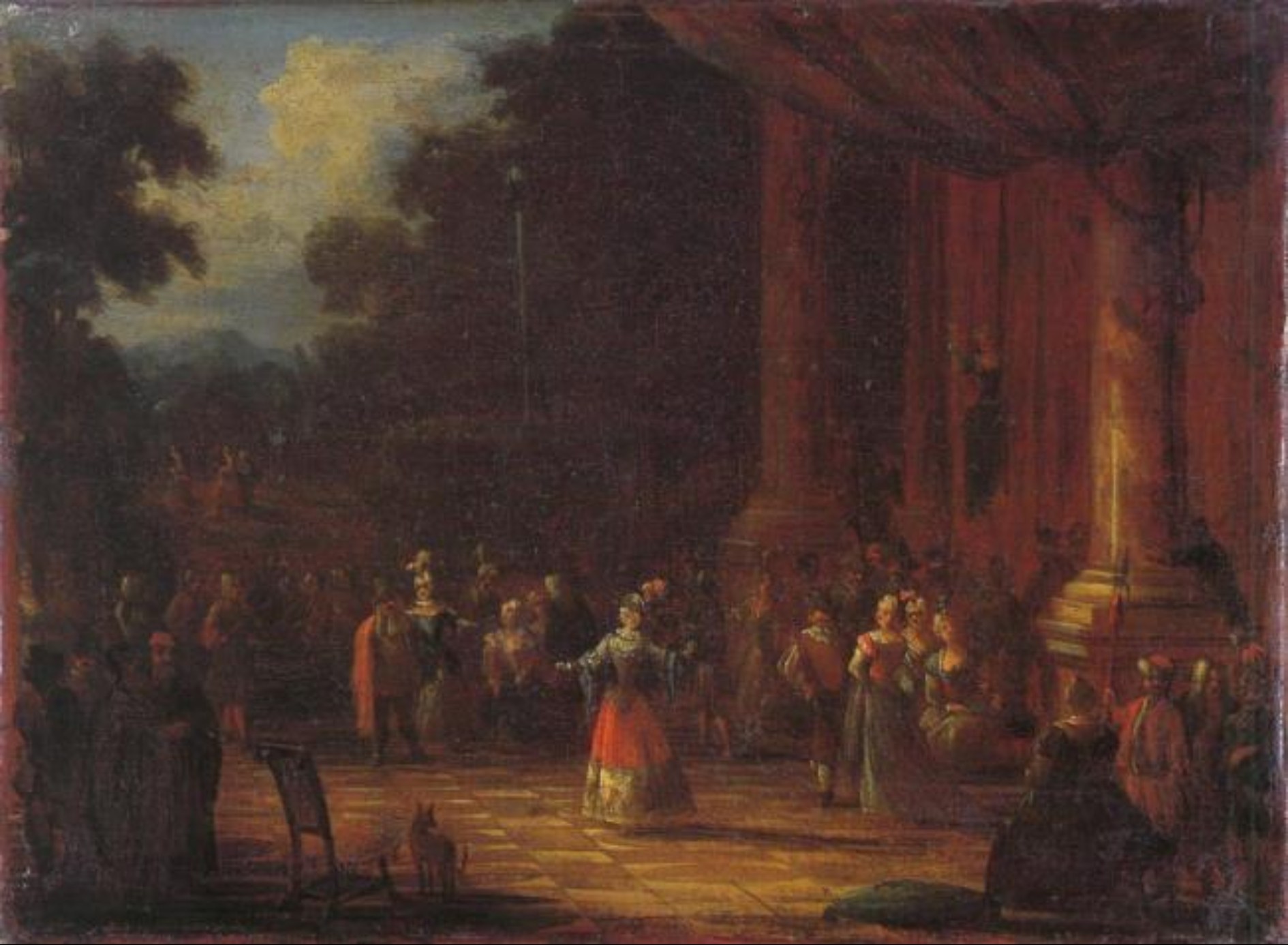
Willem Augustin van Minderhout - Dancers in front of a palace
Willem Augustin van Minderhout
- Medium:
- Oil Painting
- Era:
- 1700s (Enlightenment/Minuet Era)
- Source:
- Wikimedia Commons
- Rights:
- Public domain — free to use, share and adapt.
- Recorded as:
- Public Domain
Court ball paintings are rare visual witnesses to the social context in which 18th-century ballroom dances were embedded. This work shows not technique or footwork but the pageantry, dress codes, and power structures that organized ballroom life, helping historians understand why these dances mattered beyond their steps. For dance researchers, images like this complicate the focus on choreography alone by centering the audience, the occasion, and the ceremonial space.
What you are looking at
A grand interior palace or ballroom dimly lit by candlelight and a pale opening at the upper left. The space is defined by tall red walls or draperies and dark architectural elements that recede into shadow, creating an impression of vast height and formal grandeur. In the foreground, a crowd of elaborately dressed figures gathers in loose groups across a golden-lit floor. At center, a woman in a pale gown stands prominently, her posture suggesting she is the focus of attention. Around her, courtiers in rich costumes—reds, golds, and dark fabrics—converse, observe, and move. The lighting concentrates on the floor and the central figures, leaving much of the upper architecture in obscurity. The scene conveys a formal court gathering or entertainment, captured at a moment of relative stillness before or after movement.
The dancing
The dancers and courtiers stand mostly upright in small clusters rather than in coupled formation. The woman at center appears stationary, dressed in a pale gown with what may be a trained skirt. No obvious closed holds or partnered dance postures are visible; the arrangement suggests observation and social circulation rather than active paired dancing. The figures maintain formal court posture—upright spine, deliberate placement—consistent with 18th-century ballroom etiquette. Arms are generally at the sides or held in conversational gesture rather than extended in dance frame.
The dance depicted
This appears to depict a formal court gathering or ball, most likely of the 18th-century Enlightenment era, in which dancing is anticipated or has just concluded rather than actively performed at the moment shown. The dress, setting, and composition suggest historic-baroque ballroom culture, with dancing such as minuets, gavottes, or rigaudons likely part of the evening's entertainment. The artist has chosen to capture the social dimension—the gathering, the dress, the hierarchy—rather than the active dance itself. No footwork, specific holds, or movement vocabulary is legible enough to identify a particular dance form with confidence.
How it was made
Oil painting, using chiaroscuro lighting to dramatic effect: a single warm light source (candlelight or a lamp) illuminates the gathered figures and floor, while the upper reaches of the hall dissolve into shadow and architectural ambiguity. This technique—whether intentional or the result of the painting's age—creates a sense of mystery and grandeur, emphasizing the social spectacle of the court. The loose, sketchy handling of the crowd and the darkness of the background suggest the work prioritizes the impression and atmosphere of the scene over precise detail.
About this work
This oil painting documents the visual culture of the 18th-century court ball, a central institution of aristocratic life and a primary occasion for dancing. The work is not a record of choreography but of the social world in which formal dances took place—the dress, the lighting, the hierarchy of observation and participation. As such, it is valuable less as evidence of how a minuet or gavotte was performed than as testimony to the setting, scale, and ceremonial importance of ballroom dance in the Enlightenment. The painting records the spectacle and formality that framed the dance, the moment before or after the music, when the courtiers stood in their finery and surveyed one another.
How to look at it
Notice the hierarchy of light: the brightest area is the floor and the central standing figures, drawing the eye to the social center of the gathering. The architecture above is deliberately obscured, creating an impression of boundless height. The crowd is organized not by action but by proximity and dress—look for the clusters of attention around the pale-gowned woman at center, and the way other figures orient toward her. The painting does not show a dance in progress; instead, it captures the social event that frames dancing, the moment of assembly and observation. Attend to the formal postures and rigid spacing, which differ markedly from the looseness and movement that would characterize an active dance scene.
The artist
Willem Augustin van Minderhout (1696–1768) was a Dutch painter who specialized in interior scenes, particularly theatrical and court interiors. He worked in a tradition of painting that treated architecture and light as protagonists alongside the human figures; his interiors are often shadowy, vast, and atmospherically charged. He was active in an era when Dutch painters were documenting court life and theatrical performance across Europe, and this work aligns with that broader practice of capturing the spectacle and social order of aristocratic entertainment.
The period
In the 1740s, formal ballroom dancing was at its height as a mark of status and courtly accomplishment. The minuet in particular dominated polite society, and balls were central occasions for displaying rank, wealth, and refinement. Simultaneously, painters across Europe were developing a new interest in interior scenes and theatrical moments, moving away from portraiture toward capturing social atmosphere and the play of light. Van Minderhout's work sits at this intersection: it records the material and ceremonial grandeur of the court ball while employing the painterly techniques of chiaroscuro and crowd composition to evoke mood and drama.
Where it lives
The work is recorded as an oil painting dated 1740, attributed to Willem Augustin van Minderhout. The catalogue record provides no holding institution or collection, and the image derives from Wikimedia Commons.
Dance in this work
Questions about this work
Is anyone actually dancing in this painting?
No—this is a ball or court gathering, but the artist has captured the social moment rather than active dance. The figures stand in conversational groups, upright and still, as they might before the music begins or during a pause between dances. The painting is thus a record of the occasion and spectacle of the ballroom, not of choreography in motion.
What dances would have been performed at such a gathering?
In the 1740s, the minuet was the dominant formal dance, often preceded or followed by gavottes, rigaudons, and bourrées. These were stately, geometric, and rule-bound, suited to the formal postures and rigid hierarchy visible in van Minderhout's scene. The painting does not show which dances, but its setting and date point to that repertory.
Why paint a ball without showing the dancing?
Capturing a gathering in stillness allowed the artist to display the entire social order at once—the dress codes, the lighting, the architecture, the hierarchy of attention—things that would be lost in a scene of active movement. The painting thus documents the ceremonial and social dimensions of the ballroom, which were as important to the event as the dances themselves.
More dance artwork