49 works in this view — arrow keys or swipe to move between them.
Dance in Art · 1797
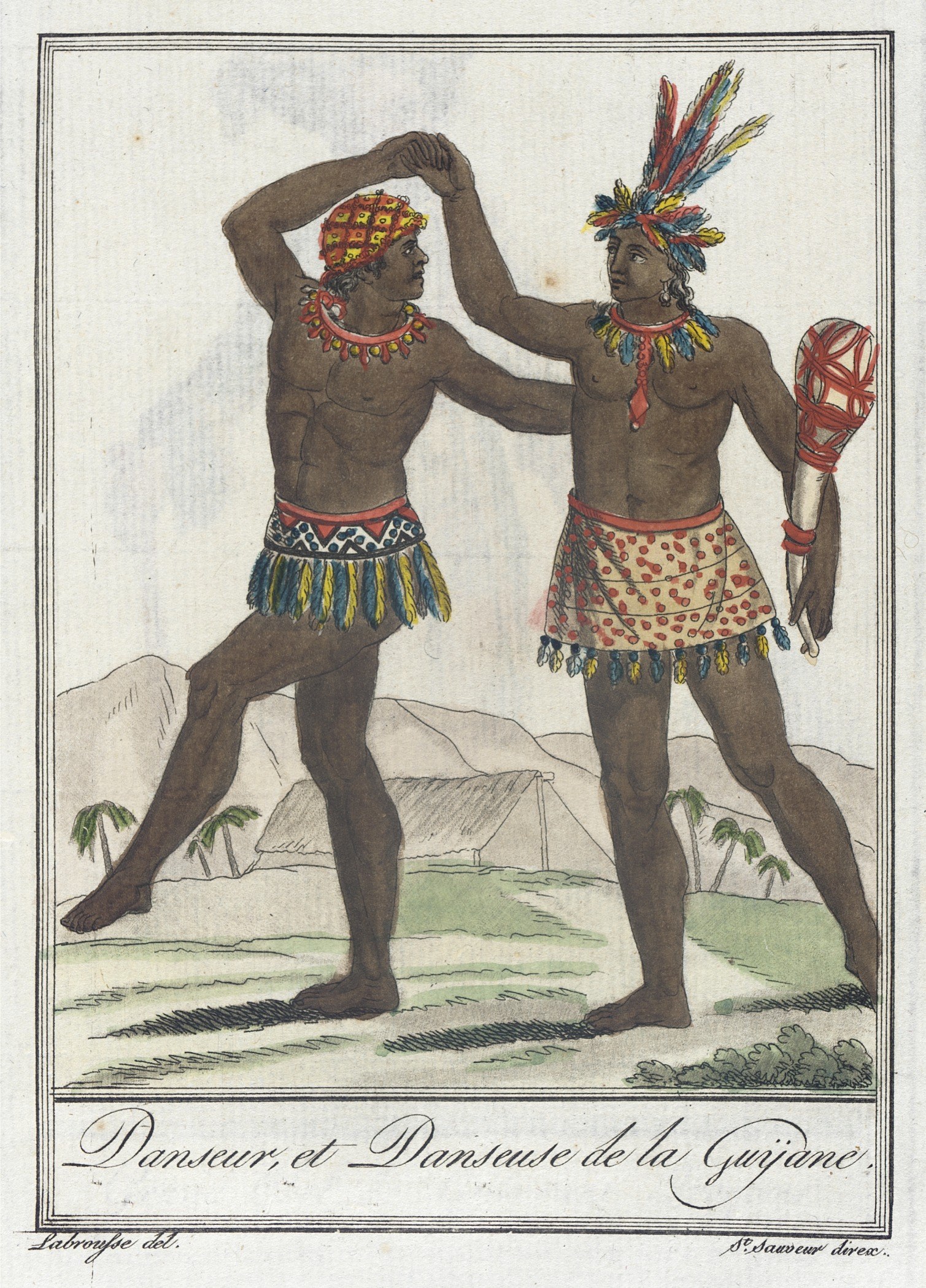
Costumes de Differents Pays, 'Danseur, et Danseuse de la Guyane' LACMA M.83.190.369
Jacques Grasset de Saint-Sauveur (France, 1757-1810), Labrousse (France, Bordeaux, active late 18th century)
- Medium:
- Engraving
- Era:
- 1700s (Enlightenment/Minuet Era)
- Source:
- Wikimedia Commons
- Rights:
- Public domain — free to use, share and adapt.
- Recorded as:
- Public Domain
This image is crucial for understanding how European artists and audiences of the 1790s understood and represented non-European dance, and what biases and power structures shaped that representation. It also documents a moment of Caribbean and South American social culture that might otherwise be invisible in European archives—even if the representation is mediated through European eyes. For dance historians, it raises important questions about who decides what counts as dance, who gets documented, and how the archive shapes what we can know about the past.
What you are looking at
Two male figures stand in a tropical landscape, posed in an animated conversation or social greeting. Both are bare-chested and muscular, depicted with dark brown skin. The figure on the left wears a red and yellow patterned cap and a beaded necklace in red; his left arm is raised to his head in a casual, contemplative gesture. The figure on the right wears an elaborate feathered headdress in red, blue, and yellow—a tall, fan-like construction of plumes—and a similar beaded necklace. He holds a decorated rattle or ceremonial object in his right hand. Both wear fringed skirts with geometric patterns in red, blue, and yellow, and both stand with weight distributed naturally, in relaxed stances. The background shows a simple tropical setting with a thatched structure and a few palm fronds, rendered in pale washes of green. The composition is framed by a double-line border, and the engraving is hand-tinted with watercolor.
The dancing
The two figures occupy equal pictorial weight and face each other in a moment of social interaction rather than synchronized movement. The left figure's raised arm and slight contrapposto suggest ease and informal sociability; the right figure stands more frontal, his posture steady and his gaze directed toward his companion. Neither figure displays the turned-out legs, lifted spine, or formal alignment that would suggest trained theatrical dance; instead, their bodies read as relaxed and naturalistic. The gestures appear communicative rather than choreographed—the raised arm is conversational rather than balletic.
The dance depicted
This engraving documents a moment of Guianese social dancing or social greeting rather than codified theatrical performance. The title identifies these as a "danseur et danseule de la Guyane"—a male and female dancer of Guiana—though the hand-tinted engraving appears to depict two male figures. The image represents a European-produced ethnographic record of indigenous or Creole social practice, not a staged theatrical work. The absence of formal dance technique and the emphasis on dress, adornment, and casual gesture suggest this is a documentation of everyday or festival social dancing, captured for European audiences unfamiliar with the regions and peoples of the European colonies. The rattle and feathered headdress indicate ceremonial or festive context, possibly Carnival or a similar celebration.
How it was made
This is a hand-tinted engraving, a reproductive print technique that allowed wide circulation of images across Europe in the late 18th century. The engraved line work (by Labrousse, according to the signature) provides the black linear structure; the hand-applied watercolor tint adds the flesh tones, fabric colors, and tropical vegetation. This combination was common in commercial and scholarly publishing—it was less expensive than fully colored prints but more visually engaging than monochrome engravings. The technique implies a European publisher and a European audience of readers, scholars, or the generally curious; the exotic subject and the careful ethnographic detail suggest this belonged to a series of costume or travel documentation books.
About this work
This is one plate from a late-18th-century European costume book documenting dancers and dress from the French colonial territories, specifically Guiana. It is not a record of a specific choreographer's work or a theatrical dance form, but rather a documentation of how people in Guiana dressed and moved in social or festive contexts. The engraving sits at the intersection of ethnography, costume study, and travel literature—a visual form of knowledge-gathering about colonized peoples that was popular among educated European audiences in the Enlightenment. The work represents both genuine observation and European aesthetic conventions and biases: the dancers are posed frontally and clearly, like museum specimens, rather than captured in spontaneous movement.
How to look at it
Attend to the stillness and formality of the pose: despite the title calling these dancers, the figures are frozen in conversation, not movement. The artist has chosen a moment of pause or social greeting, not a moment of motion. This reveals the European convention of ethnographic illustration—to show people as if in a museum display, clearly visible and explicable, rather than in the fluid, often rapid motion of actual dance. Notice also the precision of the costume detail: the beadwork, the feathered headdress, the patterned skirts are rendered with care, as if the dress itself is the primary subject and the bodies are merely vehicles for displaying it. The tropical landscape is sketchy and secondary, which is typical of costume books where the figure dominates.
The artist
Jacques Grasset de Saint-Sauveur (1757–1810) was a French author, artist, and compiler of costume and ethnographic works. He created several illustrated books documenting the dress, customs, and practices of peoples across Europe, Africa, Asia, and the Americas. His *Costumes de Différents Pays* (Costumes of Different Countries) was a multi-volume illustrated compilation, with engravings by Labrousse and others, intended for an educated European readership interested in natural history, geography, and comparative anthropology. His work was part of the Enlightenment fascination with cataloguing and comparing human diversity, though it was also shaped by colonial hierarchies and European aesthetic norms.
The period
In the 1790s, European interest in colonial territories and their peoples was intensifying as imperial powers expanded and naturalists sought to document 'exotic' cultures for metropolitan audiences. Illustrated costume books were a major publishing genre, feeding both genuine intellectual curiosity and imperial appetite for images of subordinated peoples. This was also a moment when social dance in Europe itself—particularly in the Caribbean colonies—was being influenced by African and creole practices, though European publications often treated these influences as curiosities rather than as living, dynamic traditions. The French Revolution and its aftermath did not interrupt the market for these ethnographic costume books; if anything, they proliferated.
Where it lives
This engraving is held by the Los Angeles County Museum of Art (LACMA), accession M.83.190.369. It was acquired with funds from the Costume Council, indicating that it entered the collection as a document of historical dress. The work is part of a larger series and represents a page from an illustrated publication rather than an independent fine-art print.
Dance in this work
Questions about this work
Is this actually a depiction of a dance, or just people in costume?
The title calls them dancers, but the image shows them in a posed, static moment of social greeting or conversation rather than in active movement. This is typical of ethnographic engravings, which prioritized clarity and costume documentation over capturing motion. Whether this represents an actual dance tradition or a European artist's interpretation of Guianese dress and social practice is difficult to determine from the image alone.
Why are both figures depicted as male if the title says 'danseur et danseule'?
The engraving appears to show two male figures, while the French title specifies a male and female dancer. This may indicate an error in the engraving, a later retitling of the plate, or a European convention of depicting both dancers' bodies with masculine musculature regardless of sex. Without access to the original publication, this discrepancy cannot be resolved.
What does the feathered headdress and rattle tell us about the context?
The elaborate feathered headdress and decorative rattle suggest a festive or ceremonial context—possibly Carnival or a similar celebration. These objects indicate status, ritual significance, or participation in organized festivity rather than everyday social interaction. The specificity of the costume detail suggests these are recognized elements of Guianese dress rather than the artist's invention.
How was this image made and shared?
This is a hand-tinted engraving, a reproductive print technique that allowed European publishers to produce multiple copies relatively cheaply. The black engraved lines were created by the engraver Labrousse, then each print was hand-colored with watercolor. Bound together with similar plates, this would have circulated among educated European readers interested in travel, costume, and natural history.
More dance artwork