42 works in this view — arrow keys or swipe to move between them.
Dance in Art · 1825
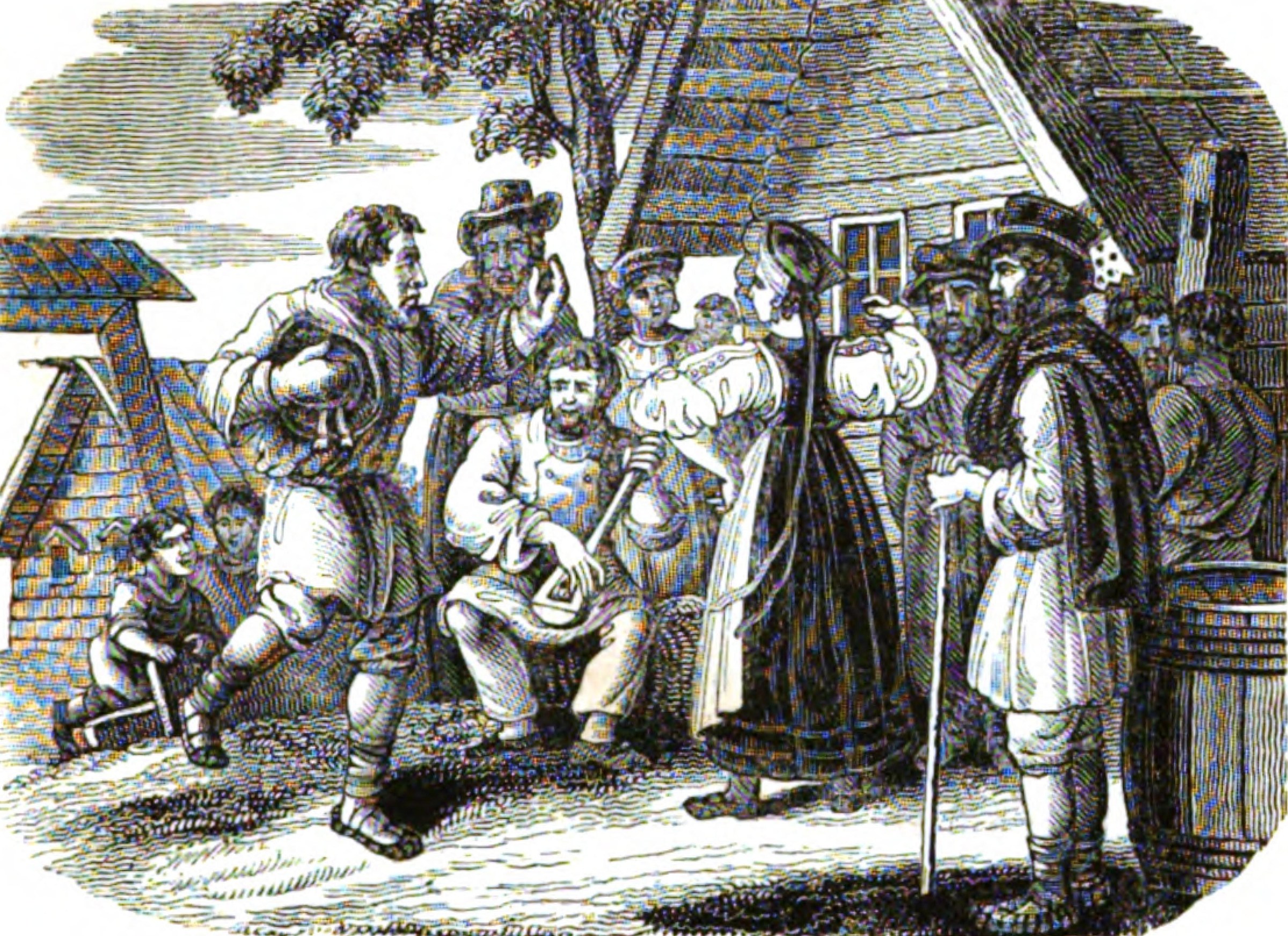
A Rural Scene in Russia, Dancing, &c. Robert Lyall. Travels in Russia, The Krimea, The Caucasus, and Georgia. 1825. Chap. XXI. P.285
Robert Lyall
- Medium:
- Oil Painting
- Era:
- Early 1800s (Waltz Revolution)
- Source:
- Wikimedia Commons
- Rights:
- Public domain — free to use, share and adapt.
- Recorded as:
- Public Domain
This is a primary visual document of early 19th-century Russian folk dance as practiced and observed in real time, made by a credible witness and published for a wide audience. Unlike later romantic or theatrical reimaginings of folk dance, it shows the actual spatial formation, dress, and social energy of village celebration, making it invaluable for understanding how folk dances were performed before they were formalized into staged or ballroom idioms.
What you are looking at
A crowded rural courtyard or village setting, depicted in a hand-colored engraving with fine parallel-line hatching throughout. The scene centers on a group of figures arranged in loose formation around what appears to be a central dancing couple or group. The setting includes timber-framed buildings with steep pitched roofs in the background, a large tree providing overhead shade, and modest domestic architecture suggesting a Russian village context. The composition is busy and narrative—multiple figures observe, gesture, and participate in the activity. The clothing throughout is consistent with early 19th-century Russian rural dress: the men wear long coats, vests, and wide-brimmed hats; the women wear full-skirted dresses and headdresses. The print technique creates a fine-grained texture across all surfaces, typical of wood or steel engraving reproduction in the 1820s.
The dancing
The central figures are engaged in active movement with arms raised and bodies leaning into the motion; at least two figures appear to be dancing while others stand in observation, some with arms extended in gesture or encouragement. The poses suggest spontaneous, energetic movement rather than formal ballroom posture—bodies are twisted, one figure appears to be mid-leap or mid-step. The dancers are not in closed ballroom hold but in open or solo positions, or possibly moving toward partners. The surrounding onlookers gesture animatedly, suggesting this is a participatory social event rather than a performance for an audience.
The dance depicted
This appears to be a Russian folk or village dance, most likely a traditional circle or line dance (possibly a trepak or similar peasant dance form), captured during an informal community celebration. The open formation, the casual village setting, the mixed-gender participation, and the animated gestural language all point to participatory folk dance rather than choreographed or ballroom dance. The image documents how such dances were actually performed in rural Russian communities—with spontaneity, social participation, and energy generated by the dancers themselves rather than external music or formal structure.
How it was made
This is a hand-colored engraving, reproduced from Robert Lyall's 1825 travel narrative *Travels in Russia, The Krimea, The Caucasus, and Georgia*. The fine parallel hatching visible throughout is characteristic of wood or steel engraving of the period, a technique that allowed for precise detail and widespread reproduction. The hand coloring—visible in the blue, gold, and ochre tones in clothing and roofs—was applied after printing, making each copy potentially unique in its color choices. The technique was ideal for illustrated travel literature, allowing detailed observation of costume and social practice to be widely disseminated to a European reading public curious about Russian rural life.
About this work
This engraving documents a Russian village dance scene as observed by Robert Lyall, a Scottish traveler and diplomat, in the early 1820s. It is not a representation of courtly or ballroom dance but rather a record of how ordinary rural Russians danced together at community gatherings. The image serves as ethnographic documentation—a snapshot of folk practice and costume captured by a foreign observer and circulated through the popular travel narrative genre. For dancers and historians, it offers direct evidence of how traditional Russian dance looked in practice, the clothing worn, the social context of performance, and the uninhibited energy and participation that characterized village celebration.
How to look at it
Attend to the open formation and lack of closed partnership holds—the dancers move in a more collective space than ballroom convention would allow. Notice the raised arms, the twisted torsos, and the apparent vertical energy (the sense of figures lifting or leaping). The surrounding figures are not passive audience but active participants or near-participants, suggesting this is not a performance but a social event in which everyone present might dance. The detail in clothing—the cut of the coats, the style of headdresses, the full skirts—documents what rural Russians actually wore for celebration, not what European imagination assumed they wore.
The artist
Robert Lyall (1790–1831) was a Scottish physician, diplomat, and travel writer who served as British consul in various parts of the Russian Empire and the Caucasus. He published *Travels in Russia, The Krimea, The Caucasus, and Georgia* in 1825, based on his direct observations during posting abroad. The illustrated travel narrative was his primary means of sharing observations of regional life, culture, and costume with a British and European audience. As a trained observer and writer, Lyall was interested in documenting local practices, dress, and social customs with some ethnographic precision, though filtered through the conventions and biases of early 19th-century travel literature.
The period
The 1820s were a transitional moment for European interest in folk and national dance. The Romantic movement was elevating folk culture as an authentic expression of national identity, and travel narratives were a primary medium through which Europeans encountered foreign dance practices. Simultaneously, ballroom dance—particularly the waltz—was becoming fashionable across Europe, creating a cultural moment in which folk and courtly dance were sharply distinguished. In Russia specifically, this period preceded the formalization of Russian ballet (which emerged in the 1830s–1840s) and the later theatrical romanticization of peasant dance. Lyall's image thus captures folk dance at a moment before it was significantly mediated through stage or formal pedagogy.
Where it lives
This engraving is reproduced from *Travels in Russia, The Krimea, The Caucasus, and Georgia* by Robert Lyall, published in 1825 and held by major research libraries. The image appears in Chapter XXI, page 285 of the published narrative. The source cited is Wikimedia Commons, suggesting the book has been digitized and made publicly available.
Dance in this work
Questions about this work
Is this a real dance or did the artist invent it?
Robert Lyall was an eyewitness observer documenting what he saw during his residence in Russia. While artistic convention shapes how he rendered the scene, the dance itself, the village setting, the clothing, and the social context all appear to be based on direct observation rather than invention. Travel writers of this period were expected to document local practice accurately as part of their credibility.
What dance is being performed?
The open formation, the village setting, and the energetic raised-arm movement suggest a traditional Russian folk circle or line dance, possibly a trepak or similar peasant dance form. The image does not provide enough detail or documentation to identify the dance by name with certainty, but it is clearly not a ballroom dance and is performed as participatory social practice rather than formal choreography.
Why would a travel writer include this scene?
Travel narratives of the Romantic era regularly documented local customs, costume, and social practice as evidence of national character and folk authenticity. For a European audience curious about Russia, scenes of rural celebration and traditional dress were ethnographic evidence—proof of how 'ordinary' Russians lived and expressed themselves culturally.
How does this compare to later depictions of Russian dance?
This is a record of folk dance as practiced in everyday village life. Later depictions, particularly in Russian ballet and staged performances from the mid-19th century onward, romanticized and formalized folk dance into theatrical idioms. This image offers a glimpse of folk dance before that theatrical transformation.
More dance artwork