44 works in this view — arrow keys or swipe to move between them.
Dance in Art · 1803
Wolfgang-Adam Töpffer Dorffest
Wolfgang Adam Töpffer
- Medium:
- Ink
- Dance:
- Folk/Country
- Era:
- Early 1800s (Waltz Revolution)
- Source:
- Wikimedia Commons
- Rights:
- Public domain — free to use, share and adapt.
- Recorded as:
- Public Domain
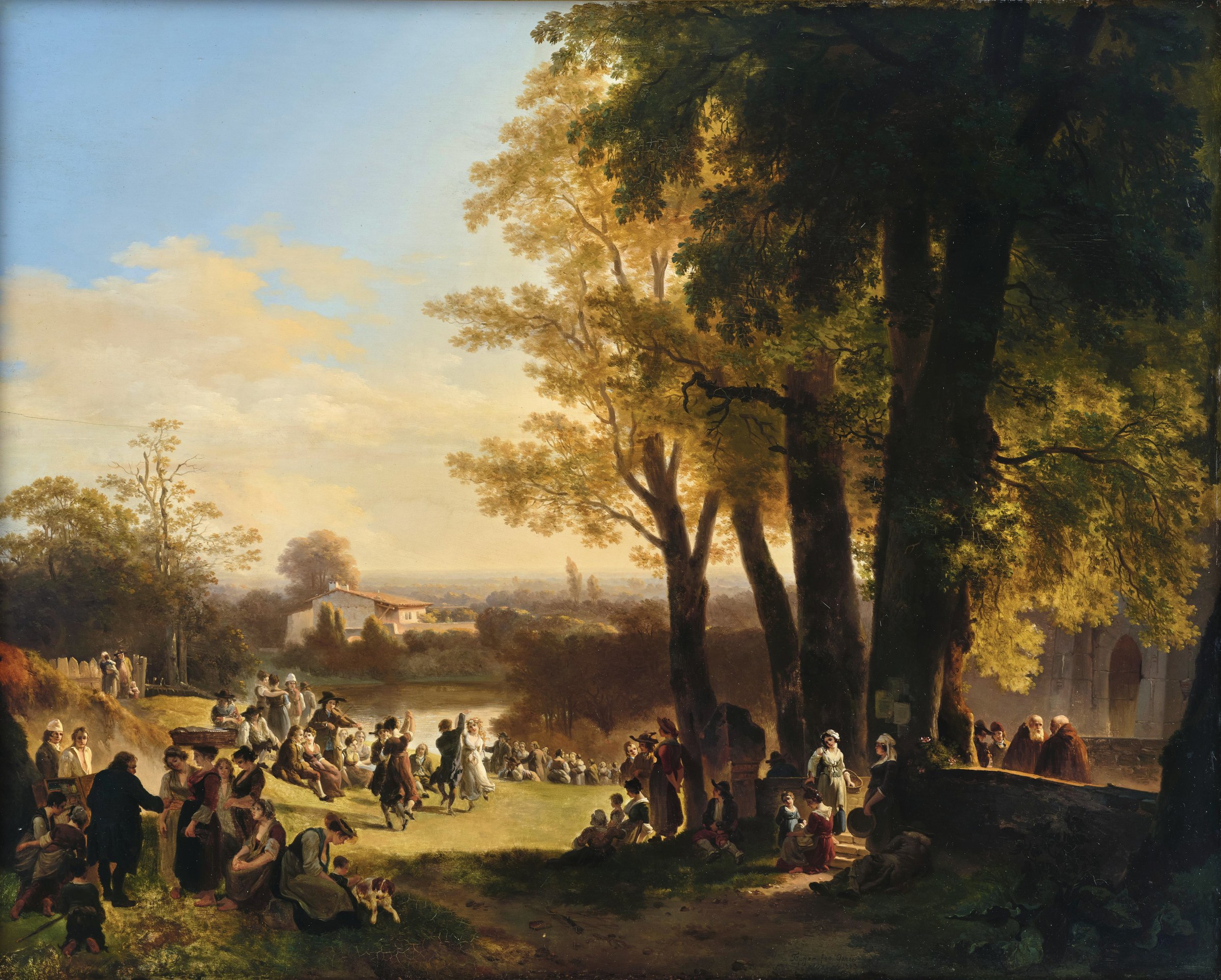
This work shows village dance as a civic institution involving entire communities—hundreds of people—rather than as couple-based entertainment or formal ballroom practice. It is one of few images from the period that documents the social scale and landscape context of folk celebration, making it essential evidence for understanding how dance functioned in pre-industrial European community life.
What you are looking at
A large village celebration unfolds in an alpine landscape, likely Switzerland given the artist's Geneva signature. Hundreds of figures populate a grassy clearing beside a river, framed by massive dark trees on the right and a distant chapel or village church visible across the water. The composition is densely populated: in the foreground and middle ground, groups stand and move in animated clusters; some sit on the ground in family units; musicians appear to gather at left; a small pavilion or refreshment structure sits at the water's edge. The light is warm and golden, suggesting afternoon or early evening, with the sky pale and luminous. The scale and organization suggest an organized public festival rather than spontaneous gathering—this is community dance on a civic scale.
The dancing
The figures are rendered in period dress: women in high-waisted Empire-line gowns with long skirts, men in dark coats and breeches. The bodies throughout show relatively little specific gesture definition—the artist prioritizes the crowd and setting over individual anatomical clarity. Where movement is legible, it reads as upright, social positioning rather than technical dance form: standing in groups, processing slowly, or seated in conversation. The overall impression is of social mingling punctuated by dancing rather than continuous formal choreography.
The dance depicted
This depicts a village festival (Dorffest) of the type that would have featured country dances, quadrilles, and social folk forms common to Switzerland and the alpine region in the early 1800s. The scale and public nature suggest organized group dances rather than couple-based ballroom forms, though the crowd density makes specific footwork or hold impossible to determine. The presence of musicians, the formal gathering space, and the mixture of dancers and observers all align with period documentation of Volksfest tradition. No single couple or moment of technical execution dominates; instead, the social institution of community dancing is the subject.
How it was made
The catalogue record lists the medium as ink, but the work shows all the characteristics of oil on wood panel: layered transparent glazes creating atmospheric depth, carefully modulated light effects in the foliage, and the warm golden tonality typical of early 19th-century Swiss landscape practice. The technique is that of landscape painting with staffage (narrative figures added to a topographical scene), a convention that allowed artists to combine picturesque scenery with social documentation. The scale and detail suggest this was a high-value commission or exhibition piece rather than a sketch, intended for a collector's cabinet rather than popular reproduction.
About this work
This is a panoramic village festival scene by the Swiss painter Wolfgang Adam Töpffer, dated 1803, depicting a Dorffest (village celebration) in an alpine setting. The work records a moment of early 19th-century Swiss folk culture at the scale of civic gathering: hundreds of inhabitants, both dancing and observing, assembled in a landscape that is as much the subject as the human activity within it. The composition balances topographical precision (the distant chapel, the river, the specific tree forms) with social documentation, creating a hybrid between landscape painting and social history. For dance history, it is valuable primarily as evidence of the scale, public organization, and social context of village dancing in the period just before the Waltz Revolution, rather than as detailed choreographic documentation.
How to look at it
Look first at the composition: this is organized as a landscape view with a human event subordinated to topography and atmosphere—the chapel across the water, the river path, the massive trees are as carefully rendered as the crowd. Then attend to the density and heterogeneity of the figures: this is not a ballroom with rows of dancing couples, but a sprawling outdoor gathering mixing music, dancing, eating, socializing, and observation. The absence of sharp gestural definition in individual dancers is itself informative: this was a vernacular event documented from middle distance for its social and picturesque qualities, not choreographic clarity. The pale sky and golden light suggest the idealization common to romantic landscape practice—this is not a sketch from life but a composed painting meant to present the village celebration as a harmonious social ideal.
The artist
Wolfgang Adam Töpffer (1766–1847) was a Swiss painter, writer, and pedagogue based in Geneva, known for landscape and genre scenes documenting Swiss social life. He was also the father of Rodolphe Töpffer, the pioneering cartoonist and writer. His practice combined topographical accuracy with narrative social content—painting specific locations while populating them with carefully observed figures representing local customs, celebrations, and daily life. His work bridged the aesthetic traditions of 18th-century landscape painting and the emerging 19th-century interest in ethnographic and social documentation.
The period
In 1803, social dance in Europe was at a turning point. The formal minuet and country-dance tradition of the 18th century were still practiced, but the waltz—danced in closed embrace and in rotating couples rather than in lines or sets—was beginning to spread from Vienna and German-speaking regions. Village celebrations like the one depicted here would have preserved older group-dance traditions while gradually absorbing new forms. This painting documents the world of folk celebration just before the Waltz Revolution (c. 1815–1830) transformed European dance culture by making the couple-dance the dominant social form across classes.
Where it lives
The work is documented in Wikimedia Commons and carries Töpffer's signature and Geneva date in the lower left. No current holding institution is recorded in the catalogue.
Dance in this work
Questions about this work
What specific dances are being performed?
The image does not render individual dancers or footwork with enough clarity to identify specific choreography. The scale and setting suggest country dances, quadrilles, or regional folk forms typical of Swiss village celebrations, but the painting prioritizes the social gathering as a whole over technical documentation. The presence of musicians and the organized clearing indicate prepared group dances rather than informal movement.
Is this a waltz scene?
Almost certainly not. The painting is dated 1803, before the waltz had become fashionable in village settings. The figures appear to be standing and moving in groups rather than in the closed-embrace rotating-couple formation that defines waltz dancing. This documents the older tradition of community line and set dances that the waltz would eventually displace.
Why are there so many people just sitting or standing still?
This reflects the actual social structure of village celebrations: not everyone was dancing at once. Families watched, ate, socialized, and took turns dancing. The mix of active dancers, musicians, observers, and seated figures records the complete social event rather than only its choreographic moments—a valuable document of how dance functioned as part of community life.
Is this a real village celebration or an idealized composition?
Likely both. Töpffer was a topographical painter who worked from specific locations (the chapel, river, and landscape formations appear to be recognizable Swiss features), but the composition is arranged, the light is romanticized, and the gathering is idealized as a harmonious social moment. It is a documentary painting rather than a literal record, showing what the artist believed a village celebration ought to look like.
More Folk/Country artwork