38 works in this view — arrow keys or swipe to move between them.
Dance in Art · 1800
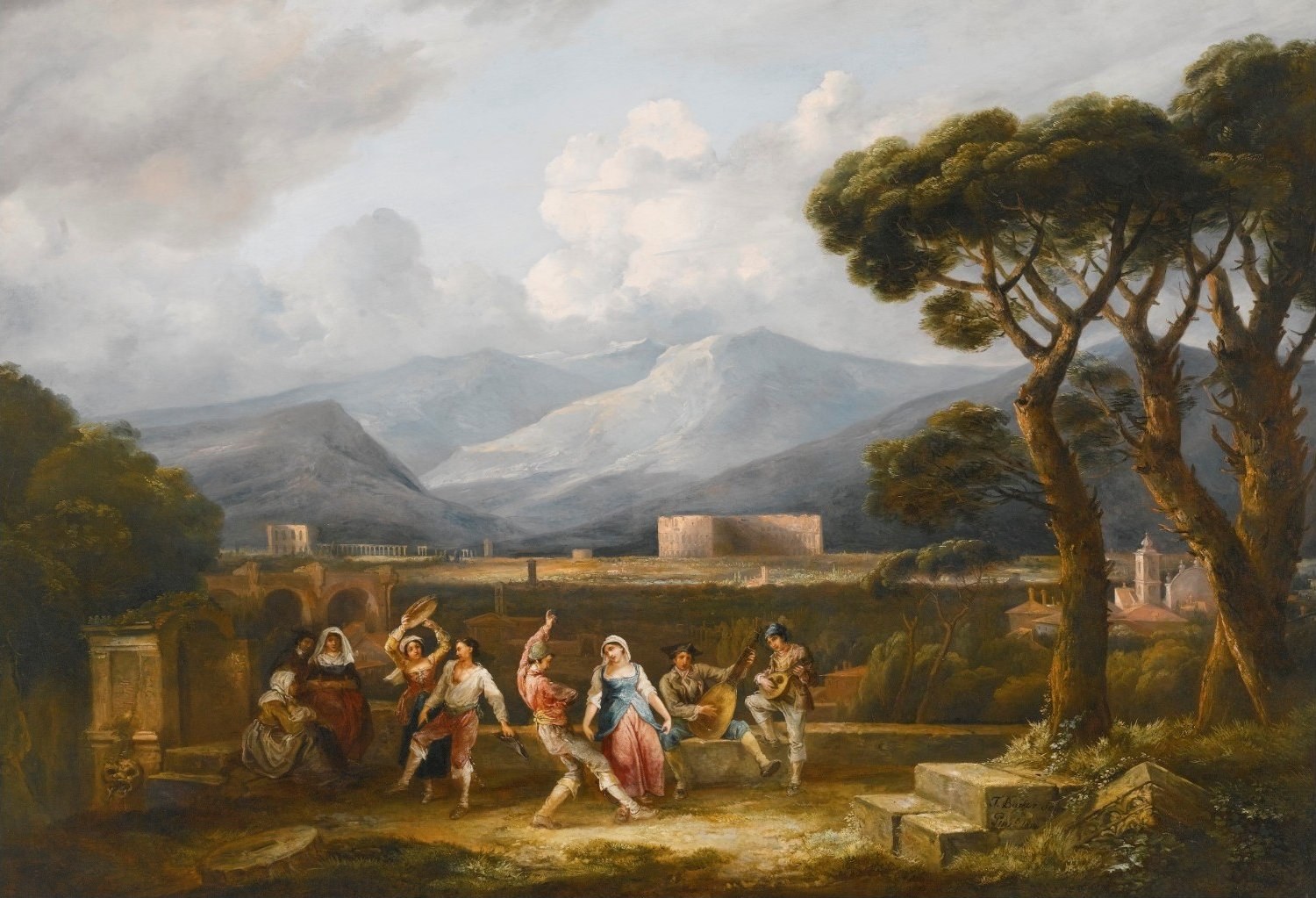
Figures Dancing the Saltarello by Thomas Barker of Bath
Thomas Barker of Bath
- Medium:
- Oil On Canvas
- Era:
- Early 1800s (Waltz Revolution)
- Source:
- Wikimedia Commons
- Rights:
- Public domain — free to use, share and adapt.
- Recorded as:
- Public Domain
This painting is one of the few images of the saltarello from the period when it was a living social dance, and it shows the form in its folk context rather than through the filter of courtly or theatrical adaptation. For historians of vernacular dance, it is valuable evidence of how the saltarello was actually performed, dressed, and socially situated in the late 18th century.
What you are looking at
A grand landscape opens before us, with mountains—one snow-capped—rising in the misty distance under billowing clouds. The foreground is dominated by classical architectural fragments: a ruined arch on the left, standing columns, and stone structures scattered across the middle ground. On a terrace in the immediate foreground, a group of about a dozen figures in bright period dress—reds, blues, yellows, earth tones—are arranged in what appears to be a social dance. Their clothing suggests late 18th-century style. The composition draws the eye from the architectural ruins through the dancing figures toward the mountains, creating a capriccio (fanciful architectural landscape) that frames an intimate moment of social revelry. On the right, tall trees frame the scene. The light is warm and golden, suggesting late afternoon or early evening.
The dancing
The dancers are arranged in loose groupings rather than tight formations. Several figures face inward toward one another in pairs or small clusters; some appear to be in motion with arms raised or extended—characteristic of folk or country dancing rather than formal ballroom posture. The bodies show varied attitudes: some upright, some leaning into the movement, with a general sense of animation rather than the rigid frame of courtly dance. Multiple dancers are scattered across the terrace rather than in strict lines or sets.
The dance depicted
The title identifies this as the saltarello, a historic Italian and Spanish dance. The saltarello was a lively, jumping dance with a characteristic springing step—its name derives from *saltare* (to jump). By the 18th century it was a folk and popular dance rather than a courtly form, typically danced in groups and known for its energetic, bouncing quality. The loose arrangement and raised arms in this composition are consistent with the saltarello's character as an exuberant, social dance performed outdoors or in informal settings. The dress of the figures suggests rural or regional costume rather than court attire, which aligns with the saltarello's identity as a folk form.
How it was made
The work is oil on canvas, a medium that allowed for the rich atmospheric effects visible here—the soft, luminous sky, the warm golden light on the architecture and figures, and the hazy treatment of the distant mountains. Oil painting was the preferred medium for grand historical and landscape works in this period, and the size (122 by 176 cm) indicates this was a substantial, gallery-scale work. The technique shows careful compositional control: the eye is guided from foreground through middle distance to the dramatic landscape beyond, a device common in capriccio paintings that blend topographical imagination with historical or genre subjects.
About this work
This is a capriccio painting that combines a fantastical landscape—built from real or imagined classical ruins—with a genre scene of folk dancing. Barker here uses the saltarello as the vehicle for depicting popular social life set against an idealized classical past. The work bridges the Enlightenment taste for both picturesque ruins and authentic folk culture. It belongs in a dance gallery because it documents not only a specific historic dance form but also the context in which it was performed—outdoors, among common people, in informal groupings—and because it captures the saltarello's essential character: spirited, unbounded, and physically exuberant.
How to look at it
Notice how Barker positions the dancers in the foreground but does not make them the painting's sole focus: the ruins and landscape command almost equal visual weight. This suggests the saltarello as part of a lived historical continuum rather than a spectacle. Observe the dancers' varied poses and raised arms—the artist captures the moment of animation and exertion rather than a frozen geometric pattern. The warm golden light and the soft treatment of the distant mountains create a sense of pastoral idealization, lifting the scene beyond mere documentary into something timeless.
The artist
Thomas Barker of Bath (1769–1847) was a British painter known for rural and romantic scenes, capriccio landscapes, and subject pictures drawn from literature and history. He worked primarily in oil and was associated with the picturesque movement, which privileged authenticity of detail, atmospheric effect, and the aesthetic appreciation of humble subjects. His practice often combined meticulous observation of contemporary life and dress with imaginative or idealized settings.
The period
The painting dates to 1800, at the height of Enlightenment interest in folk culture and classical antiquity. The late 18th century saw a revival of interest in vernacular dances and rural life, partly as a reaction against the formality of courtly culture and partly through the influence of Romanticism. Simultaneously, European taste was fascinated by real and imagined classical ruins, especially following increased archaeological interest in Pompeii and Herculaneum. This work synthesizes both interests: it presents the saltarello as an expression of authentic popular culture, framed by the romance of classical remains.
Where it lives
The work is recorded as oil on canvas, 122 by 176 cm, dated 1800, and is attributed to Thomas Barker of Bath. The current holding collection is not recorded in the available documentation. The source provided is Wikimedia Commons.
Dance in this work
Questions about this work
What is the saltarello?
The saltarello is a lively jumping dance with roots in Italy and Spain, its name derived from the Latin *saltare* (to jump). By the 18th century it was primarily a folk and popular dance, performed outdoors and in informal settings. It was known for its energetic, springing rhythm and was typically danced by groups rather than couples in strict formation. This painting shows it in its folk context.
Why does the painting show ruins in the background?
The ruins are part of a capriccio—a tradition of painting that combines real or imagined architecture with landscape and genre scenes. In the late 18th century, classical ruins symbolized both historical depth and romantic beauty. By framing the saltarello among ruins, Barker suggests that this folk dance is part of an ancient, continuous culture rather than merely contemporary entertainment.
How can you tell this is the saltarello and not another dance?
The title explicitly identifies it as such, and the artist's visual choices support it: the loose, energetic groupings; the raised and extended arms; the outdoor setting; and the rural dress all align with the saltarello's character as an exuberant folk dance. The composition captures the jumping, animated quality associated with the form.
More dance artwork