29 works in this view — arrow keys or swipe to move between them.
Dance in Art · 1816
Bikkessy Heinbucher Verbunkos dudás
József Bikkessy Heinbucher
- Medium:
- Oil Painting
- Dance:
- Folk/Country
- Era:
- Early 1800s (Waltz Revolution)
- Source:
- Wikimedia Commons
- Rights:
- Public domain — free to use, share and adapt.
- Recorded as:
- Public Domain
The verbunkos is a foundational form in Hungarian popular dance and musical tradition, and this image is rare documentation of the military recruitment context in which it flourished. For dance historians, it shows how folk movement traditions were embedded in state institutions and how music and uniform conveyed authority and collective identity. The work also illustrates the role of engraving in recording and circulating knowledge of regional practices across the multilingual Habsburg realm.
What you are looking at
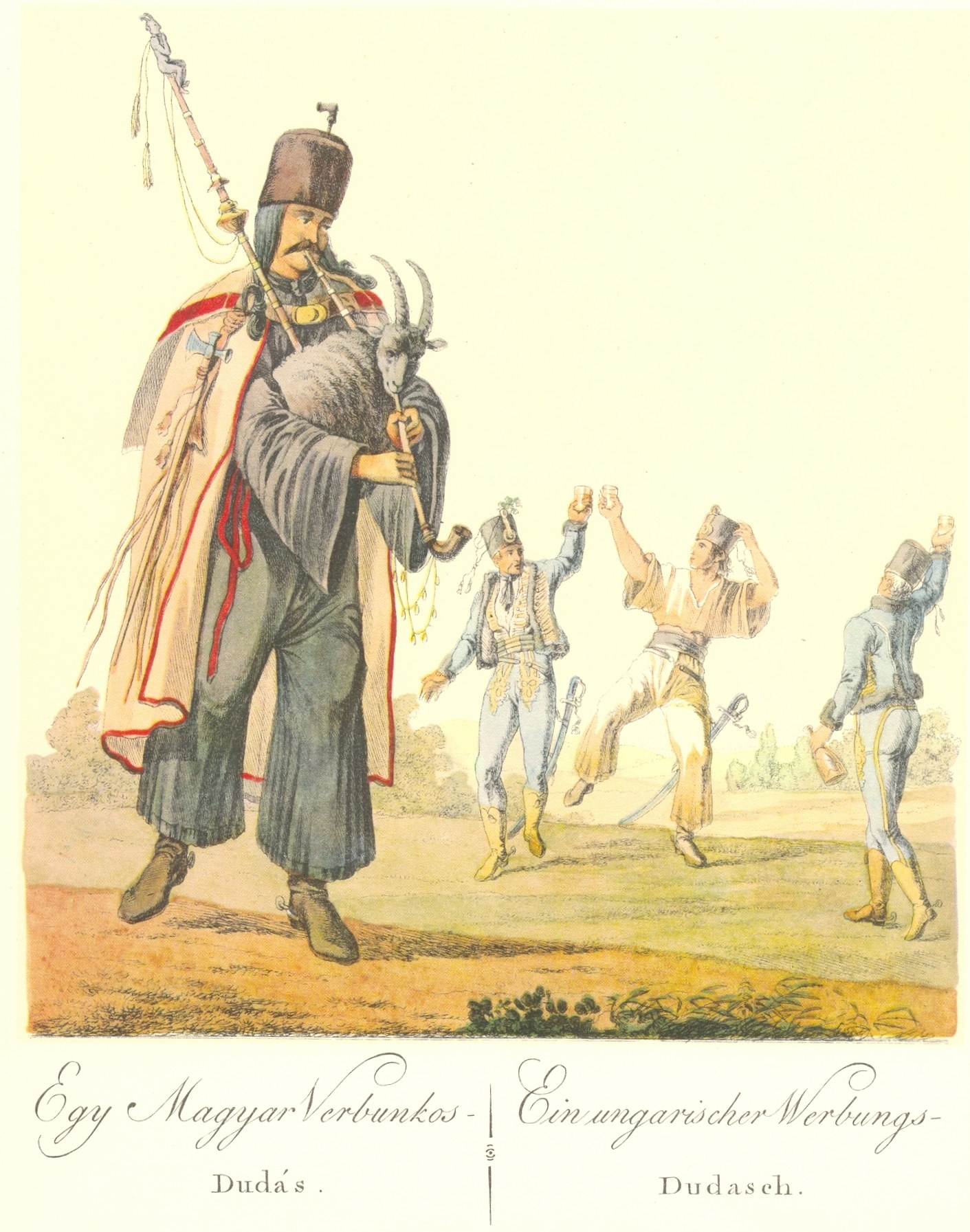
A tall figure in Hungarian military dress dominates the left foreground, holding a bagpipe with ornate strings and tassels aloft. He wears a tall cylindrical fur hat (busbies), a dark coat with pale sleeves, and a red-lined cape with gold trim, standing in a commanding pose on open ground. To the right, four soldiers in lighter uniforms and similar headgear stand at attention or with raised arms in celebratory gestures—one holds something aloft, another points or gestures upward. The composition suggests a moment of military pageantry or recruitment ritual. The figures are rendered in colored engraving technique with fine cross-hatching, set against a pale yellow-cream background with minimal landscape detail. The scale relationship emphasizes the bagpiper's authority; the other figures are smaller and recessive.
The dancing
The primary figure stands erect with the bagpipe elevated in both hands, arms extended upward in a gesture of display or triumph. The four background figures have varied postures: some stand at attention, others with arms raised in gestures suggesting enthusiasm, acclamation, or military salute. There is no paired or coupled dance hold visible; instead, the composition suggests a hierarchical arrangement where the bagpiper is performer or leader and the soldiers are audience or subordinate figures. The bodies are rendered with anatomical attention but in static or transitional poses rather than in the midst of coordinated movement.
The dance depicted
This image documents the verbunkos, a Hungarian recruitment dance tradition tied to military ceremony, specifically depicting a bagpiper (dudás) of the 32nd Eszterházy Hussar Regiment. The verbunkos combined music, dance, and spectacle to attract recruits; the soldier-musicians performed in public spaces to draw crowds. The image captures the musician rather than dancers in motion, suggesting the bagpipe as both instrument and symbol of military identity. The surrounding soldiers' gestures imply the celebratory or participatory context in which such performances occurred, though the specific dance steps of the verbunkos proper are not legible from static posture alone.
How it was made
This is a hand-colored engraving (Kupferstich in the German text), a technique that involved incising fine lines into a copper plate, inking, and printing, with subsequent hand application of watercolor or gouache for the tints. The precise, controlled line-work and fine cross-hatching visible in the fabric and shadow areas are characteristic of copper engraving. This medium permitted mass production relative to painting and ensured wide circulation among military, academic, and educated audiences. The inclusion of both German and Hungarian titles suggests dual-language marketing for a multinational imperial audience.
About this work
This 1816 hand-colored engraving documents a Hungarian military bagpiper (dudás) of the 32nd Eszterházy Hussar Regiment, a figure emblematic of the verbunkos—a recruitment ritual that fused music, uniform, and choreographed display. The image belongs to a tradition of military portraiture and ethnographic documentation common to the early 19th-century Habsburg Empire, recording both a specific musician and a social practice tied to national identity and imperial service. The work sits at the intersection of military history, folk music documentation, and the visual recording of dance-adjacent spectacle—capturing not dancers in motion but the ceremonial context that generated participation and attraction.
How to look at it
Attend to the bagpiper's elevated posture and the ornate display of the instrument—the verbunkos bagpiper was not merely a musician but a public figure whose appearance and bearing were designed to attract and impress. Notice the formal military dress (busbies, capes, insignia) on all figures, signaling that this is a regulated, state-sanctioned spectacle rather than spontaneous folk performance. The background soldiers' varied gestures—some celebratory, some formal—suggest the ritual nature of the moment and the collective participation it invited. The engraving technique itself, with its precise line-work, conveys an official, documentary purpose: this is a record meant to circulate and be preserved.
The artist
József Bikkessy Heinbucher is listed as the artist but little is recorded of his practice. The inscription "Ein ungarischer Verbungs-Dudás" (A Hungarian Recruitment Bagpiper) and the dual-language text suggest this work was part of a series documenting regional types or military units of the Habsburg dominions, a practice common among engravers and lithographers of the early 19th century who supplied illustrated newspapers, military academies, and scholarly collectors.
The period
This engraving dates to 1816, just after the Napoleonic Wars, when the Austrian Empire was reasserting territorial and cultural control and documenting its constituent regions and military forces. The verbunkos itself was a living tradition in Hungary and neighboring lands, performed to recruit soldiers and maintain ethnic and regional identity within imperial service. Early 19th-century visual culture increasingly turned toward ethnographic and regional documentation, reflecting both scholarly interest in folk customs and imperial appetite for images of its diverse subjects. The hand-colored engraving was the dominant medium for such work before lithography displaced it in the 1820s–1830s.
Where it lives
The work appears in Wikimedia Commons and is identified as an oil painting in the catalogue record, though the image is clearly a hand-colored engraving. No holding collection is recorded. The work is reproduced in the context of military and ethnographic documentation of the Habsburg Empire.
Dance in this work
Questions about this work
What is a verbunkos?
The verbunkos is a Hungarian folk dance and musical tradition associated with military recruitment. Soldiers and musicians, often dressed in striking uniforms and carrying bagpipes, would perform in public spaces to attract recruits through music, movement, and spectacle. It was both a practical military tool and an expression of Hungarian national and military identity within the multinational Habsburg Empire.
What is a dudás and why is the bagpipe so prominent?
A dudás is a Hungarian bagpiper. In the verbunkos tradition, the bagpiper was the central figure, as the instrument's loud, distinctive sound could draw crowds in public squares and streets. The bagpipe was iconic to Hungarian military and folk identity, and the pipes themselves became symbols of Hungarian cultural distinctiveness within the empire.
Why are there soldiers in the background?
The background soldiers represent the military and ceremonial context of the verbunkos. They suggest the collective nature of the performance—the gathering, acclamation, and participation that recruitment spectacle involved. Their varied gestures of attention and celebration indicate the ritual's social function.
How does an engraving like this circulate and reach an audience?
Hand-colored engravings were printed from copper plates and then hand-tinted, making them relatively inexpensive and reproducible compared to paintings. They were sold to collectors, used in military academies and administrative offices, and appeared in illustrated publications. The dual-language German and Hungarian text suggests this was marketed across the polyglot Habsburg realm to those interested in military uniforms, regional customs, or imperial history.
More Folk/Country artwork