25 works in this view — arrow keys or swipe to move between them.
Dance in Art · 1847
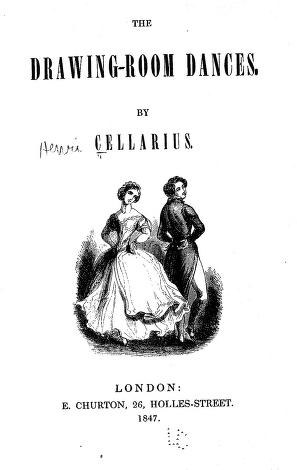
The drawing-room dances
Unknown artist
- Medium:
- Illustration
- Era:
- Early 1800s (Waltz Revolution)
- Source:
- Library of Congress
- Rights:
- Public domain — free to use, share and adapt.
- Recorded as:
- public_domain
Cellarius's manuals are among the most detailed surviving records of how ballroom dances were actually taught and danced in the 1840s–1860s, and this frontispiece reveals how dance instruction was framed as a matter of social refinement and bodily discipline, not merely technical skill. The formality and restraint of the posed figures embody the period's attitudes toward drawing-room dancing as a civilizing practice.
What you are looking at
This is the title page of a printed instruction manual, not a dance scene. The engraving shows two figures in Regency-era dress positioned against a plain background: a woman in a white gown with puffed sleeves and a man in dark formal coat and breeches. They stand in close proximity in what appears to be a conventional pose for demonstrating ballroom propriety rather than captured mid-movement. The woman's posture is upright and formal; the man stands beside her in an attitude of attentiveness. The setting is entirely schematic — no floor, no room detail, no musicians or context — which is typical of the cover illustration for a dance instruction book. The typography identifies the work as "The Drawing-Room Dances" by Cellarius, published in London by E. Churton in 1847.
The dancing
The two figures are posed stiffly and symmetrically, with neither in active movement. They do not touch or demonstrate a dance hold; instead they occupy separate positions as if presenting themselves to the reader. The woman's arms hang at her sides in a modest posture; the man's posture is similarly formal and still. This is characteristic of frontispiece portraiture for dance manuals of the period, where the figures represent the ideal social dancers rather than enacting a specific step or phrase.
The dance depicted
This is a title page for an instructional manual, not a depiction of dance in action. Cellarius (Henri Henrici) was a prominent dance master and author of multiple popular instruction books in mid-19th-century London. The "Drawing-Room Dances" covered the social ballroom repertoire of the Regency and early Victorian periods — quadrilles, cotillions, polkas, and waltzes — dances performed in formal domestic settings by the middle and upper classes. The book's audience was aspiring dancers and their teachers. The frontispiece presents the dancers as models of decorum: upright carriage, modest dress, formal demeanor — the ideal ballroom comportment that the manual's text and diagrams would teach.
How it was made
This is an engraving, a relief print made from an incised metal plate. The fine line work and subtle tonal gradation are characteristic of steel or copper engraving. The technique allowed for sharp detail in dress fabrics and faces, which would have been important to the manual's intended audience — they needed to see the correct posture and deportment. Engraving was the standard medium for book illustration in the 1840s, particularly for works aimed at a genteel readership. The print's durability and the precision of engraved plates made them ideal for multiple printings of popular instructional texts.
About this work
This is the frontispiece of "The Drawing-Room Dances," a mid-Victorian instruction manual by the dance master Cellarius. It does not depict an actual dance performance but rather presents an idealized image of two social dancers in formal dress, intended to illustrate the standards of ballroom decorum and presentation that the manual would teach. The work belongs in a dance history collection as evidence of how the ballroom dancing world of the 1840s was marketed, taught, and visualized — the book's popularity and multiple editions made it an influential authority on mid-Victorian social dance practice.
How to look at it
The viewer should attend to the absolute stillness and formality of the pose — there is no suggestion of movement, rhythm, or the pleasure of dancing. This reveals the period's anxiety about ballroom dancing as a social practice that required careful management and moral oversight. The frontispiece is not selling the joy of dance but the propriety and restraint of dancers. The careful rendering of dress and posture signals that this is a technical manual for self-improvement, not entertainment.
The artist
The artist of the engraving is not recorded. Cellarius (Henri Henrici, c. 1800–1868) was a German-born dance master who became highly influential in London. He published several widely circulated instruction manuals including "The Code of Terpsichore" and multiple volumes on specific dances. His books were translated and reprinted across Europe and America, making him one of the most authoritative voices on ballroom technique of his era.
The period
The 1840s saw the peak of the Regency and early Victorian ballroom dancing culture. The waltz had become established in fashionable circles after decades of resistance from older generations. Quadrilles, cotillions, and polkas were central to social life among the middle and upper classes. The growth of a prosperous urban middle class created demand for instruction manuals that would allow people outside aristocratic circles to learn the correct steps, hold, and deportment. Lithography and engraving were the technologies that made such manuals widely affordable and distributable.
Where it lives
The image is held in the Library of Congress. The work is catalogued from a holding of period dance instruction manuals and related ephemera documenting the 19th-century ballroom dancing culture.
Dance in this work
Questions about this work
Is this a picture of actual dancers or a posed illustration?
This is a posed illustration for a title page, not a candid record of dancers in motion. The two figures stand formally and separately, not executing any step or hold. This was standard practice for dance instruction books: the frontispiece presented an idealized image of correct deportment and dress rather than the specific steps taught inside.
Who was Cellarius and why does he matter?
Cellarius (Henri Henrici) was a highly influential dance master and author of the most widely used ballroom instruction manuals of the mid-19th century. His books documented the quadrilles, waltzes, polkas, and cotillions that dominated European and American drawing rooms in the 1840s–1860s. Because he was specific about steps, holds, timing, and floor patterns, his manuals are invaluable primary sources for how ballroom dancing was actually performed and taught.
What dances are described in this book?
The drawing-room dances of the 1840s included the quadrille, cotillion, waltz, polka, galop, and schottische. These were all partner dances or group formations performed in formal domestic settings. Cellarius's manual would have provided step-by-step instructions, often with diagrams showing floor patterns and the relative positions of dancers.
Why do they look so stiff and formal?
This was the ballroom ideal of the 1840s. Dancers were expected to maintain upright posture, controlled movement, and emotional restraint. The waltz had only recently become acceptable in polite society after decades of moral objection. By presenting dancers in formal, modest dress with dignified bearing, the manual reassured its readers that learning these dances was a respectable, civilizing pursuit.
More dance artwork