41 works in this view — arrow keys or swipe to move between them.
Dance in Art · 1908
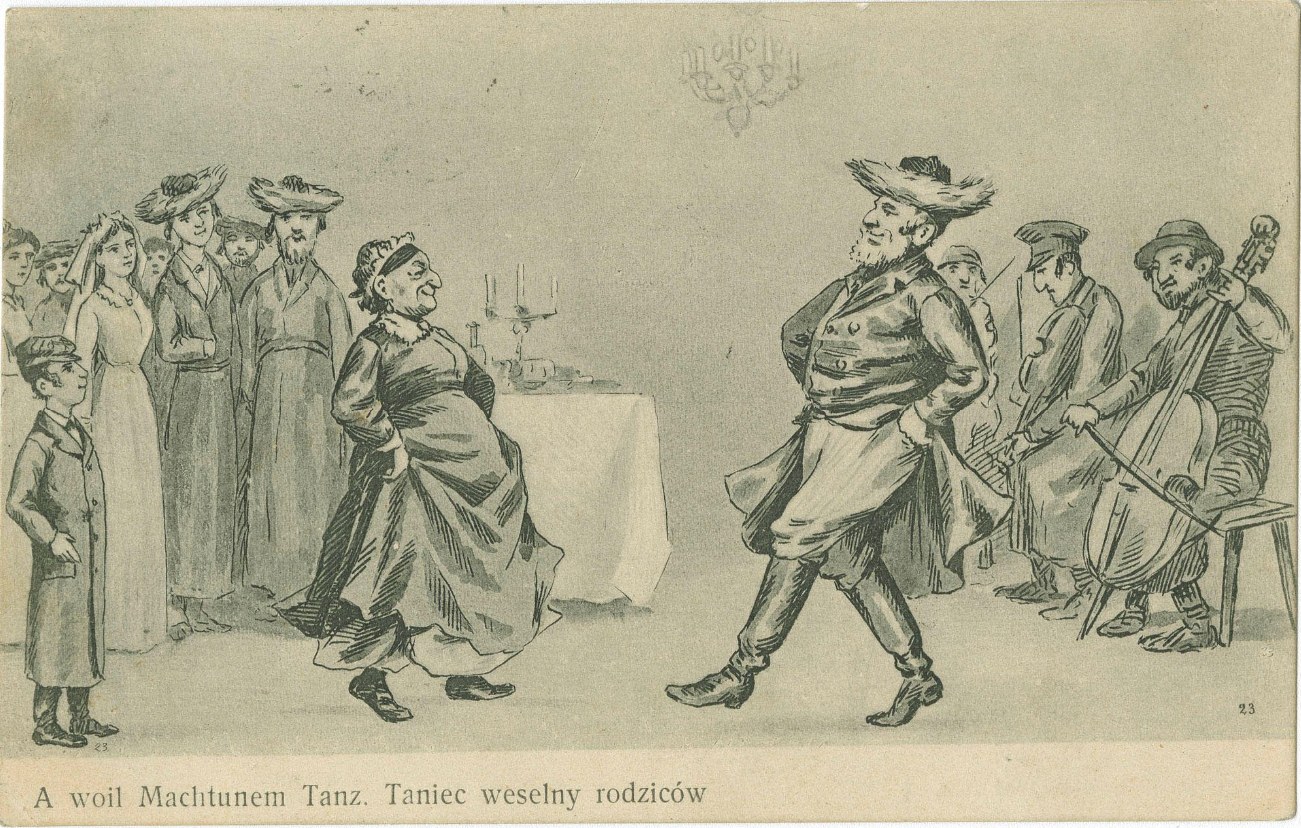
A woil Machtunem Tanz postcard
Unknown
- Medium:
- Oil Painting
- Era:
- 1900-1920 (Ragtime/Early Jazz)
- Source:
- Wikimedia Commons
- Rights:
- Public domain — free to use, share and adapt.
- Recorded as:
- Public Domain
This is a rare early-20th-century visual documentation of a living Jewish wedding dance tradition, captured before much of Eastern European Jewish culture was lost. For dance historians, it provides evidence of the Machtunem Tanz's place in wedding ritual and its physical vocabulary—the springing, energetic movement, the importance of individual display, and the klezmer musical accompaniment. For social historians, it shows how folk practices were mediated and circulated through popular postcards, shaping cultural memory and diaspora identity.
What you are looking at
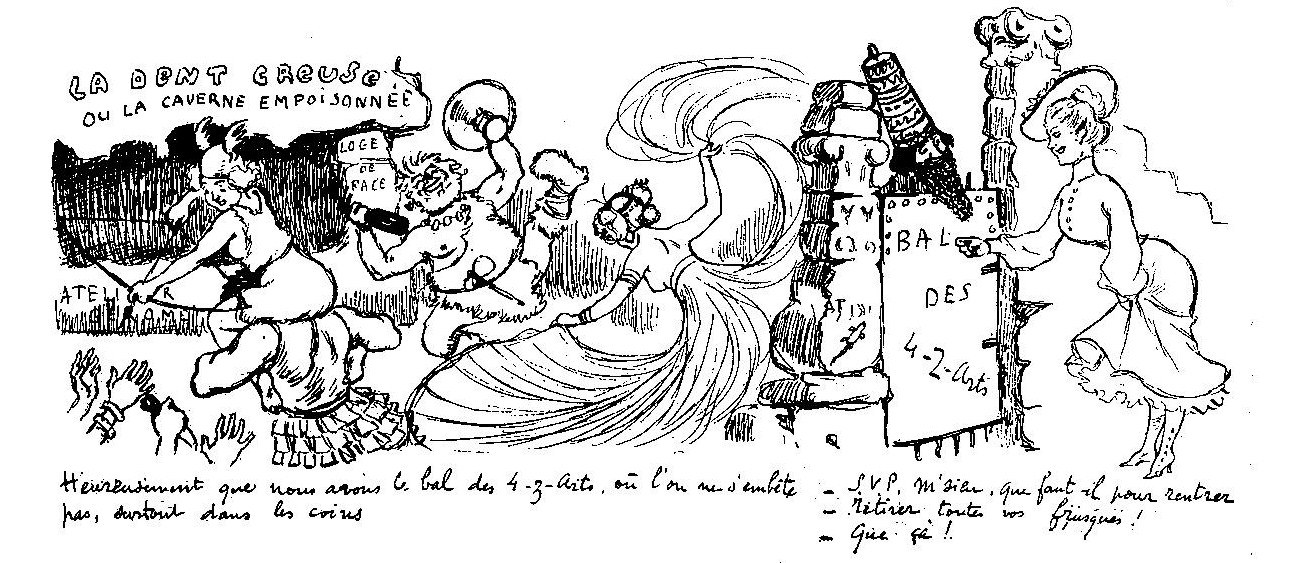
This postcard shows a wedding celebration split into two distinct groups. On the left, the bride's wedding party gathers around a table, the bride identifiable by her veil and formal dress, surrounded by guests in early 20th-century attire—tailored jackets, hats, and long dresses. On the right, a bearded man in traditional Jewish dress (long coat, wide-brimmed hat) dances with energetic, sprung posture while a klezmer band plays behind him: musicians with instruments, one playing what appears to be a violin or fiddle. The figure at center-right dominates the composition, captured mid-leap or vigorous step, his body angled dynamically, his garments billowing. The drawing style is ink on paper, rendered in loose, expressive hatching that conveys movement and texture. The scene captures the moment of the Machtunem Tanz, the traditional in-law's dance that was a pivotal moment in Eastern European Jewish weddings.
The dancing
The central male dancer exhibits an open, exuberant posture: knees bent, torso upright and slightly forward, arms free and gesturing. His weight appears to be on the balls of his feet, suggesting springing or hopping action. The bride and her attendants stand relatively still in closed groupings, serving as witnesses and context. The musicians are depicted in profile, playing without formal hold. The artist captures a moment of individual exuberance rather than partnered movement: this is a solo or leading figure's dance, not a couple's closed position.
The dance depicted
The Machtunem Tanz (or Mekhutonim tants) was a traditional dance of the bride and groom's in-laws, performed as part of the wedding celebration in Eastern European Jewish communities. This image documents the folk practice as it would have been performed in the early 1900s, showing the characteristic energetic, springing movement and the klezmer band accompaniment essential to the tradition. The dancer's vigorous posture and the surrounding guests suggest this was both a ceremonial honor and a moment of joyful physical display. The visual evidence—the Yiddish caption, the traditional dress, the wedding setting, and the klezmer musicians—confirms this is a documented record of Ashkenazi Jewish wedding dance practice.
How it was made
This is an ink drawing, likely prepared as a postcard illustration (as indicated by the format and source). The artist used expressive cross-hatching and loose linework to convey volume, movement, and the texture of fabric and hair rather than precise realistic detail. This technique was well-suited to mass reproduction as a postcard, allowing the scene's narrative and energy to be clear even in small scale. The style suggests this was made from observation or memory of an actual wedding scene, rendered with the satirical or folkloric tone common to Jewish cultural postcards of the period.
About this work
This is a postcard documentation of the Machtunem Tanz, a traditional dance from Eastern European Jewish weddings, drawn in the early 1900s and circulating as a mass-produced image. It shows both the ceremonial moment—the in-law's dance as a central ritual—and the social context around it: the wedding party, the musicians, the festive atmosphere. The image is valuable as both a visual record of folk dance practice and as evidence of how this tradition was circulated, remembered, and presented to audiences through popular printed imagery. The bilingual caption (Yiddish and Polish) places it in the Ashkenazi diaspora, likely from Poland or Eastern Europe.
How to look at it
Pay attention to the contrast between stillness and movement: the bride and her attendants are formal and posed, while the male dancer dominates through dynamic action. The artist has chosen the moment of maximum exertion—the leap or vigorous step—to convey the dance's energy and the dancer's status as a honored figure. The placement of the klezmer band, integrated into the composition rather than separated, emphasizes that music and dance are inseparable in this tradition. The surrounding guests' gaze and posture suggest they are witnessing and validating the dancer's performance.
The period
The postcard was produced during the golden age of the European postcard as a mass medium (1890s–1920s), when illustrated postcards were affordable and widely circulated as souvenirs and cultural documents. In the Yiddish-speaking world, postcards depicting folk life, weddings, and cultural types were popular, often with a mix of documentary interest and gentle satire. This image dates to a period when Eastern European Jewish culture was being documented and circulated to diaspora communities and to outsiders. The Machtunem Tanz itself was undergoing change during this period as emigration and modernization altered traditional wedding practices; this image may represent either an established tradition or an idealized or nostalgic memory of one.
Where it lives
This work is a reproduced postcard, now held in Wikimedia Commons. The original medium, publisher, and print run are unknown. The bilingual Polish-Yiddish caption suggests it was published for circulation in Eastern Europe or among Yiddish-speaking diaspora communities, likely in Poland or neighboring regions.
Dance in this work
Questions about this work
What is the Machtunem Tanz?
The Machtunem Tanz (Yiddish: in-law's dance) was a traditional moment in Eastern European Jewish weddings where the bride and groom's in-laws danced, usually as an honored, celebratory act. It functioned as both a family ritual and an opportunity for individual display. Music was provided by klezmer musicians, as shown here. The dance appears to have involved springing, vigorous movement, often performed solo or as a lead figure.
Who would have performed this dance?
The Machtunem Tanz was danced by the in-laws (parents, aunts, uncles, or other relatives) of the bride and groom. It was an honor to be invited to dance, and the dancer's energy and skill were on display for the entire wedding party. The figure at the center of this postcard, judging by his mature appearance and central placement, is likely a senior in-law.
Why is this a postcard?
Postcards were a major medium for popular culture distribution in the early 1900s. Illustrated postcards depicting folk life, traditional practices, and cultural types were bought and collected, sent by travelers, and preserved by diaspora communities. This postcard likely circulated among Yiddish-speaking audiences in Eastern Europe and North America, serving both as a souvenir and as a way of documenting and remembering traditional culture during a period of rapid social change.
More dance artwork