49 works in this view — arrow keys or swipe to move between them.
Dance in Art · 1872
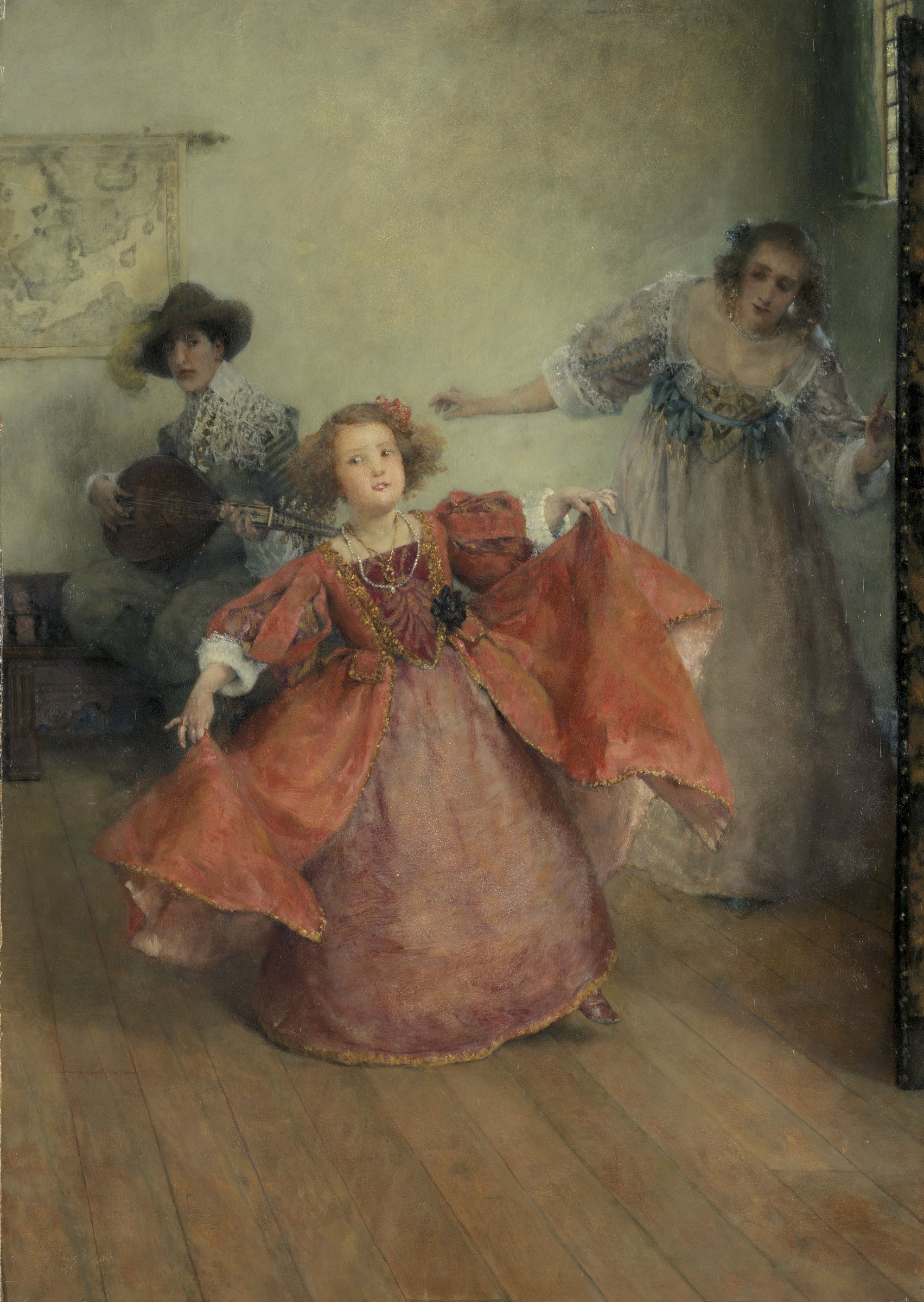
Airs and Graces by Laura Theresa Alma Tadema Rijksmuseum Amsterdam SK-A-2652
Laura Theresa Alma-Tadema
- Medium:
- Oil Painting
- Era:
- Late 1800s (Victorian Ballroom)
- Source:
- Wikimedia Commons
- Rights:
- Public domain — free to use, share and adapt.
- Recorded as:
- Public Domain
The work documents how dance and movement were understood in the Victorian household—not as autonomous physical expression but as a crucial marker of gentility, training, and marriageability. It shows that 'dancing' in this context could mean the display of learned posture and grace rather than actual choreographed movement, revealing the social uses of dance training among the well-to-do.
What you are looking at
An interior domestic scene depicts a young girl in the center, dressed in an elaborate red-orange cloak or cape lined with gold, worn over a burgundy dress with gold embroidery and ornamental chains. She stands in a vivid pose of theatrical presentation, one arm extended gracefully while her body twists in a dynamic contrapposto, her reddish-gold curled hair catching the light. Behind her, a woman in pale lace—likely her mother or chaperone—gestures approvingly from the right, her hand raised in an encouraging or admiring gesture. On the left, a young man in dark clothing plays a stringed instrument, possibly a lute or similar period piece. The setting is a sparsely furnished interior with pale walls, wooden floorboards, and minimal props: a decorative tapestry hangs on the upper left wall, a mirror or frame is visible on the right. The light is warm and diffuse, typical of interior portraiture, with soft shadows that emphasize the girl's central position. The moment captures something between a private performance and a domestic musical gathering—the child is clearly displaying herself, watched by her attendants.
The dancing
The central figure stands with weight shifted onto one leg, creating a pronounced S-curve through her body. Her extended arm is held at an elegant height, palm open and fingers gracefully extended—a classical pose of display and refinement. The posture suggests balletic or courtly training: the carriage is upright, the head tilted with conscious poise, the entire frame composed for observation. Her companions are static and supportive: the musician is seated or semi-seated with instrument in hand, while the woman behind stands in a posture of approval rather than participation. The girl is isolated as the sole active performer, while the others form an audience.
The dance depicted
This appears to depict a demonstration of fashionable social accomplishment—likely a minuet, galop, or courtly dance—rather than an actual dance in progress. The pose is too still and too consciously displayed to be mid-movement; instead, it captures a moment of presentation or curtsy-like display of training and grace. The girl is showing off her deportment and refinement to her attendants, a common Victorian domestic scene. The instrument suggests musical accompaniment, and the elaborate costume indicates this is a formal or semi-theatrical family entertainment. The title 'Airs and Graces' reinforces this interpretation: the work is about the performance of refined manners and accomplishment rather than energetic dancing.
How it was made
This is an oil painting with the soft, luminous quality characteristic of 1870s academic realism. The artist employs careful attention to fabric texture and surface—the shimmer of the gold-lined cloak, the delicate lace of the attendant's dress, the sheen of the girl's silk—rendering these materials with technical precision. The interior is loosely suggested rather than detailed, allowing the figures to dominate. The warm overall tonality and the soft modeling of forms create an intimate, domestic atmosphere typical of Victorian interior genre painting. Oil paint allowed the artist to build up luminous glazes in the fabrics and skin tones, creating the jewel-like quality of the girl's costume against the muted background.
About this work
This is a domestic scene of Victorian genteel accomplishment depicting a young girl in theatrical dress displaying her refinement through controlled posture and gesture before her family attendants. Painted in oil in 1872 by Laura Theresa Alma-Tadema, it belongs to the tradition of Victorian interior genre painting that celebrated the cultivation and display of feminine accomplishment. The work is titled 'Airs and Graces'—a phrase meaning affected manners or studied elegance—and that ironic or observational title is key: the painting captures the moment of display itself, the performance of refinement, rather than unguarded movement or authentic dance. It belongs here because it depicts the social function of dance training and courtly deportment in the Victorian household.
How to look at it
The painting's composition enforces focus on the girl's pose and costume. Notice how the attendants' positions direct attention to her center: the musician's gaze and the standing woman's gesture both frame the performer. Look at her posture carefully—the weight distribution, the arm extension, the tilt of the head—to understand what 'refined' movement meant in Victorian drawing rooms. The title 'Airs and Graces' invites a reading of the scene that may be slightly ironic or observational: is this display of accomplishment genuine or performed? The girl's composed expression and static pose suggest a moment held for observation—a tableau rather than action.
The artist
Laura Theresa Alma-Tadema (1852–1909) was the sister of the celebrated academic painter Lawrence Alma-Tadema. Less well-known than her famous brother, she trained as a painter and exhibited genre and historical scenes in oil. Her work shares her brother's interest in careful historical and material detail, domestic interiors, and the life of women, though her subject matter is predominantly contemporary Victorian society rather than classical antiquity. This painting exemplifies her interest in capturing intimate domestic moments and the material culture of refined households.
The period
In the 1870s, dance training for young middle- and upper-class girls was a standard component of education alongside music and drawing. These accomplishments were marks of gentility and preparation for marriage. The Victorian era saw a nostalgia for older courtly forms—minuets and gavottesrevived for special occasions and amateur performance—alongside newer ballroom dances. Simultaneously, academic painting was intensely interested in capturing private domestic life and the details of contemporary dress and interiors. Alma-Tadema's painting sits at the intersection of this educational expectation and the genre painter's interest in revealing the texture of domestic daily life.
Where it lives
The work is held in the Rijksmuseum Amsterdam (accession SK-A-2652) and was sourced through Wikimedia Commons. It is a single-artist oil painting from the museum's collection of Victorian and academic-era art.
Dance in this work
Questions about this work
Is this a real dance or just posing?
It is both. The girl is displaying a learned posture and grace that would have been taught through dance and deportment training, but the moment captured is one of presentation rather than active dancing. She is showing off her accomplishment—her 'airs and graces'—to her attendants. In the context of Victorian genteel education, this kind of refined display was itself a social performance with dance-like qualities.
What is the man playing?
The instrument appears to be a lute or similar stringed instrument. Its presence suggests live musical accompaniment, which would have been essential to any formal display of dancing or refined movement in a Victorian household. Music and movement were always paired in these educational contexts.
Who was Laura Theresa Alma-Tadema?
She was a 19th-century British painter and sister of the more famous academic painter Lawrence Alma-Tadema. She specialized in genre scenes of contemporary life, particularly domestic interiors and scenes of women. Though less celebrated than her brother, her work shows the same attention to material detail, light, and historical accuracy.
What do the costumes tell us?
The girl's elaborate cloak and embroidered dress are her finest clothes—this is a formal display, not casual movement. The red and gold fabrics, the ornamental chains, and the careful coiffure all signal that this is a staged moment of presentation. The attendants' simpler dress marks them as supporters rather than performers. The costumes show that this kind of refined display was itself a form of dress-up and theater.
More dance artwork