36 works in this view — arrow keys or swipe to move between them.
Dance in Art
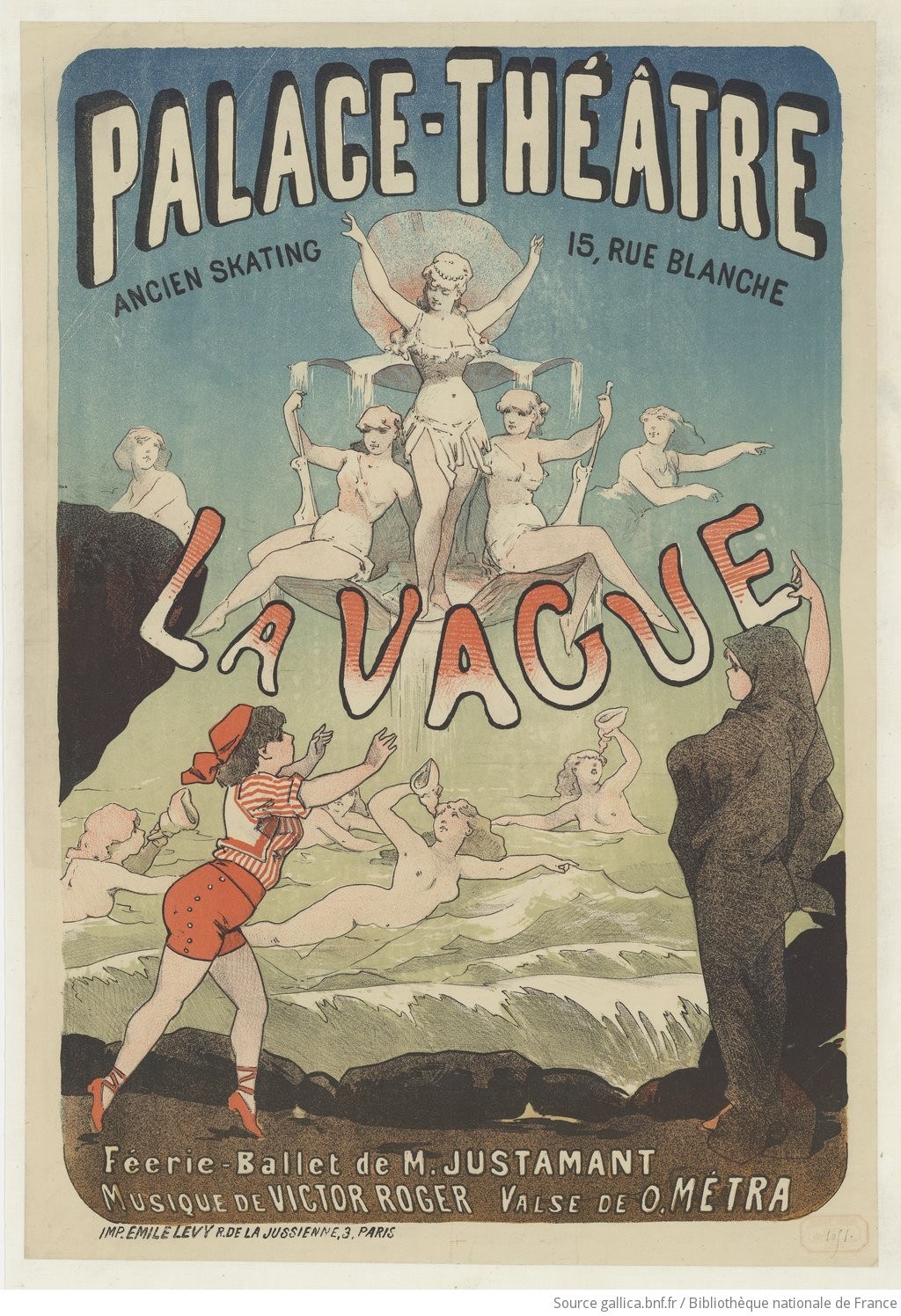
Palace-Théâtre, ancien skating, 15 rue Blanche. La Vague. Féerie-ballet de M. Justamant. Musique de Victor Roger... [et Olivier Métra] : [affiche] / [non identifié]
Unknown artist
- Era:
- Late 1800s (Victorian Ballroom)
- Source:
- Bibliothèque nationale de France (Gallica)
- Rights:
- Public domain — free to use, share and adapt.
- Recorded as:
- domaine public
Féerie-ballet was the dominant form of theatrical dance in Paris for several decades and profoundly influenced the development of modern spectacle and ballet itself; understanding how these works were advertised and presented to audiences illuminates the values and fantasies embedded in late-nineteenth-century performance culture. The poster's formal composition and graphic language reveal the aesthetic strategies by which semi-nude dancers were made acceptable and desirable to bourgeois audiences, a tension that shaped theatrical dance for generations.
What you are looking at
This is a theatrical poster for a féerie-ballet (fairy extravaganza) titled *La Vague* (*The Wave*), performed at the Palace-Théâtre (formerly a skating rink) on rue Blanche in Paris. The composition is organized in three spatial zones. At the top, within a blue sky, sit five semi-nude female figures arranged on chairs in a pyramidal formation, with a central figure standing elevated above the others with both arms raised. Below them, large red lettering spells "LA VAGUE" across a pale yellow-green ground. In the lower register, a figure in a red and white striped costume with a red hat poses with splayed legs in the foreground, while several more semi-nude figures recline or sprawl across sandy ground in a beach or seaside setting, flanked by dark rocky outcrops. The poster employs bright flat color typical of Belle Époque commercial printing, with strong black outlines defining all forms.
The dancing
The figures display a studied languor rather than vigorous choreography. Those in the upper formation sit with open, relaxed postures in classical poses reminiscent of sculptural groups—knees bent, legs visible, arms extended in soft arabesques. The central elevated figure strikes an attitude with both arms raised in a gesture of openness or presentation. The foreground figure in costume adopts a wide, splayed stance with legs apart and arms extending outward in a gymnastic or acrobatic attitude. The recumbent figures below show elongated, stretched positions. Throughout, the bodies are presented as living statuary rather than mid-movement dancers, emphasizing display and tableau over kinetic momentum.
The dance depicted
This is a féerie-ballet, a theatrical form popular in late-nineteenth-century Paris that combined choreography, pantomime, elaborate scenery, and stage machinery in loosely narrative spectacles. The specific scenario of *La Vague* (The Wave) suggests a beach or seaside setting with attendant water nymphs or ondines—a common theme in this genre. The positioning and costumes indicate this was a scenic tableau piece rather than virtuoso classical ballet. The semi-nude figures and beach setting are typical of the orientalizing and mythologizing subject matter that allowed fin-de-siècle impresarios to present the body in theatrical contexts; the striped costume and exaggerated pose suggest comic or grotesque character roles intermixed with the idealized figures. The music was by Victor Roger and Olivier Métra, both known for operetta and theatrical music.
How it was made
This is a color lithographic poster, identifiable by its bold, flat areas of color (blue, yellow, pale green, red, black), minimal tonal gradation, and the characteristic way lithography renders decorative lettering and organic forms with clean outlines. Lithography allowed rapid, economical production of multiple copies for street distribution and display. The design is characteristic of Belle Époque theatrical publicity—visually arresting, sexually suggestive within the bounds of public decorum, and designed to be legible at distance. The technique's efficiency made theatrical posters an ideal vehicle for experimental composition and graphic design, allowing artists to reach working-class audiences who would never enter a gallery.
About this work
This poster advertises a féerie-ballet, the dominant form of Parisian theatrical spectacle in the 1880s and 1890s, which combined choreography with pantomime, scenery, and narrative spectacle. *La Vague*, performed at the Palace-Théâtre in 1883, exemplifies the genre's characteristic blend of classical posturing, orientalist fantasy, and the display of the semi-undressed body within a theatrical frame. The poster is an artifact of commercial theatrical culture and an important document of how dance was publicized and how female bodies were presented in popular performance. As a lithographic design, it represents the convergence of fine-art composition and mass-market printing that defined the Belle Époque poster as an art form in its own right.
How to look at it
Attend to the composition's three registers—the idealized sculptural group at top, the emphatic lettering in the middle, and the beach scene with the comic character below. The poster is designed to be read from a distance: the large red letters announce the title before any figure can be distinguished. Notice how the artist uses the striped costume and splayed pose of the foreground figure to break the symmetry and introduce visual excitement; this is the comic or eccentric element that féerie-ballets depended on for variety. The recumbent figures below are presented not as dancers executing steps but as luxurious, available bodies—a key to understanding how this form was marketed and received.
The artist
The artist is not recorded. The poster is attributed to the printer Imp. Emile Levy (rue de la Jussienne, 3, Paris), a commercial printing house, but theatrical posters of this era were often designed by graphic specialists whose names were not preserved. The style and competence suggest a professional theater poster designer working within the conventions of Belle Époque promotional graphics.
The period
The 1880s and 1890s saw the full flowering of the féerie-ballet in Paris, a form that succeeded classical ballet as the most commercially successful and culturally visible dance genre. These spectacles drew audiences from all social classes and provided employment for hundreds of dancers, often women who lacked the classical training demanded by the Opéra. The form was orientalized, sensationalized, and often morally controversial; it was also formally inventive, incorporating music-hall comedy, acrobatics, and scenic machinery that prefigured early cinema. Simultaneously, lithographic color posters had become a major medium of urban visual culture, displayed on kiosks and street corners throughout Paris, making theatrical advertising a recognized art form.
Where it lives
The poster is held in the Bibliothèque nationale de France (Gallica digital library). It is a commercial theatrical advertisement, one of thousands produced to publicize Parisian performances, and is valuable primarily as evidence of theatrical practice and visual culture rather than as a signed artwork.
Dance in this work
Questions about this work
What was a féerie-ballet?
A féerie-ballet was a spectacular theatrical entertainment that combined choreographed dances, pantomime, elaborate scenery, magical effects, and narrative spectacle. Unlike classical ballet, which demanded virtuoso technique and was performed at the Opéra for elite audiences, féeries were accessible popular entertainment, often with mythological or orientalist themes, performed in commercial theaters and music halls. They were the dominant form of dance performance in Paris from the 1870s through the early 1900s.
Why are the dancers semi-nude?
The display of semi-draped or semi-nude bodies was central to the féerie-ballet's appeal and commercial strategy. Impresarios justified this within mythological or fantasy narratives—water nymphs, sylphs, odalisques—that made such display narratively coherent and socially acceptable. This visual strategy drew audiences across class boundaries and was widely criticized by moralists; it also anticipated the later development of revue spectacles and cabaret performance.
What is the striped-costume figure doing?
This figure, likely a comic character or grotesque role, provides the type of visual and comedic relief that féerie-ballets depended on. The exaggerated posture and bright costume distinguish this character from the idealized mythological figures above and below, suggesting a clown, mime, or character dancer whose role was to entertain through physical comedy and vernacular movement rather than classical technique.
Who were the composers?
Victor Roger and Olivier Métra were both prolific composers for theatrical music in late-nineteenth-century Paris. Métra was particularly known for his waltzes and orchestral works for theater; Roger composed operettas and theatrical scores. For féeries, composers provided orchestral music that supported the spectacle and pantomime without the formal structure demanded by classical ballet or opera.
More dance artwork