27 works in this view — arrow keys or swipe to move between them.
Dance in Art
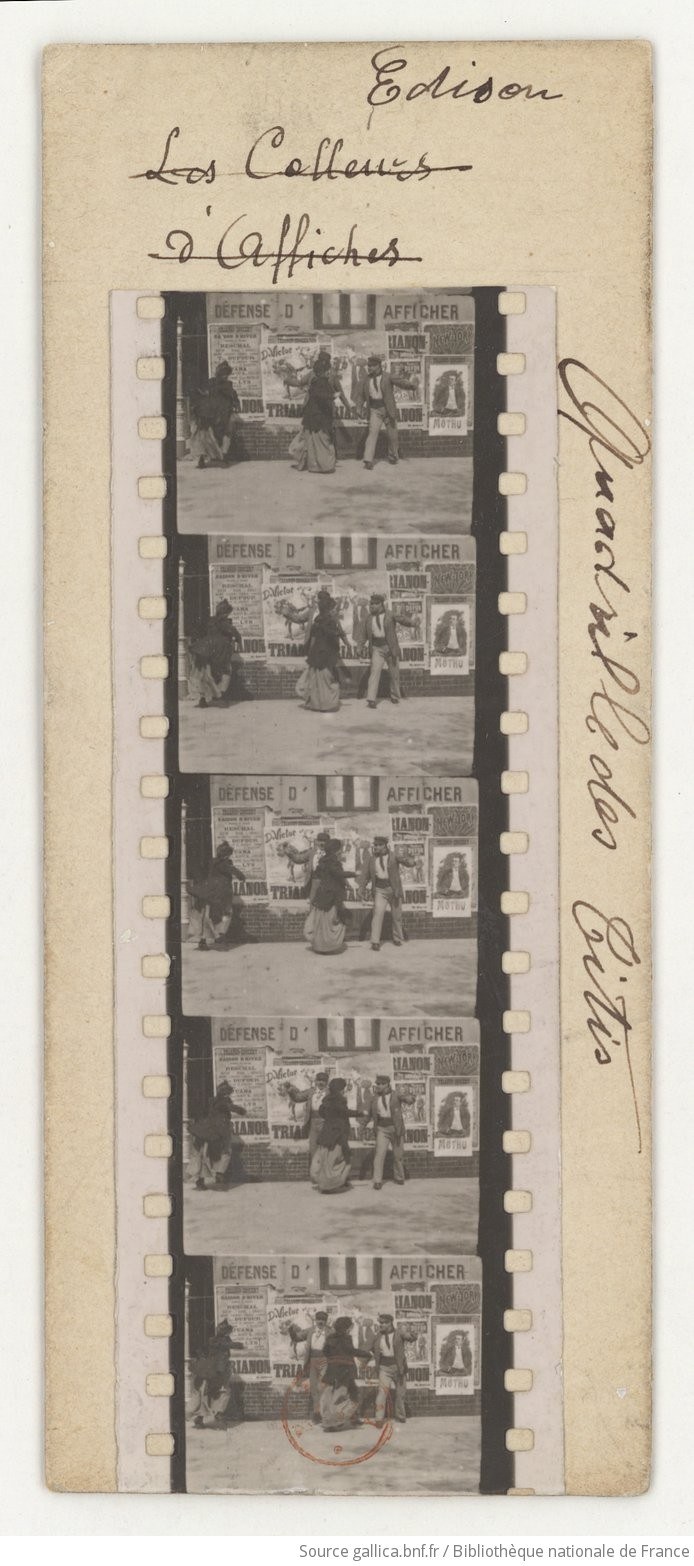
[Recueil. Quadrille des Titis, production d'Eugène Pirou. Paper prints]
Unknown artist
- Dance:
- Quadrille
- Era:
- Late 1800s (Victorian Ballroom)
- Source:
- Bibliothèque nationale de France (Gallica)
- Rights:
- Public domain — free to use, share and adapt.
- Recorded as:
- domaine public
This is rare visual documentation of an actual quadrille performance, captured at the moment when cinema was beginning to document dance. The filmstrip format and Pirou's pioneering work make it significant to the history of both dance recording and early cinema; it shows how a popular, social form was being adapted for the camera and audiences.
What you are looking at
This is a filmstrip of five frames from a late 19th-century motion picture, showing a street scene with figures in period dress moving in and around a storefront. The setting is an urban street with posters and advertisements visible on the building facade—signage for "DÉFENSE D'" (Defense) and "AFFICHER" (Posting) is legible, along with other commercial notices. In each frame, several figures in long dresses and period clothing are positioned at different stages of movement through the space. The lighting is consistent across frames, suggesting this is a continuous sequence captured in daylight. The figures appear to be engaged in a stylized, choreographed movement rather than casual street activity, with deliberate positioning and gestures that suggest a planned performance or entertainment piece.
The dancing
The figures are dressed in 1890s clothing: women in long skirts and fitted jackets, men in suits and hats. Their movement suggests a structured group choreography rather than naturalistic pedestrian motion. In the visible frames, the dancers shift their positions and orientations, with some figures bending or gesturing toward the storefront advertisements. The spacing and positioning shift meaningfully between frames, indicating a coordinated ensemble piece. The scale of the figures and their engagement with the architectural setting suggests this is a street performance or theatrical piece designed for visual spectacle rather than intimate partner work.
The dance depicted
This appears to be documentation of "Quadrille des Titis," a production credited to Eugène Pirou, who was a pioneering French filmmaker of the 1890s. The quadrille was a popular 19th-century group dance that had become a staple of music halls and popular entertainment by the 1890s. The title "Titis" refers to the Parisian street children and street-vendor characters—this was a comedic or character-based version of the quadrille, performed for camera in an urban street setting. The filmstrip format is itself the work: this is not a photograph of a stage performance but a motion picture, captured in discrete frames that would be projected in sequence to show the movement over time.
How it was made
This is a paper print made from a motion picture film—a photographic positive on paper stock, likely created by contact printing from a film negative. The images show perforations along both edges, characteristic of early cinema film (35mm or similar gauge). The paper support appears aged and slightly yellowed, consistent with gelatin silver print stock from the 1890s. Such prints were used for archival purposes, distribution, and publicity; they allowed the work to be circulated, studied, and preserved in a stable medium when film stock itself was vulnerable to decomposition. The decision to print frames in sequence on a single sheet preserves the temporal continuity of the motion, making it readable as movement rather than as isolated moments.
About this work
This work documents a Parisian street-performance piece from the 1890s—a comedic quadrille performed for the motion-picture camera. Eugène Pirou was among the first to recognize cinema's capacity to capture and distribute performance, and this work sits at the intersection of two 19th-century entertainment forms: the music-hall quadrille (by then a coded, codified social dance with comic variants) and the new medium of film. The paper print format suggests this was preserved and circulated as a document of the piece, reaching audiences who could not attend a live performance. It is both a record of a specific dance work and evidence of how cinema began to reshape the circulation and preservation of choreographic practice.
How to look at it
Watch the progression across the frames: the figures shift their positions and gestures in a pattern that repeats or develops, suggesting the structure of the quadrille or a comic variation on it. The engagement with the storefront—the glances toward the advertisements, the theatrical posturing—suggests a narrative or character comedy layered onto the dance structure. Note how the filmstrip format itself becomes a score: each frame is a moment in a continuous movement sequence, and the eye should read them in order to reconstruct the full choreography. The street setting and period dress ground this in a specific time and place, but the framing and composition show Pirou's awareness of the camera as an audience.
The artist
Eugène Pirou was a French filmmaker and pioneer of cinema in the 1890s. He is credited with several early films, including this quadrille piece. Pirou was among the first to recognize that cinema could capture movement and performance in ways that photography alone could not, and he worked in the period when the distinction between documentary and entertainment film was still fluid. His work is part of the early cinema tradition of filming street scenes, performances, and popular entertainments.
The period
The 1890s saw the quadrille in transition from an aristocratic salon dance to a music-hall and street entertainment form, often performed in comic or character variants. At the same time, the Lumière brothers and their contemporaries were establishing cinema as a medium for capturing everyday life and performance. Pirou's work emerges in this moment: the quadrille was still familiar enough to audiences to require minimal explanation, yet cinema was creating new possibilities for distributing and preserving performance. The paper-print format reflects the archival consciousness of early cinema: these works were understood as valuable documents that needed to be preserved in permanent form.
Where it lives
This work is held in the Bibliothèque nationale de France (BnF) and catalogued in the Gallica digital library, the BnF's online collection of digitized manuscripts, books, maps, and multimedia materials. It is classified as a paper print from a film collection—a category of archival object distinct from both the original film and a conventional photograph.
Dance in this work
Questions about this work
What is a paper print?
A paper print is a photographic positive made on paper stock, printed from a film negative. In early cinema, paper prints were the primary means of preserving and circulating films: they were more stable than nitrate film stock, easier to handle and store, and could be mailed and projected. The Library of Congress's paper print collection, begun in the 1890s, preserves thousands of early films that would otherwise have been lost when the original film decayed.
Is this a stage performance or a street performance?
The evidence suggests this was performed specifically for the camera in an actual street setting, not a stage. The natural light, the urban architecture, and the camera angle suggest an outdoor location. Whether the characters and narrative were invented for the camera or whether this documents an actual street performance is unclear from the image alone; Pirou's practice included both documentary street scenes and staged comedies.
What was a quadrille?
The quadrille was a group dance for four couples (or a multiple of four couples) that emerged in France in the early 19th century and became one of the most popular dances of the 19th century, performed in ballrooms, at court, and—by the 1890s—in music halls. It was composed of five figures, each typically a set of eight counts, and it followed a strict structure. By the 1890s, composers and performers were creating comic or character variants, such as this 'Quadrille des Titis.'
Who were the Titis?
In Parisian slang of the 19th century, 'titis' referred to street children, street vendors, and working-class or lumpenproletarian characters. A 'quadrille des titis' would be a comic or character-based version of the quadrille, performed by or depicting these figures. The specific narrative or gag of this piece is not fully legible from the image alone.
More Quadrille artwork