47 works in this view — arrow keys or swipe to move between them.
Dance in Art
Falstaff Quadrille
Coote, Charles
- Dance:
- Quadrille
- Era:
- Late 1800s (Victorian Ballroom)
- Source:
- Victoria and Albert Museum
- Rights:
- Rights vary by item — check the source record before reusing this image. Source record ↗
- Recorded as:
- Check V&A creditLine
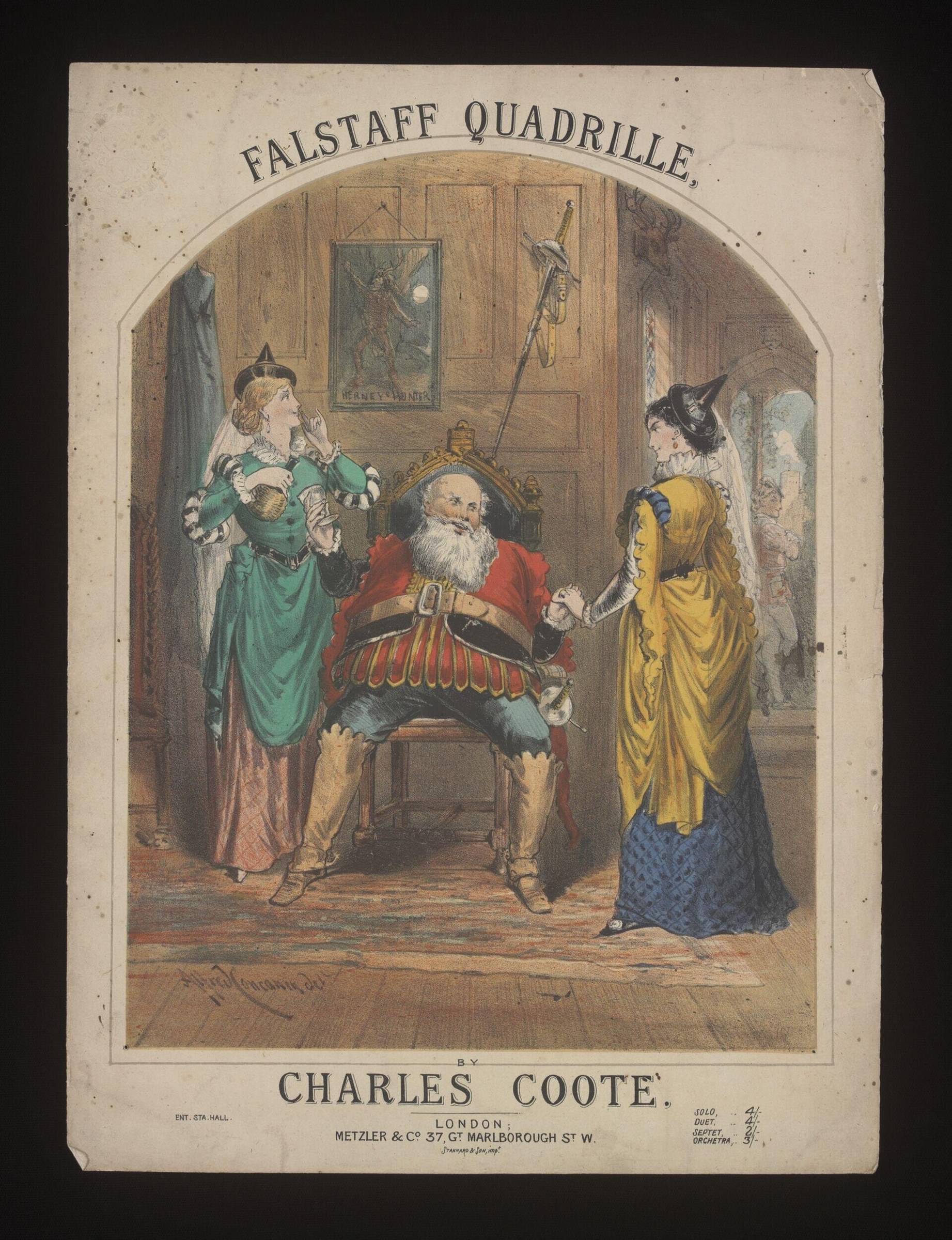
The *Falstaff Quadrille* reveals how 19th-century ballroom culture was shaped by theatrical literature and performance. This engraving documents the visual and dramatic vocabulary—the costumes, the character types, the narrative moment—that ballroom choreographers drew upon, showing that social dance was not separate from theater but deeply interwoven with it. For dance historians, it demonstrates how a single narrative could move across multiple media: literature, theater, and dance.
What you are looking at
A colored engraving shows a richly dressed military figure seated centrally in a wooden-paneled interior, surrounded by three attendants in elaborate period costume. The seated man wears a red doublet with ornate gold-trimmed armor plating across the chest and a broad decorative belt; he has a full white beard and holds a commanding posture. To his left stands a younger figure in green silk with white fur trim, one hand raised to the chin in a gesture of attention or concern. To his right are two female figures: one in yellow silk with a dark hood, the other partially visible in blue. The setting is a nobleman's chamber with wooden wall paneling, a framed portrait on the wall, and various weapons—a sword and what appears to be a staff—hanging behind. The composition is staged and theatrical, lit from the front to model the figures' faces and rich fabrics.
The dancing
The figures are positioned in conversational or attendant relationships rather than in a coordinated dance formation. The standing figures are upright and relatively still, their weight on their feet, their arms and hands expressive but not in any standard dance hold or frame. The raised hand of the left figure and the formal posture of the women suggest theatrical gesture—a moment of dramatic interaction—rather than the kinetic commitment of active dancers. There is no visible footwork, weight transfer, or partnering characteristic of social or theatrical dance.
The dance depicted
This image does not depict an active dance. The title *Falstaff Quadrille* refers to a quadrille choreographed to scenes or characters from Shakespeare's *Henry IV, Part 1*—a theatrical adaptation common in 19th-century ballroom culture, where quadrilles were given narrative and character themes. However, this engraving shows a dramatic tableau or scene from the play itself, frozen at a moment of character interaction in Falstaff's chamber, not a ballroom quadrille in progress. The work documents the theatrical context and costume vocabulary that inspired the dance rather than the dance itself.
How it was made
This is a hand-colored engraving—established by the fine line work, the printed black outlines, and the careful watercolor or gouache wash applied to the figures and setting. The technique allowed for both fine detail in the faces and armor and broad, luminous color in the silk garments. As a colored engraving by a London publisher (Metzler & Co.), it was a relatively affordable way to circulate theatrical imagery to a broad audience of ballroom dancers, theater enthusiasts, and the educated public. The date and publisher information suggest this was issued during or shortly after a successful theatrical production.
About this work
This is a theatrical engraving documenting a scene from a Shakespeare adaptation that inspired a ballroom quadrille—a type of group dance popular in the 19th century. The *Falstaff Quadrille* belonged to a tradition of thematic quadrilles that drew on literature, history, and theatrical performance, translating dramatic characters and scenes into choreographed figures danced in a rectangular formation by four couples. The engraving shows the source material: Falstaff in his chamber, a moment of dramatic tension or revelation. For dancers and ballroom enthusiasts of the 1870s, this image would have provided both costume inspiration and narrative context for the choreographed dance that bore the same name.
How to look at it
Observe the richness of the costume detail—the armor, the silk, the fur trim—and recognize that these elements would have been replicated in stylized form by ballroom dancers. Notice the theatrical staging of the scene: the composition is carefully balanced, the lighting frontal and modeling, the moment chosen for dramatic clarity rather than narrative progression. The engraver has frozen a moment of heightened emotion or significance in the play, not a moment of physical action. This is how dance-themed theatrical prints work: they provide narrative and visual authority without showing movement itself.
The artist
Charles Coote was a London-based artist and engraver working in the mid-19th century. He specialized in theatrical and popular imagery, particularly hand-colored engravings and lithographs. His work was published by established London firms like Metzler & Co., which distributed affordable color prints to the middle-class market. Coote's practice was typical of commercial printmaking of the period—producing narrative and character-driven images for a public hungry for theatrical imagery, costume information, and literary illustration.
The period
The 1870s saw the quadrille at the height of its cultural prestige and theatrical elaboration. What had begun as a relatively simple group dance in the late 18th century had evolved into an elaborate theatrical form, often choreographed around literary themes, historical moments, or character studies. Simultaneously, Victorian theater was at a peak of spectacle and Shakespeare adaptation; illustrated editions and dramatic prints were major commercial enterprises. The *Falstaff Quadrille* sits at the intersection: a Shakespeare character entering the ballroom through both narrative themes and visual costume codes.
Where it lives
This hand-colored engraving was published in London by Metzler & Co., a significant ballroom and theatrical print publisher of the period. The source is recorded as the Victoria and Albert Museum, which holds extensive collections of theatrical and ballroom imagery from the 19th century. The work is part of the broader archive of commercial theater and dance prints that documented and promoted theatrical dance forms to the urban middle class.
Dance in this work
Questions about this work
Is this a dance scene?
No. This is a theatrical scene—a moment from Shakespeare's *Henry IV, Part 1*—that inspired a choreographed ballroom quadrille with the same title. The quadrille itself was danced in a different context (ballroom, in formation, with specific figures), but this engraving shows the play scene that provided the narrative theme and costume vocabulary for that dance.
What is a Falstaff Quadrille?
A quadrille is a group dance for four couples (eight dancers) performed in a rectangular formation with specific figures and sequences. Thematic or narrative quadrilles, popular in the 19th century, were choreographed around literary or theatrical sources. The Falstaff Quadrille used the character and scenes from Shakespeare's play as its framework, allowing ballroom dancers to connect their social dance to high culture and theatrical spectacle.
Who would have danced this?
The urban middle and upper-middle classes—the same people who attended theater and read Shakespeare, and who frequented ballrooms and assembly halls. The quadrille was the dominant social dance of the mid-to-late 19th century, and thematic quadrilles gave educated dancers a way to demonstrate cultural knowledge through dance.
Why publish a theatrical scene rather than show the dance?
Theater and dance were not separate worlds; they informed each other. An engraving of the theatrical source gave dancers visual authority and narrative depth, while also serving as a promotion for both the play and the dance. The print's circulation also reached people who might see the play, attend the dance, or do both.
More Quadrille artwork