28 works in this view — arrow keys or swipe to move between them.
Dance in Art
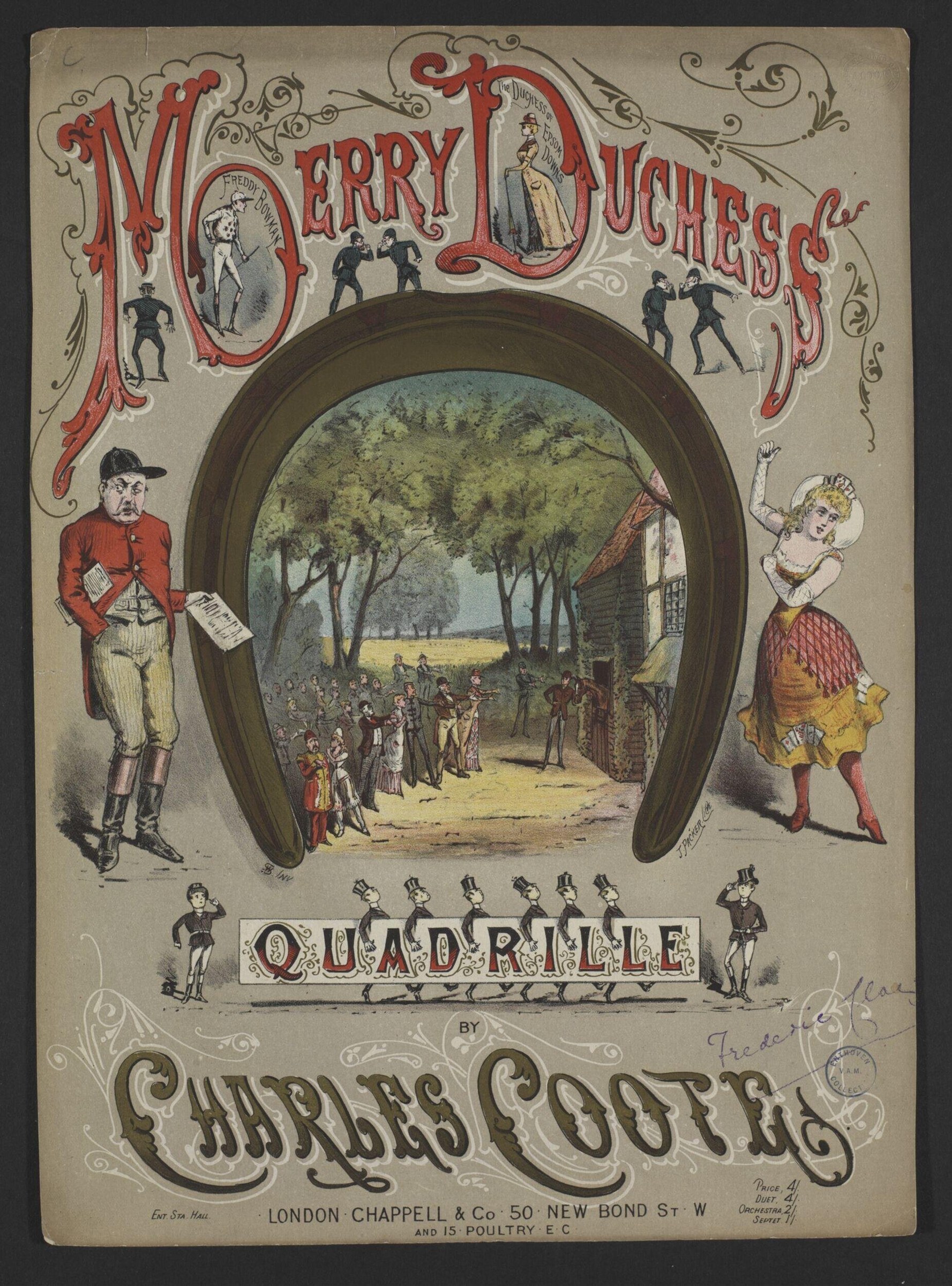
Merry Duchess Quadrille
Charles Coote
- Dance:
- Quadrille
- Era:
- Late 1800s (Victorian Ballroom)
- Source:
- Victoria and Albert Museum
- Rights:
- Rights vary by item — check the source record before reusing this image. Source record ↗
- Recorded as:
- Check V&A creditLine
This image is a primary source for how ballroom dances were understood and presented to the Victorian public: as theatrical social events rather than technical disciplines. The cover design reveals the intersection of domestic ballroom culture, commercial sheet music production, and theatrical spectacle that defined 19th-century dance entertainment. For historians, it documents the visual conventions used to market quadrilles and other social dances to middle-class consumers.
What you are looking at
This is a chromolithographic cover for a quadrille musical score, designed as a theatrical frame narrative. A large horseshoe—a symbol of luck—dominates the center, its opening framing a pastoral dance scene beneath trees. Within the horseshoe, a crowd of figures in formal dress gathers outdoors, suggesting an evening celebration or garden party. The surrounding decorative border, printed in red and black on cream stock, contains the title in ornate lettering and small vignettes of individual dancers and acrobats positioned around the frame's perimeter. At the bottom, a row of seven dancers in formal evening wear stands in a line, reinforcing the quadrille as a group dance. The overall composition celebrates the quadrille as a fashionable social spectacle, mixing theatrical presentation with the graphic conventions of Victorian sheet music covers.
The dancing
The central pastoral scene shows figures in standing and social positions rather than mid-movement, consistent with how quadrilles were often illustrated—as structured social formations rather than dynamic choreography. The seven figures at the base stand in relaxed, upright postures in a line, facing forward in the formal dress typical of ballroom dancers of the period: men in dark jackets and women in full skirts. The smaller vignettes around the border show isolated male and female figures, some in acrobatic or performative poses (including what appears to be a contortionist on the left), suggesting a theatrical context or carnival atmosphere. None of the figures shown are in the closed or open holds characteristic of the actual quadrille's executed figures; the emphasis is on display and spectacle rather than technical precision.
The dance depicted
This is a quadrille, one of the most fashionable ballroom dances of the 19th century, danced by four couples (eight people) in a square formation and consisting of five figures performed to a medley of popular melodies. The title "Merry Duchess Quadrille" suggests a specific named quadrille, likely composed for a particular social occasion or to commemorate a notable event. The image presents the quadrille as a theatrical and celebratory social dance, not a folk or ceremonial form. The horseshoe framing and carnival-like decorative elements suggest this version may have been associated with a performance, theater production, or special entertainment event rather than an ordinary ballroom evening, though the formal dress and garden setting indicate the ballroom social context. Quadrilles were danced by the middle and upper classes throughout the Victorian period and were often performed at balls, garden parties, and public entertainment venues.
How it was made
This is a chromolithograph, a color printing process that uses multiple lithographic stones to build up layers of colored ink. The technique is evident in the precise color separation—red for the lettering and ornamental elements, black for detail work and outlines, and natural cream for the paper stock. Chromolithography allowed for vibrant, detailed color reproduction at relatively low cost, making sheet music covers affordable and visually striking for middle-class consumers. This process was the dominant method for illustrated sheet music covers from the 1870s through early 20th century, enabling mass circulation of musical works and transforming them into collectible graphic objects. The publisher's mark at the bottom (London: Chappell & Co) and the decorative sophistication of the design indicate this was a commercial product marketed to consumers who purchased sheet music for home performance or display.
About this work
The *Merry Duchess Quadrille* by Charles Coote is a chromolithographed cover for a ballroom dance composition, executed in the Victorian taste for ornamental, theatrical sheet-music design. It presents the quadrille—the defining group ballroom dance of the 19th century—as a fashionable social spectacle, using the symbolic horseshoe frame to transform a ballroom dance scene into a stage picture. The decorative border, populated with theatrical figures and acrobats, suggests the intersection of ballroom dancing with theatrical and carnival entertainment.
As a design object, it documents how ballroom dances were visualized and marketed in the late 1800s: not as technical instruction or intimate courtship, but as public spectacle and fashionable social participation. The sheet-music cover was one of the most widely distributed images of dance in its era, visible in homes, music shops, and parlors. The *Merry Duchess Quadrille* exemplifies how commercial graphic design shaped the public's understanding and appreciation of ballroom culture.
How to look at it
Notice how the artist uses the horseshoe frame to transform the ballroom scene into a theatrical spectacle, lifting a social dance into the realm of luck, fortune, and entertainment. The ornate lettering and surrounding vignettes—especially the acrobats and contortionists—suggest that this particular quadrille was performed with theatrical flair, possibly as a special event or charitable ball. Look at the figures in the pastoral scene: they are standing, socializing, and posing rather than captured mid-movement. This reflects how Victorian sheet-music covers typically depicted ballroom dances: as fashionable gatherings and status displays rather than as technically demanding movement. The formal line of seven dancers at the bottom grounds the composition in the actual dance tradition while the decorated border lifts it into a realm of fantasy and public spectacle.
The artist
Charles Coote was an illustrator and designer working in late 19th-century London, active in the commercial music publishing industry. The chromolithographed sheet-music cover was a significant branch of graphic design during this period, and accomplished cover designers like Coote were sought after by major publishers like Chappell & Co. His work demonstrates the sophisticated visual vocabulary that emerged around ballroom dancing in Victorian popular culture. Limited biographical information survives, but his designs exemplify the theatrical and decorative approach that made sheet-music covers collectible and culturally significant objects.
The period
The quadrille was at the height of its fashionability in the 1870s–1890s, the period suggested by the style of dress and printing in this cover. After originating in early 19th-century France as a figure dance for four couples, the quadrille became the dominant social dance across Europe and America, performed at balls, assembly rooms, and garden parties. By the Gilded Age, quadrilles were often performed as theatrical spectacles or with thematic variations—hence the specific naming ("Merry Duchess"). Simultaneously, chromolithography was revolutionizing the visual presentation of sheet music; covers became increasingly theatrical and ornamental, transforming printed music into a form of popular graphic art. The ballroom itself was shifting from an exclusive aristocratic institution toward a commercialized middle-class social space, reflected in the publication and marketing of named quadrilles as consumer entertainment.
Where it lives
This cover is held by the Victoria and Albert Museum, part of their collection of printed design and popular graphics. Chappell & Co, the London music publisher credited at the bottom, was one of the major publishers of sheet music in the 19th century, and their printed covers are well represented in museum collections across Europe and North America.
Dance in this work
Questions about this work
What exactly is a quadrille?
A quadrille is a ballroom dance for four couples (eight people) arranged in a square, consisting of five distinct figures danced in sequence to a medley of popular tunes. It originated in early 19th-century France and became the most fashionable social dance of the Victorian era. Each figure had a different character and formation, but all quadrilles followed the same basic structure, making them easy to teach and popular at balls and assembly rooms.
Why is there a horseshoe on the cover?
The horseshoe is a traditional symbol of good luck and protection, and was often used in theatrical and entertainment contexts as a sign of festivity and good fortune. Its use here frames the dance scene as a celebratory occasion and may also suggest this was a benefit ball or special performance intended to bring luck and happiness. The theatrical framing transforms an ordinary ballroom dance into a staged spectacle.
Why did ballroom dances have specific names like 'Merry Duchess'?
By the mid-to-late 19th century, quadrilles were often composed for specific occasions (charitable balls, royal celebrations) or given themed names to make them memorable and marketable. Named quadrilles allowed composers and publishers to create variations on the basic form and to tie them to current events or fashionable topics. Sheet-music covers with eye-catching designs helped sell these compositions to amateur musicians and ballroom dancers.
What was the purpose of sheet-music covers like this?
Sheet-music covers served multiple purposes: they protected the printed music inside, identified the composition and composer, advertised the publisher, and functioned as collectible graphic art. They were designed to be visually striking and fashionable, appealing to middle-class consumers who purchased music for home performance or amateur ballroom dancing. In the age of chromolithography, they became significant forms of popular graphic design and were often displayed or collected for their artistic merit.
More Quadrille artwork