38 works in this view — arrow keys or swipe to move between them.
Dance in Art
L'enfer quadrille diabolique
Bohlman-Sauzeau, Henri
- Dance:
- Quadrille
- Era:
- Late 1800s (Victorian Ballroom)
- Source:
- Victoria and Albert Museum
- Rights:
- Rights vary by item — check the source record before reusing this image. Source record ↗
- Recorded as:
- Check V&A creditLine
This print reveals how ballroom dance functioned in 19th-century moral discourse: fashionable movement was not aesthetically neutral but symbolically charged with questions of bodily control, social order, and spiritual danger. For historians of dance, it is essential evidence of the *cultural reception* of the quadrille—not how dancers moved, but what non-dancers feared about their movement. The image also demonstrates how satirical prints used dance as a visual language for broader anxieties about modernity, sexuality, and class.
What you are looking at
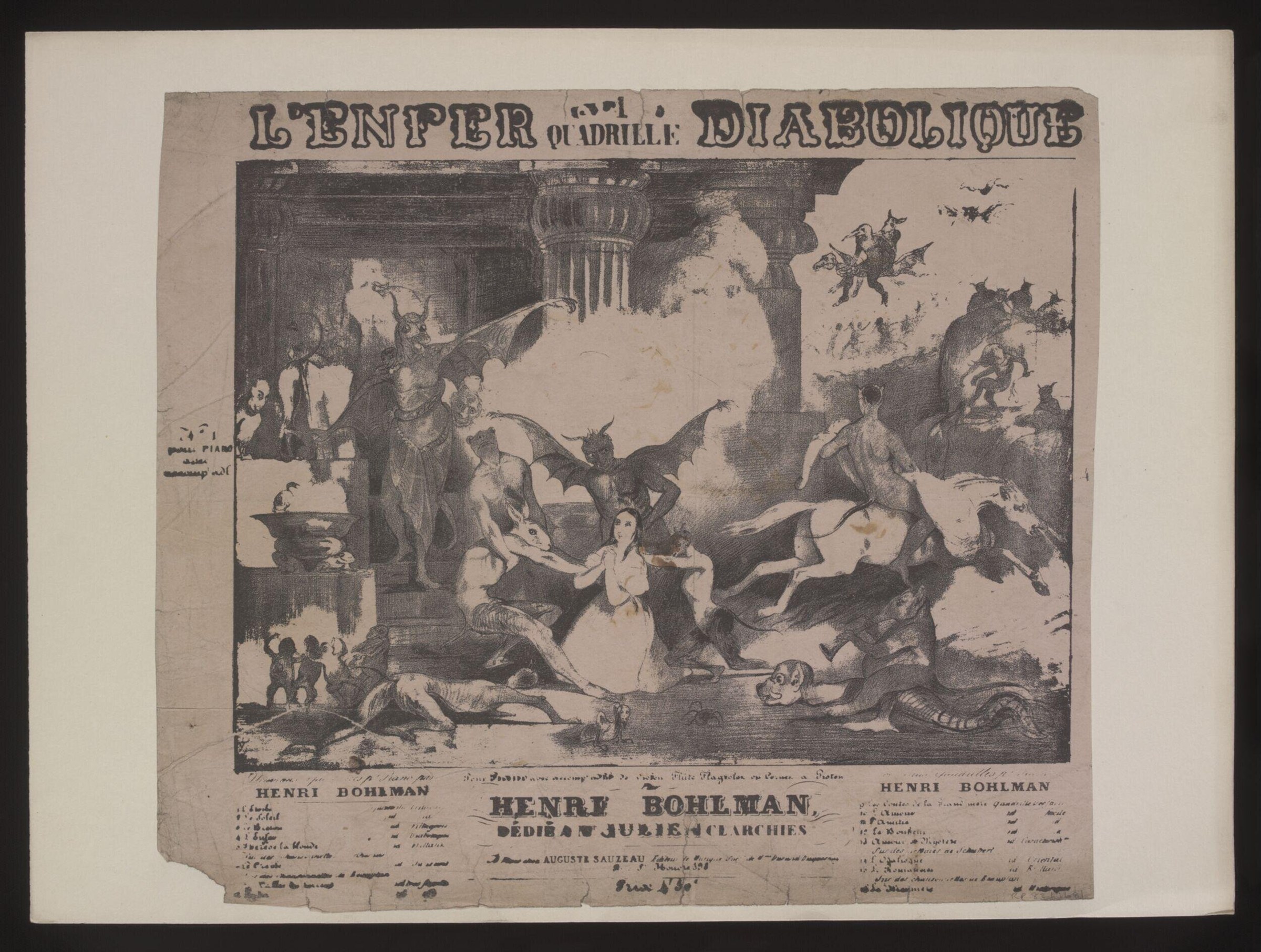
This is a dense, theatrical infernal scene rendered as a satirical print that animates the quadrille—the fashionable ballroom dance—as a demonic celebration. The composition pivots around a central female figure in a pale gown, arms raised, surrounded by winged demons, satyrs, and infernal creatures in various states of grotesque revelry. The setting is architectural: classical columns and archways frame the scene, establishing it as a grand hall or temple, but the space is invaded by smoke, flying figures, and writhing bodies that erase the boundary between ballroom and underworld. In the foreground, pale human dancers—women in light dresses, men in formal dress—move among the darker demonic figures; in the background, more figures caper and fly through a smoky upper register. The entire composition suggests simultaneous worlds: above, an orderly classical interior; within and around it, chaos, lust, and supernatural transgression. Torch-lit and sulfurous, this is a morality print disguised as a dance scene.
The dancing
The central female dancer stands nearly upright with both arms raised—a pose of ecstatic abandon or invocation rather than the closed holds and disciplined frames of actual quadrille technique. Her body is the visual anchor; around her, male and demonic figures lean, grasp, and contort. Male dancers in the middle ground are shown in loose, open positions, some with bodies arched backward or twisted sideways—nothing like the upright posture and precise footwork the quadrille demanded. The demons and satyrs adopt exaggerated, writhing attitudes: wings spread, limbs extended, bodies in impossible flexions. This is a deliberate visual refusal of ballroom discipline: every body says transgression.
The dance depicted
The title names the quadrille explicitly—*L'enfer ou Adrille Diabolique*, the infernal or demonic quadrille. The quadrille was by this date (late 19th century) a standardised ballroom form: four couples, precise geometric figures, strict protocols of hold and deportment. This print inverts that entirely. It uses the quadrille's social prestige as the frame for a satire of fashionable dance as moral corruption—a tradition reaching back to 18th-century prints against the waltz's 'impropriety.' The bodies and groupings have no kinship with actual quadrille structure or technique; instead, the demons and disorder *replace* the dance's rational form with carnival chaos. This is not a document of how the quadrille was danced, but a polemical image using dance as metaphor for social transgression.
How it was made
This is a relief print—likely a wood engraving or steel engraving, given the fine hatching, crisp blacks, and the delicate tonality visible in the smoke and drapery. The medium allowed for mass circulation; this type of satirical dance print was a standard format for popular moral and social commentary in the 19th century, distributed as broadsheets, in periodicals, or bound in albums. The technique's precision suited the detailed costume work and allowed the artist to layer multiple scales of figure (humans, demons, architectural detail) into a single dense composition. The inscription and artist attributions at the base suggest this was published, likely in Paris.
About this work
This is a satirical morality print that weaponises the ballroom quadrille as a metaphor for social and spiritual corruption. Made in the late 19th century as a relief print, it belongs to a centuries-long tradition of attacks on fashionable dance as a site of moral danger—here literalised by replacing dancers with demons and the ballroom with hell. The title and format place it squarely within French popular print culture and moral polemic. For the history of dance, it is valuable not as evidence of how the quadrille was performed, but as evidence of how the quadrille was *feared* and *imagined* by its critics: a space where bodily discipline breaks down and transgression begins. It also documents the quadrille's cultural prominence in the 1880s-90s; no dance merited this level of satirical attention unless it was still widely danced and socially contested.
How to look at it
Attend first to the compositional inversion: the architectural order (columns, arches) is a mere backdrop, overwhelmed by the teeming figures and smoke. The artist has frozen no single moment of the quadrille's geometric progression; instead, the image is a simultaneous scene of multiple bodies and creatures in different postures and attitudes. Notice how the bodies of the human dancers are rendered in lighter tones and more naturalistic anatomy, while the demons are darker, more distorted, and more violently active—the image uses shading and distortion as moral indicators. The central female figure's raised arms are the emotional fulcrum; everything radiates outward from her gesture of abandonment. This is not a scene of discipline or order, but of ecstatic surrender.
The artist
Henri Bohlman (or Bohlman-Sauzeau) was a 19th-century French printmaker active in the tradition of popular satirical and moral prints. The collaboration with Saumeau on this composition, noted in the inscriptions, was typical of print-shop practice, where design, engraving, and publication involved multiple hands. The style and subject matter place him within the market for broadsheet and periodical satire that flourished in France during the July Monarchy and Second Empire.
The period
The quadrille reached peak popularity in Europe in the 1840s-1880s, becoming the standard group dance of middle-class ballrooms. By the 1880s-90s, when this print likely dates, it was being displaced by waltzes and newer forms, but remained socially significant enough to merit satirical attention. The parallel tradition of moral critique of dance was equally long: attacks on the waltz in the 1810s-20s had used very similar rhetorical and visual strategies (transgression, disorder, bodily impropriety). This print is thus both a snapshot of the quadrille's cultural moment and evidence of the enduring structure of dance anxiety in European bourgeois culture.
Where it lives
The work is recorded in the Victoria and Albert Museum collection (London), one of the largest collections of printed satire and design in the world. The V&A's holdings of dance prints and satirical broadsides are exceptional; this work sits within a documented tradition of ballroom satire in the museum's collection.
Dance in this work
Questions about this work
Is this image actually showing how the quadrille was danced?
No. This is a morality satire, not a dance manual. The demonic figures, the chaotic composition, and the absence of the quadrille's strict geometric formations all signal that the artist is making a polemical point about moral corruption, not documenting actual dance technique. For evidence of real quadrille practice, you would need dancing manuals, choreographies, or photographs.
What is the quadrille, and why would anyone satirise it?
The quadrille was a ballroom dance for four couples, performed to precise figures and strict rules of hold and deportment. It was fashionable and respectable, but like all social dances, it was also controversial: critics saw it as a site of bodily proximity, sensuality, and loss of rational control. Satirists used it as a symbol of moral danger and social disorder, especially when highlighting the behaviour of younger dancers or the urban middle class.
Why are there demons in a dance print?
The demons are visual metaphors for moral transgression. In the rhetoric of 19th-century moral critique, fashionable dance was associated with hell, temptation, and the loss of spiritual discipline. By filling the ballroom with devils and satyrs, the artist literalises this metaphor: the quadrille is not merely disorderly, it is infernal. This was a common rhetorical strategy in both text and image.
When was this made?
The catalogue record dates it to the late 19th century (Victorian period, 1880s-1890s), but the exact date is not recorded. The style, printing technique, and cultural context (the quadrille's persistent popularity despite its decline) all support a late date, possibly 1870s-1890s.
More Quadrille artwork