49 works in this view — arrow keys or swipe to move between them.
Dance in Art · 1780
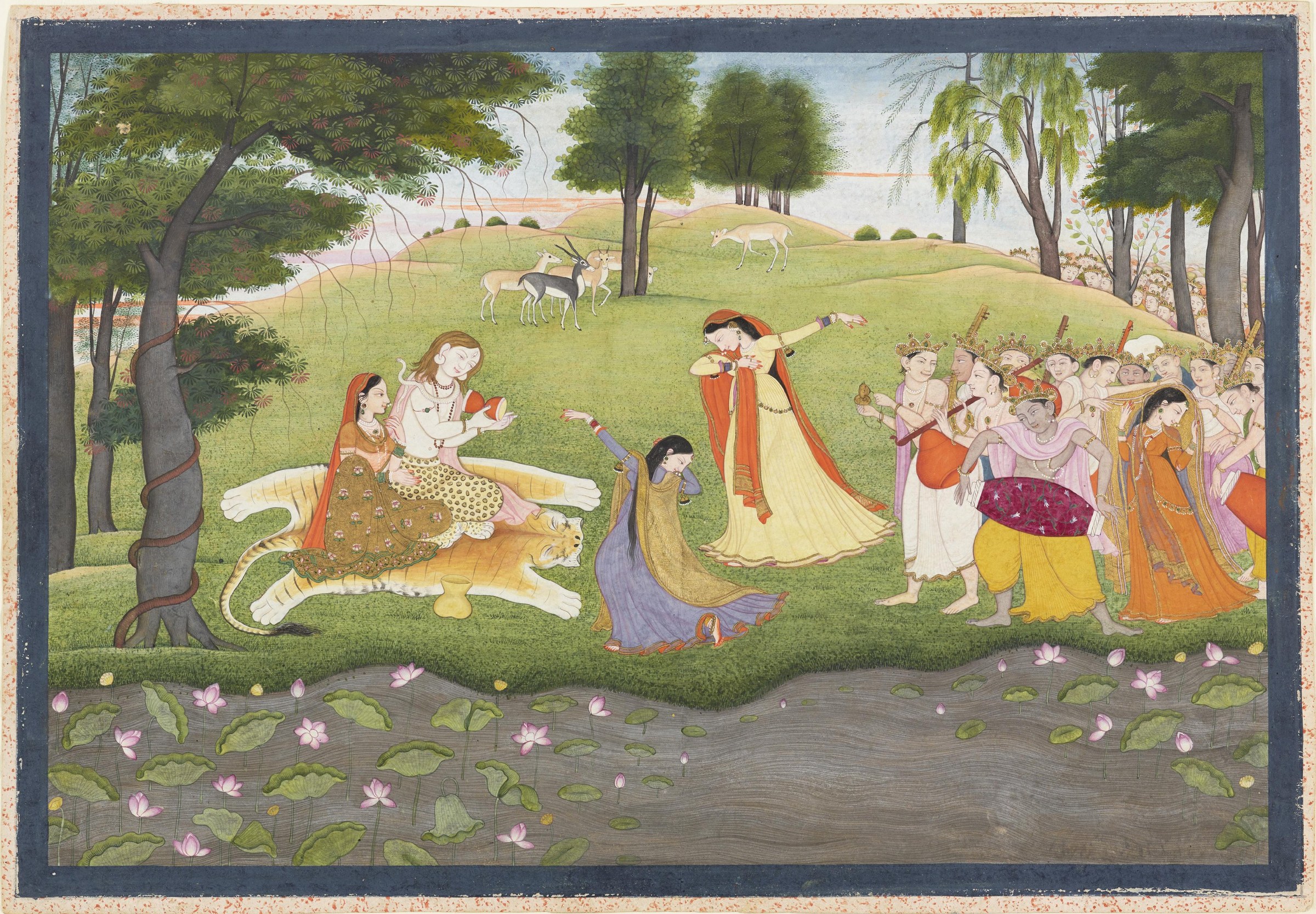
Attributed to Khushala, Indian, active late 18th century - The Gods Sing and Dance for Shiva and Parvati
Khushala, Indian, active late 18th century – Attributed artist (Indian) Details on Google Art Project
- Medium:
- Oil Painting
- Era:
- 1700s (Enlightenment/Minuet Era)
- Source:
- Wikimedia Commons
- Rights:
- Public domain — free to use, share and adapt.
- Recorded as:
- Public Domain
This work is essential for understanding how dance and spectacle were conceived within the Mughal court tradition: not primarily as human bodily practice, but as court entertainment embracing animal performance, costume display, and the gathered gaze of a hierarchical society. It documents the entanglement of religious narrative (the divine couple Shiva and Parvati), imperial power, and sensory pleasure in a specific moment of South Asian artistic production, revealing what kinds of movement and performance an imperial court deemed worthy of recording and celebration.
What you are looking at
This painting depicts a lively court scene set in a palatial garden landscape, rendered in the Mughal miniature tradition. A tiger, depicted with cream-and-black stripes, appears to be dancing or rearing up on its hind legs before two seated figures in the foreground—a woman in jeweled dress and a man in white robes. To the right, a large gathering of courtiers and attendants in brilliant silks—reds, oranges, pinks, yellows—stand or gesture in animated clusters, their bodies turned inward as if watching the performance. The background shows rolling green hills dotted with deer, pavilions, and groves of trees beneath a pale sky. The foreground is bordered by a dark water channel planted with lotus flowers in bloom and bearing lily pads. The composition uses sharp color contrasts and a flattened perspective typical of Mughal court painting, with careful attention to textile patterns and jewelry.
The dancing
The two central seated figures are rendered in profile and three-quarter view, upright and stationary, observing rather than participating. Their hands are raised or gesturing in acknowledgment. The standing courtiers in the crowd display varied poses—some with arms raised, some with hands pressed together, some leaning toward neighbors—suggesting animated conversation and excitement rather than coordinated movement. The tiger, the true performer, is captured mid-leap with front legs extended upward, body arched, demonstrating animal grace rather than human dance technique. The density of the crowd and the spread of figures across the field suggests a formal courtly spectacle rather than partner dance or any structured choreography.
The dance depicted
This is not a depiction of human dance but rather a court entertainment involving an animal performer—a trained or ceremonially presented tiger. The painting records a moment of courtly pleasure and spectacle, likely referencing a real genre of Mughal imperial entertainment in which rare animals were displayed, trained, or featured in processional or staged events. The setting and figures suggest this is a sacred or ritual occasion, possibly celebrating Shiva and Parvati (as the title claims), reimagined as a Mughal court scene. No human dance style is recognisable; the 'dance' is the animal's movement, and the human response is one of courtly observation and celebration rather than participation in choreographed steps.
How it was made
This is an oil painting executed in the Mughal miniature style, despite the relatively large format for that tradition. The technique employs translucent glazes of pigment layered over a prepared ground, allowing the artist to render fine detail in jewelry, textile pattern, and floral elements while maintaining the characteristic flatness and jewel-like colour saturation of Indo-Persian court painting. The use of oil permitted the subtle modelling visible in faces and the luminous quality of the water and sky. The work would have been created for a court manuscript or album (muraqqa), suggesting an audience of imperial or noble patrons and a function within a context of dynastic record, divine celebration, or artistic patronage.
About this work
This painting belongs to the Mughal court art tradition of the late 18th century, a moment when that tradition was absorbing and reflecting upon narrative and spectacular moments within the empire's ritual and entertainment life. The work records a court spectacle—not dance, but an entertainment involving an animal performance before assembled nobility. It is attributed to Khushala, a painter active in the late 18th-century Mughal atelier, and reflects the synthetic religious and courtly sensibility of the period, in which Hindu divine narratives (Shiva and Parvati) were reframed as Mughal imperial spectacle. The painting demonstrates the Mughal court's investment in recording pleasure, magnificence, and the tamed exotic—the controlled wildness of a tiger within a geometrically ordered garden. It appears in a Gallery of Dance as a record of how South Asian courts understood and documented spectacle, festivity, and the body in motion within a formal setting.
How to look at it
Attend first to the tiger's body: the artist has captured a moment of exuberant movement that suggests either trained performance or divine/supernatural energy—the animal is presented as the choreographic centre of the scene, not the assembled courtiers. Notice how the seated couple's stillness and formal posture frame and validate the animal's motion; their gesture and attention direct the viewer's eye to what matters. The painted garden landscape uses a continuous, flattened perspective typical of Mughal miniature painting, allowing multiple moments and spaces (the water garden, the hillside, the gathered court) to coexist on a single plane. The abundance of jeweled detail in dress and ornament is not mere decoration but a record of material wealth and status; the spectacle is one of accumulated magnificence as much as animal performance.
The artist
Khushala (active late 18th century) was a painter working within the Mughal atelier, a tradition of court artists employed to record dynastic events, divine narratives, and courtly pleasures. The attribution is not certain; the work is known through Wikimedia Commons and Google Art Project. Little is documented about Khushala's individual practice, and this painting must be read within the larger context of late Mughal painting, a period of refined miniature technique and increasing European influence, executed for patrons who valued both traditional Indo-Persian imagery and the novelty of new perspectives and techniques.
The period
This work dates to 1780, a moment when the Mughal Empire was politically fragmented but its court culture remained vibrant and artistically sophisticated. The Mughal miniature tradition had been developing for over two centuries by this point and was approaching its final flourishing before the empire's formal dissolution. In European art, 1780 falls within the late Enlightenment and the early Romantic period, a moment when European interest in 'exotic' Asian art was beginning to grow, though this work was created for Indian patrons within an Indian artistic tradition. In South Asian dance and spectacle, the late 18th century saw court traditions (Kathak, temple dance, and courtly entertainments) continuing under regional kingdoms and declining Mughal patronage, with training systems becoming more formalised even as court support fragmented.
Where it lives
The work is held or known through Wikimedia Commons, sourced from Google Art Project. The current institutional holding is not recorded. It is recognised as a Mughal court painting, likely from an imperial album or collection of such works, created for viewing within elite circles as a record of court spectacle and divine celebration.
Dance in this work
Questions about this work
Is this actually dance?
Not in the sense of structured human choreography. The painting records a moment of courtly entertainment centred on a performing tiger, with assembled courtiers as an audience rather than dancers. It belongs in a gallery of dance history because it documents what South Asian courts understood as spectacle and performance worthy of artistic record—a broader definition of 'dance' that includes animal performance, collective gathering, and ritual celebration.
Who are the two seated figures?
The title attributes them to Shiva and Parvati, the divine couple from Hindu mythology. They are depicted in the dress and posture of Mughal courtiers, suggesting a syncretistic reimagining of divine narrative as court spectacle. The seated couple's central position and formal stillness mark them as the focal point around which the entertainment revolves.
What does the water garden mean?
The lotus-filled water channel in the foreground is both a visual frame for the scene and a reference to Mughal garden design, a central element of court pleasure and imperial aesthetics. Mughal gardens were designed as earthly paradises and settings for courtly gathering, music, and spectacle. The inclusion of the garden signals that this is not merely a performance but a ceremonial moment within an ordered, controlled landscape.
Why was this painted in oil rather than the traditional Mughal tempera?
By the late 18th century, oil paint was increasingly adopted within Mughal ateliers, valued for its luminosity and capacity for subtle colour gradation. The choice of oil allowed the artist to render the jeweled quality of textiles and ornament with particular richness while maintaining the miniature painting tradition's precision and flatness.
More dance artwork