49 works in this view — arrow keys or swipe to move between them.
Dance in Art · 1895
BMVB - Desconegut - Escenari de 2 ballarins i públic - 9232
Anonymous
- Medium:
- Oil Painting
- Era:
- Late 1800s (Victorian Ballroom)
- Source:
- Wikimedia Commons
- Rights:
- Public domain — free to use, share and adapt.
- Recorded as:
- Public Domain
The work provides visual documentation of late 19th-century dance performance conventions—particularly the practice of solo male display and the role of spectating (rather than universal participation) in formal entertainment. It captures a moment when social dance was becoming increasingly theatrical and when male dancers in particular were expected to demonstrate virtuosity and energy.
What you are looking at
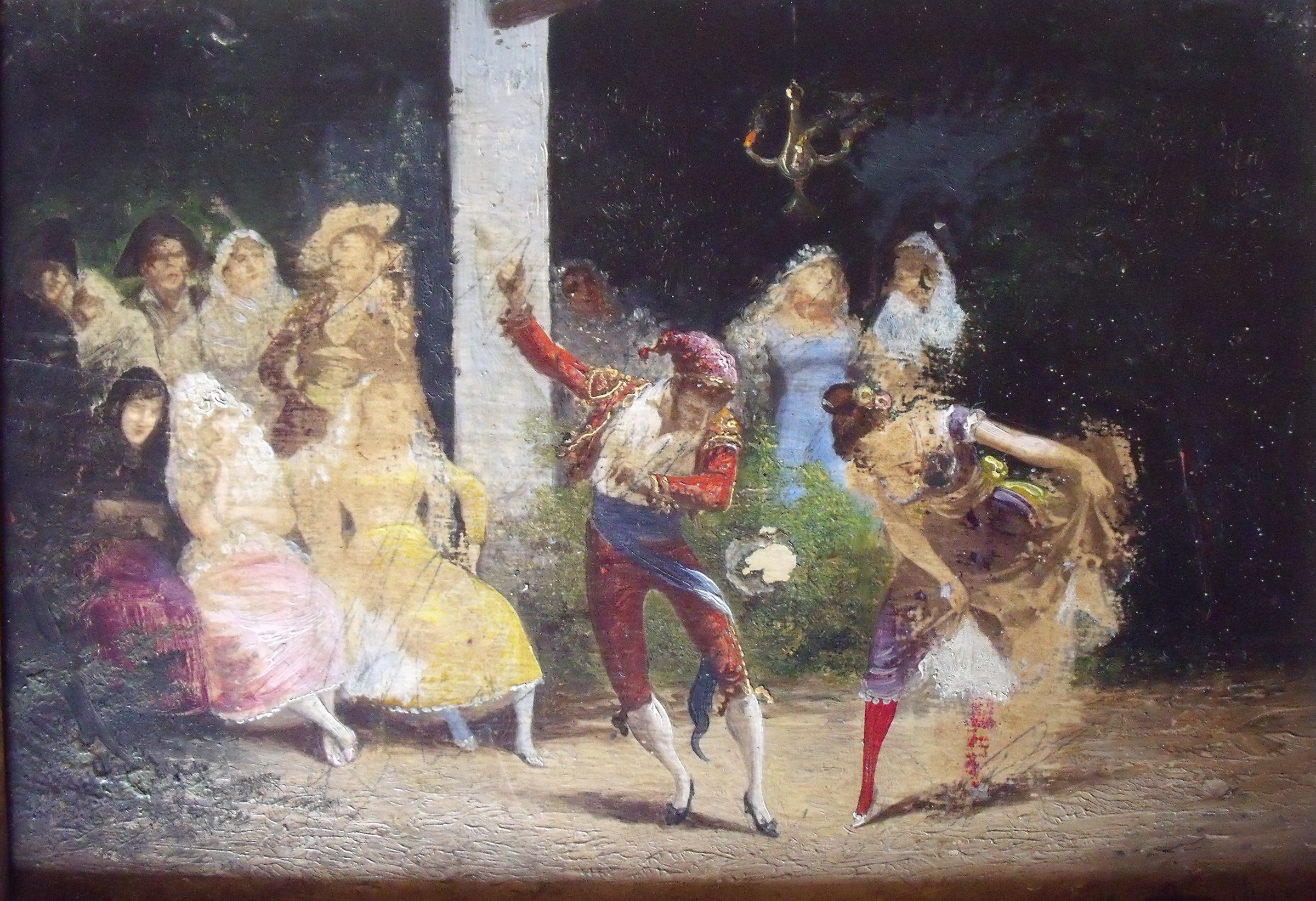
A theatrical scene set beneath a classical colonnade captures a moment of social dance during what appears to be a formal evening entertainment. On the left, a group of women in pale silk gowns and white headdresses stand watching; on the right, a second group of similarly dressed women observes. Between them, in the open space, a single male dancer in a striking red coat and blue breeches executes an energetic step, his body animated and his arm raised. The lighting is theatrical and warm, illuminating the figures against a deep, dark backdrop that suggests an interior space—possibly a ballroom or salon—with the white column rising prominently through the composition. The painting's color and technique suggest late 19th-century academic work, with careful attention to the textures of silk, lace, and skin. The scene captures a moment of display and social performance typical of elite entertainment.
The dancing
The central male dancer stands in an active, upright posture with one arm raised, demonstrating a step that reads as energetic rather than constrained. His weight appears mobile and his leg position suggests a springing or bouncing quality. The female figures flanking him are stationary, arranged in loose groups as spectators; they stand with the upright carriage and composed demeanor of their social rank, their bodies creating a static frame around the dancer's movement. The composition emphasizes his isolation and display—one body in action against many in repose.
The dance depicted
This appears to depict a solo social dance from the Gilded Age, most likely a specialty dance or display piece such as a galop or a variant of country dance performed at a formal evening entertainment. The costume—red coat and blue breeches—suggests theatrical or formal dress rather than everyday clothing, indicating this is a performance or a socially sanctioned solo exhibition. The energetic, springing quality of the dancer's movement and the animated posture are consistent with the character of the galop or similar high-energy dances of the 1890s. The context of spectators and formal dress places this within elite social dance practice, where accomplished dancers were invited to perform solo turns for assembled company.
How it was made
This is an oil painting on paper (as stated in the catalogue), executed in the academic realist style of the late 19th century. The technique demonstrates confident handling of figure drawing, particularly in the rendering of silk textures and the play of theatrical light across surfaces. The warm color palette and the soft modeling of flesh tones are characteristic of academic salon painting. Oil on paper was a less expensive and more portable support than canvas, suggesting this work may have been a study, a preparatory piece, or made for circulation within an artist's collection or among collectors with less formal ambitions than monumental salon pieces.
About this work
This oil painting documents a moment of social and theatrical dance at the height of the Gilded Age, capturing the spectacle and formality of elite entertainment. The work shows a solo male dancer performing a vigorous step before an assembled company of women, frozen in the moment of display and observation that characterized social dancing in the 1890s. The painting belongs within the visual record of historic ballroom and salon dance, offering evidence of how such entertainments were staged, costumed, and valorized in contemporary art.
How to look at it
Attend to the moment the artist has chosen: the dancer is captured in a moment of extension and energy, mid-step, with his body rising and his arm reaching. This is not a moment of repose or symmetry but of kinetic display. The composition uses the white column to separate the performer from the audience, emphasizing the theatrical nature of the entertainment and the social boundary between performer and observer. The careful rendering of the women's still figures and their composed expressions heightens the contrast with the dancer's animation.
The period
The painting dates to 1895, a moment when European ballroom culture was at its height and when dances such as the galop, polka, and waltz had become fixtures of elite social life. This was also the period in which such social dances began to be incorporated into theatrical performance and in which dance itself became an increasingly valued subject for academic painting. The 1890s saw the rise of the 'New Woman' and shifting social expectations around women's participation in public entertainment; the composition of this scene—with the solo male performer and the observing female audience—reflects conventional gender roles of the period while also suggesting the spectatorial pleasure women took in dance performance.
Where it lives
The work is recorded in the Biblioteca Museu Víctor Balaguer in Barcelona (though the current holding is not confirmed in the catalogue). It appears in the museum's collection as a work documenting theatrical and social dance practice.
Dance in this work
Questions about this work
What dance is being performed here?
The specific dance cannot be identified with certainty from the image alone, but the energetic, springing quality of the movement, the male dancer's animated posture, and the formal context suggest a Gilded Age specialty dance such as a galop or a solo country dance turn. The red coat and theatrical setting indicate this is a performance or exhibition rather than a conventional social dance.
Why are the women just standing and watching?
In formal Gilded Age entertainment, social dance often involved moments of solo performance and spectatorial observation. Accomplished dancers, particularly men, would perform solo turns for assembled company. This scene reflects the conventions of the time, where not all participants danced simultaneously and where display and observation were integral to the social and theatrical function of dance.
Is this a painting of an actual event?
This is almost certainly a theatrical genre scene created for exhibition or private consumption, rather than a record of a specific event. The formal composition, academic technique, and careful lighting suggest the artist was creating an idealized or representative image of Gilded Age ballroom entertainment rather than documenting a particular evening.
More dance artwork