49 works in this view — arrow keys or swipe to move between them.
Dance in Art · 1765
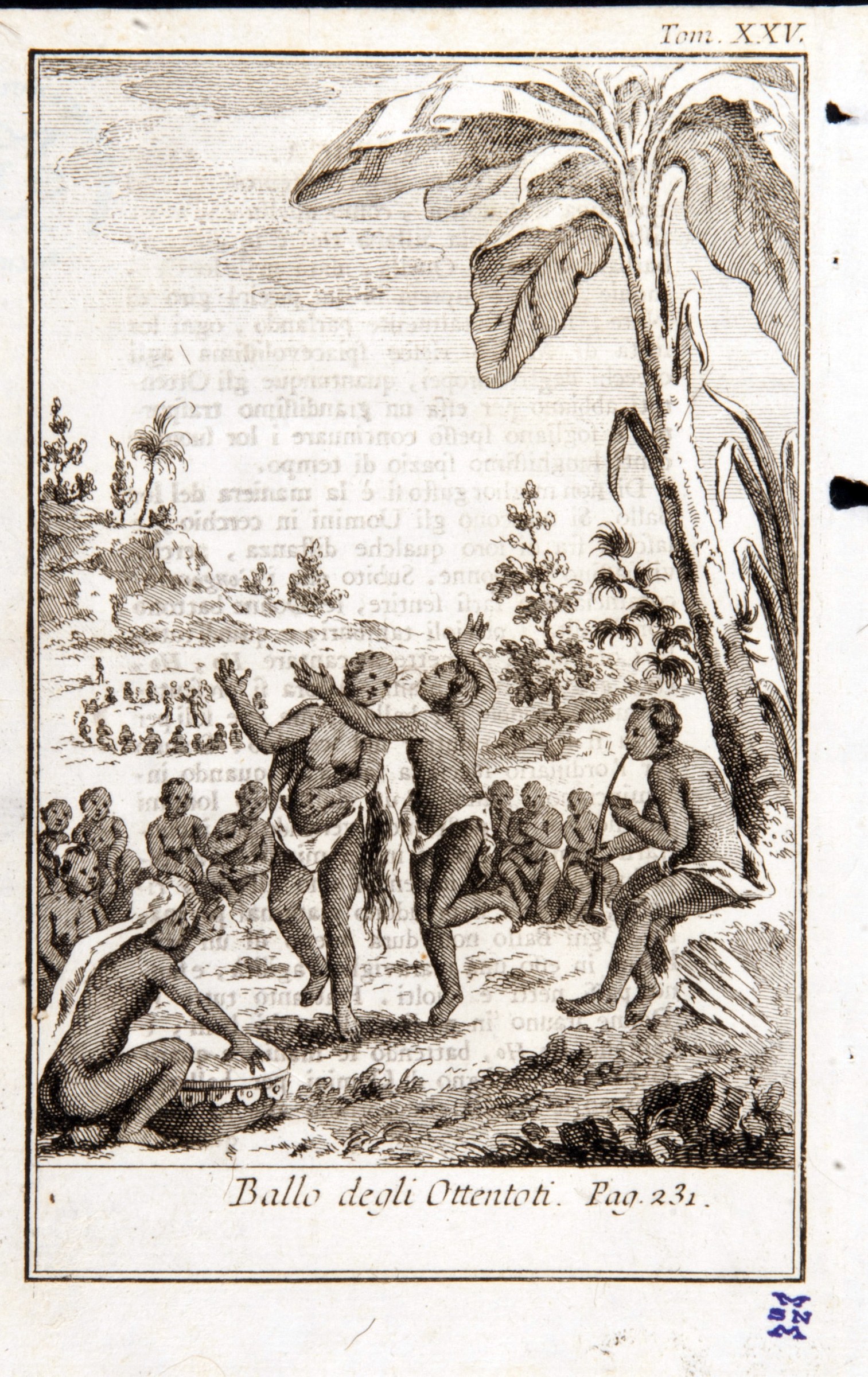
Ballo degli Ottentoti, 1765 – BEIC IE8955117
Unknown artist
- Medium:
- Oil Painting
- Era:
- 1700s (Enlightenment/Minuet Era)
- Source:
- Wikimedia Commons
- Rights:
- Public domain — free to use, share and adapt.
- Recorded as:
- Public Domain
This image illuminates how 18th-century European visual culture constructed ideas about African dance and bodies at the height of the slave trade and early colonialism. It shows the power of engraved reproduction to create and circulate a particular vision of 'otherness,' and it raises critical questions about how dance history has inherited and often uncritically repeated such representations.
What you are looking at
A large gathering of nude or lightly clothed figures occupies a rocky, mountainous landscape under a clouded sky. Two central figures—a man and a woman—dance together in energetic poses, their bodies in dynamic motion with raised arms and bent legs suggesting vigorous movement. The woman's long hair flows loose. Around them, dozens of onlookers sit and stand on rocky outcrops, observing the performance. Tall banana or palm-like plants frame the composition on the right and upper left, establishing a tropical setting. The foreground includes seated figures in various postures of attention, while the middle ground shows standing spectators clustered on elevated ground. The entire scene conveys a moment of communal gathering and festive activity, rendered in brown-ink engraving with careful cross-hatching to create depth and shadow.
The dancing
The two central dancers occupy contrasting positions: the man stands with legs bent in a wide stance, torso upright and arms raised dynamically, suggesting athletic exertion; the woman beside him adopts a similarly energized posture with raised arms and bent knees, her body turned slightly toward her partner. Neither dancer wears shoes, and both are essentially unclothed or wear minimal coverings. The surrounding figures—numbering at least thirty to forty—sit in informal groups or stand in loose ranks, their postures ranging from seated attention to standing observation. The composition privileges the central dancers' movement while organizing the crowd around them as witnesses rather than participants.
The dance depicted
This engraving purports to depict the dance of the Hottentots (Khoikhoi people of southern Africa), a subject that became common in European illustrated ethnographies during the 18th century as travel accounts and colonial knowledge circulated. The vigorous, bent-knee movement and energetic arm-raising visible here align with descriptions in European travel narratives of Khoikhoi social dances, though these accounts were filtered through colonial observation and often distorted by European preconceptions. The communal setting, with dancers and witnesses together in a bounded space, reflects how such performances functioned as social events within their actual contexts. However, the image is a European artistic interpretation, not documentation: the artist has composed and dramatized the scene according to 18th-century aesthetic conventions rather than eyewitness accuracy.
How it was made
This is a brown-ink engraving on paper, a reproductive print technique that allowed the image to circulate widely in illustrated books and collections. Engraving's crisp lines and fine cross-hatching permitted the artist to render both landscape detail and the nuanced musculature of the human figures, creating a sense of naturalistic study even in a highly conventionalized composition. The technique was ideal for the production of ethnographic illustrations—repeatable, affordable, and suited to the detailed rendering of dress, ornament, and bodily form that European audiences expected from images of distant peoples. The image's presence in a bound volume (indicated by the page reference 'Pag. 231' at the bottom) suggests it was part of a larger illustrated compendium, likely a travel narrative or natural history encyclopedia.
About this work
This 1765 engraving depicts a scene titled 'Ballo degli Ottentoti' (Dance of the Hottentots), presenting a European representation of Khoikhoi people of southern Africa engaged in a communal dance. The work belongs to the 18th-century genre of ethnographic illustration, wherein European artists created images of non-European peoples and practices based on travel accounts, colonial reports, and artistic imagination. The engraving circulated as a page in an illustrated compendium, contributing to European knowledge—or rather, to European constructions—of African dance and social life.
The image is significant not primarily as documentation of actual Khoikhoi dance (which it is not) but as evidence of how Europeans in the Enlightenment period visualized and represented non-European bodies, movement, and sociality. The vigorous, unclothed figures and the energetic, bent-knee dancing visible here encode European assumptions about African physicality, proximity to nature, and uninhibited expression. The work thus belongs in a dance history that attends to representation, power, and the visual archive through which colonial knowledge was made.
How to look at it
Observe the artist's choice to freeze the moment at the height of exertion: the bent knees, raised arms, and dynamic postures of the central dancers create a sense of vigorous motion even in a static image. Notice how the engraver has used the surrounding crowd to frame and authorize the central action—the seated and standing figures direct attention to the dancers and lend ethnographic weight to the scene. The landscape—rocky, sparse of formal cultivation—reinforces European associations between African peoples and nature. The complete nudity of the figures was a European convention for depicting 'primitive' or 'natural' peoples, not necessarily an accurate representation of actual dress or practice.
The period
The 1760s saw intense European curiosity about non-European peoples and practices, driven by expanding colonial contact, travel narratives, and the Enlightenment appetite for comprehensive natural and cultural knowledge. Illustrated ethnographic compilations were popular among educated European readers. Dances of distant peoples were among the subjects represented in these works, often based on secondhand accounts and filtered through European artistic conventions. During this same period, European dance itself—particularly the minuet and court dances—was becoming the subject of refined study and written instruction, establishing a stark contrast with how non-European dance was depicted as instinctive, physical, and unrefined.
Where it lives
The image comes from Wikimedia Commons and bears the identifier BEIC IE8955117, indicating it is held in or catalogued by a digital collection (likely the Biblioteca Europea di Informazione e Cultura or a partner institution). The page reference 'Pag. 231' suggests it was an interior illustration in a bound volume, most likely an illustrated travel narrative or ethnographic encyclopedia of the 1760s. The holding collection and complete provenance are not recorded.
Dance in this work
Questions about this work
Is this a reliable depiction of how Khoikhoi people actually danced?
No. This is a European artistic interpretation based on travel accounts and colonial hearsay, not eyewitness documentation. The engraver worked according to 18th-century European aesthetic and ethnographic conventions, and the image encodes European assumptions about African physicality and 'primitive' expression. It tells us more about European attitudes than about actual Khoikhoi dance practices.
Why are the figures nude?
Nudity was a European convention for depicting 'natural' or 'primitive' peoples in the 18th century. It served to emphasize perceived difference from clothed European civilization and to link non-European peoples to nature rather than culture. This reflected European colonial ideology rather than accurate representation of dress.
What does the landscape setting suggest?
The rocky, sparsely vegetated terrain with tropical plants reflects European associations between African peoples and wild or uncultivated nature. The setting was chosen to reinforce a particular narrative about African life as existing outside European civilization and refinement.
How did this image circulate?
As an engraving, it was a reproducible print bound into an illustrated volume—likely a travel narrative or ethnographic encyclopedia. This allowed it to reach educated European readers and to shape their understanding of African peoples and practices. Repeated circulation of such images made them appear authoritative even when based on limited or distorted sources.
More dance artwork