33 works in this view — arrow keys or swipe to move between them.
Dance in Art
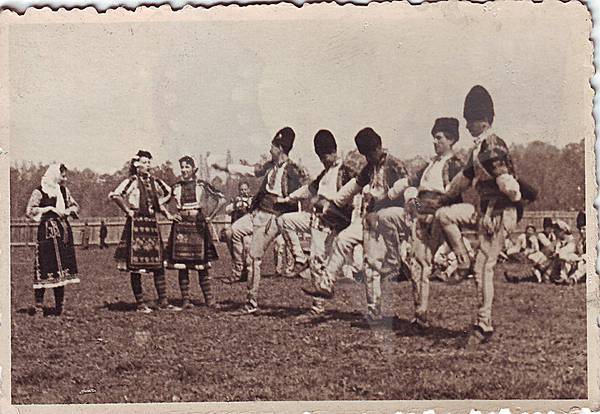
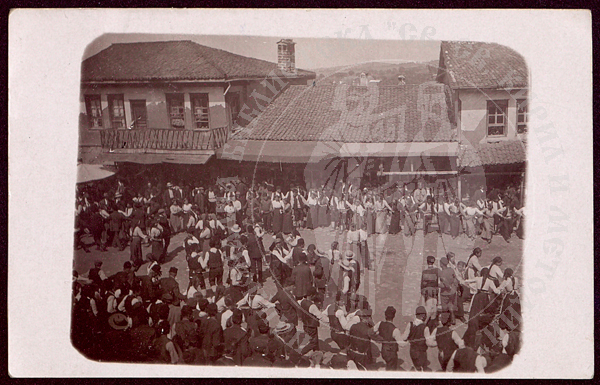
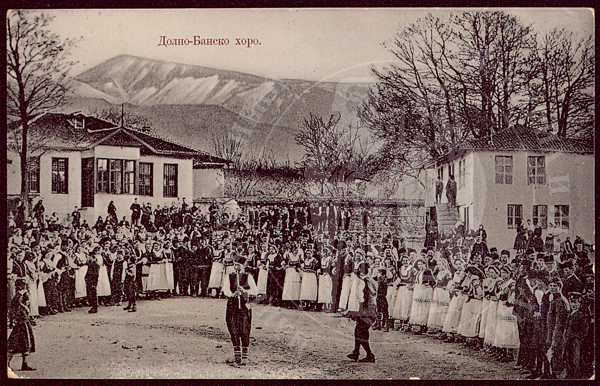
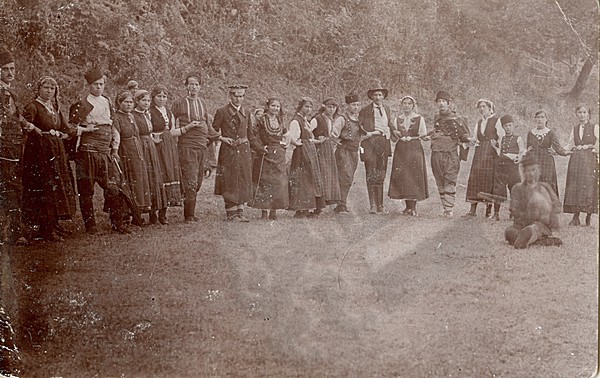
Folk dance in Boykovo
Unknown artist
- Dance:
- Folk/Country
- Rights:
- Not recorded. Do not assume this image is free to reuse — check the source record.
Early photographs of folk dance in Eastern European communities are rare and fragile records of practice that was largely unwritten and undocumented through conventional means. This image captures the social infrastructure of folk dance—the gathering, the community, the moment of assembly—rather than the dance itself, revealing how folk tradition lived as lived practice, not staged performance. For historians of dance and ethnography, such photographs are primary evidence of cultural continuity and change across the 20th century.
What you are looking at
A large group of people stands in a loose circle or gathering in an outdoor setting, photographed from above in what appears to be early photographic documentation. The image is grainy and faded, characteristic of early 20th-century photography. The figures are arranged informally across bare ground, many wearing long skirts and period clothing typical of the 1900s–1920s era. The composition suggests a moment of collective pause or assembly rather than active performance—some figures stand upright, others appear more relaxed in posture. The outdoor, rural setting and the casual arrangement of the group suggest this may document a community gathering or folk celebration rather than a formal staged dance.
The dancing
The group comprises approximately 20–30 people of mixed apparent ages and genders, with women in long skirts predominating. Bodies are largely vertical and stationary, with little evidence of synchronized movement or the dynamic partnering typical of ballroom or theatrical dance. Most figures stand independently rather than in pairs or lines. The posture is generally upright but informal, without the rigid frame or extended line of trained dancers. The loose dispersal suggests observation or assembly rather than active participation in structured choreography.
The dance depicted
This image most likely documents a folk gathering rather than a dance performance in progress. The title 'Folk dance in Boykovo' and the catalogue designation as folk/country dance suggest this records a community social occasion in what is now Ukraine or a neighboring region. However, the photograph captures a moment of stillness—figures assembled, perhaps between dances, during a break, or posed for documentation. Without visible active footwork, partnering, or spatial organization characteristic of any specific folk dance tradition, the image functions as social or ethnographic documentation rather than a record of performed movement.
How it was made
This is a black-and-white photograph, likely taken with an early hand-held or field camera. The image quality—graininess, fading, and sepia toning—is consistent with gelatin dry-plate or early film stock from approximately 1900–1930. The perspective suggests the photographer stood at or near ground level, documenting the scene directly. The photographic medium allowed portable, objective recording of folk practice in situ, though the monochrome format and technical limitations obscure fine details of dress, landscape, and individual expression. This was likely made as ethnographic or documentary record rather than for artistic or commercial circulation.
About this work
This photograph documents a folk community gathering in Boykovo, likely in the early 20th century, capturing a moment of assembly during or between dance activities. The subjects are largely stationary, dressed in period clothing from the 1900s–1920s, arranged informally outdoors. It functions as ethnographic documentation of folk social practice rather than a record of active choreography or performance. The image belongs in a dance archive as evidence of how folk tradition was practiced and recorded in its social context, and as testimony to the role of photography in preserving endangered cultural knowledge.
How to look at it
Look at the spatial arrangement and posture rather than at active movement. The photographer chose to document the social assembly rather than the dynamic moment of dance itself, freezing the gathering at a moment of pause or transition. This choice tells us something important: folk dance was not primarily a spectacle for external viewers but a social activity embedded in community life. Attend to the dress, the outdoor setting, the loose informality of grouping—these are the markers of folk practice as lived experience rather than performance tradition. The photograph's perspective and the ground-level vantage point suggest the photographer was a participant or intimate observer rather than a distanced documentarian.
The period
In the early 20th century, before film and sound recording, still photography was the primary tool for documenting folk practice in rural and remote communities. European ethnographers and cultural collectors increasingly turned to the camera to record folk dance, dress, and social custom as industrialization and migration threatened traditional practice. The Boykovo region (in historical Bukovina or Bessarabia, areas of complex ethnic and political identity) would have been of particular interest to collectors seeking evidence of distinct folk traditions. This photograph sits within a broader documentary impulse—part fieldwork, part preservation—that shaped how folk dance entered the archive and how it is understood today.
Where it lives
The work is held in the Europeana digital collection, a pan-European digital library aggregating cultural heritage from participating institutions. The original holding institution is not identified in the available record. The photograph was likely created as part of early 20th-century ethnographic or cultural documentation, possibly by a traveling photographer, local recorder, or visiting researcher.
Dance in this work
Questions about this work
Is this a photograph of actual dancing?
No. The image captures a moment of assembly or pause rather than active dance. The figures are largely stationary and informally arranged. The photograph documents the social gathering and community context in which folk dance took place, not the choreography itself.
Where is Boykovo?
Boykovo likely refers to a community in what is now Ukraine, Moldova, or a neighboring region of historical Bukovina or Bessarabia. The name suggests a Slavic locality, though the precise location cannot be confirmed from the photograph alone. The region was known for distinct folk traditions and was of interest to early 20th-century ethnographers.
When was this photograph taken?
The catalogue record lists the date as unknown, but the photographic quality, style of dress, and documentation method suggest early 20th century, most likely 1900–1930. The clothing—long skirts, period coats and hats—and the technology of the camera support this approximate dating.
Who took this photograph?
The artist or photographer is not recorded. The image was likely made by a traveling photographer, ethnographic documentarian, or community recorder during fieldwork in the region. Without more information, the maker's identity and intention remain unknown.
More Folk/Country artwork