31 works in this view — arrow keys or swipe to move between them.
Dance in Art · 1875
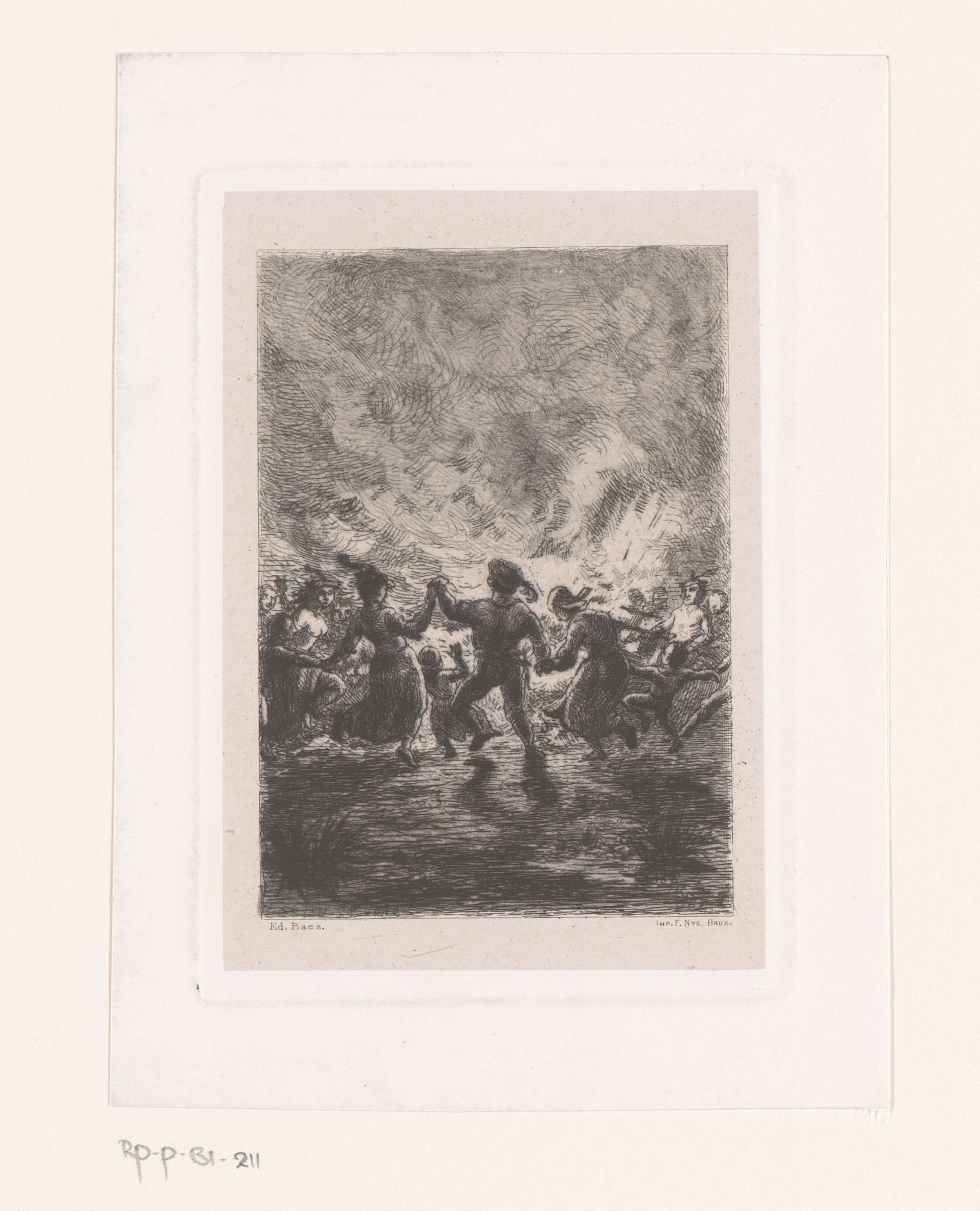
Rondedans om een vreugdevuur, RP-P-BI-211
Unknown (Rijksmuseum collection)
- Medium:
- Oil Painting
- Dance:
- Folk/Country
- Era:
- Late 1800s (Victorian Ballroom)
- Source:
- Wikimedia Commons
- Rights:
- Public domain — free to use, share and adapt.
- Recorded as:
- CC0
The image is one of the few contemporary visual documents of the ronde as a living folk practice in 19th-century Europe, showing the form in its actual social context rather than as a staged or codified performance. For historians of folk dance and vernacular culture, it provides specific evidence about participation, scale, setting, and the relationship between dance and communal ritual. The etching technique and its circulation as a refined art print also reveal the 19th-century fascination with folk authenticity and the aestheticization of working-class culture.
What you are looking at
A bonfire celebration, rendered in etching, captures a moment of social dancing in what appears to be a rural or working-class setting. A group of figures, numbering roughly a dozen, are arranged around or near a bright fire that dominates the upper half of the composition. The fire is depicted with vigorous cross-hatching that creates a sense of warmth and movement. The figures below are rendered in darker tones, their forms somewhat simplified but their postures active and engaged. They stand in or near shallow water or wet ground, their clothing suggesting 19th-century dress. The scene has the character of a folk celebration—informal, communal, and tied to the landscape. The composition is intimate and crowded; there is no clear focal point but rather a sense of collective participation. The lighting is theatrical, with the fire providing the primary illumination.
The dancing
The dancers occupy a loose circular or scattered formation around the fire, suggesting a ronde or round dance. Most figures appear to be standing upright, with some bodies angled toward the fire or toward each other. The postures are informal rather than balletic; there is a sense of swaying or gentle movement rather than formal technique. Arm positions are not clearly distinguished in the etching's graphic language, but the overall impression is of bodies moving together without rigid partnering. The number of participants and their loose arrangement suggest a participatory, community-based dance rather than a performance for an audience.
The dance depicted
The title *Rondedans om een vreugdevuur* (Circle Dance Around a Joy-Fire) explicitly names the form: a round dance, or ronde, performed in a circle around a bonfire. This is a folk tradition with deep roots in European culture, particularly in Low Countries and Germanic regions, often associated with seasonal celebrations, harvest festivals, and communal gatherings. The image shows the democratic, non-hierarchical character of such dances—multiple participants of varying ages and stations gathered for shared movement and celebration. The setting near water and fire, combined with the informal dress and loose formation, places this firmly in the tradition of peasant or working-class festivity rather than ballroom or courtly dance.
How it was made
This is an etching with dry-point work, printed on chine collé (thin Asian paper adhered to a backing sheet), a technique that allows fine linear detail and tonal variation. The catalogue attributes it to Edgar Alfred Baes as the printmaker, with F. Nys as the printer, dated 1875 and produced in Brussels. The etching technique enabled the artist to render both the vigorous marks of the fire and the delicate articulation of the figures below. The use of chine collé suggests a refined art print intended for a cultivated audience rather than popular broadsheet circulation. The technique's capacity for subtle tonal gradation is fully exploited in the contrast between the bright, agitated fire and the darker, more tonally complex figures.
About this work
This is a 19th-century Belgian etching documenting a folk tradition—the ronde or circle dance performed around a bonfire—rendered by artist Edgar Alfred Baes in 1875. The work belongs to a broader 19th-century interest in folk culture and peasant life, an interest shared by artists, ethnographers, and romantics seeking authentic national traditions. It is a rare graphic record of how a specific form of participatory dance was actually performed in the artist's own time, capturing not the formalized or theatrical version but the lived practice in a rural or working-class setting. The print preserves both the social structure of the dance (a circle, communal, non-exclusive) and its occasion (festivity, fire, night).
How to look at it
Focus first on the composition: the fire occupies the upper, brighter portion of the image, while the dancers are below, in shadow and in contact with the ground or water. This creates a visual hierarchy that makes the fire the source of light, warmth, and meaning—the dancers are gathered *around* it. Note the artist's choice to depict the moment not as a frozen tableau but as an ongoing event; the figures are in motion, not posed. The etching's linear technique—visible in the cross-hatching of the fire and the finer lines of the figures—gives the work a documentary quality, as if the artist were recording an observed event. Look at how the bodies relate to one another: they are not in closed partnerships or formal lines, but in a looser, more organic arrangement suggestive of genuine communal participation.
The artist
Edgar Alfred Baes (1834–1894) was a Belgian painter and printmaker active in Brussels during the second half of the 19th century. He is documented here as the creator of this etching, with printer F. Nys. Baes worked in the period when Belgian and Northern European artists were increasingly turning to folk subjects, rural life, and national traditions as sources for artistic legitimacy and content. The choice to render a folk bonfire dance as a fine-art etching is consistent with broader European Romantic and Realist interests in capturing authentic, premodern cultural practices.
The period
The 1870s were a period of intense interest in folk culture across Northern Europe, driven by nationalism, Romanticism, and early ethnographic curiosity. In Belgium and the Low Countries, this manifested in efforts to document and preserve folk traditions—music, dance, costume—as markers of national identity. Simultaneously, the rise of the printed art market and the refinement of etching techniques made it possible to create small-edition works on folk subjects for educated, middle-class collectors. The bonfire dance itself has ancient roots in European seasonal and ritual practice, but by the 1870s it was becoming historicized, studied, and aestheticized by artists and scholars. This print sits at the intersection of folk preservation and artistic ambition.
Where it lives
The work is held in the Rijksmuseum collection in Amsterdam (accession RP-P-BI-211) and entered the collection with a collector's mark (Lugt 2228). It is documented as part of an album of prints, though the full album context is not recorded in the available catalogue data. The etching was produced in Brussels in 1875 by printmaker Baes and printer F. Nys.
Dance in this work
Questions about this work
What is a ronde or Rondedans?
A ronde is a circle dance, a form of participatory social dancing in which a group of people stand in a circle or loose ring and move together, often to music or singing. The ronde has ancient roots in European folk tradition and was performed at festivals, celebrations, and communal gatherings. It is egalitarian in structure—no fixed roles or hierarchy—and inclusive, allowing anyone present to join. This particular dance is associated with bonfire celebrations and harvest festivals.
What does the fire represent?
The bonfire (vreugdevuur, literally 'joy-fire' in Dutch) is both a practical light source and a ritual focal point. Bonfires were central to many European folk celebrations, particularly those tied to seasonal transitions, harvest, or midwinter festivals. The fire provided warmth and illumination for night dances and carried symbolic associations with purification, community, and festivity. In this image, it is the reason for the gathering and the center around which the dance organizes itself.
Who would have danced this dance?
The ronde was a folk or working-class dance, performed by rural and urban laborers, peasants, and lower-class communities. Unlike ballroom dances of the same period, which were formalized, taught, and restricted to those who could afford instruction, the ronde was learned by participation and was accessible to anyone. The informal dress of the figures in this print and the outdoor, communal setting suggest people of modest means gathering for collective celebration.
Why would a fine artist create a print of a folk dance?
By the 1870s, folk culture and folk traditions were being actively collected, studied, and aestheticized by educated Europeans interested in national identity, authenticity, and pre-industrial life. Creating fine-art prints of folk subjects was a way to elevate and preserve those traditions while also producing art for sale to middle-class collectors. The choice to depict a bonfire dance reflects both genuine ethnographic interest and Romantic-era nostalgia for a supposedly more authentic, premodern way of life.
More Folk/Country artwork