36 works in this view — arrow keys or swipe to move between them.
Dance in Art
Folk dance
Unknown artist
- Dance:
- Folk/Country
- Rights:
- Not recorded. Do not assume this image is free to reuse — check the source record.
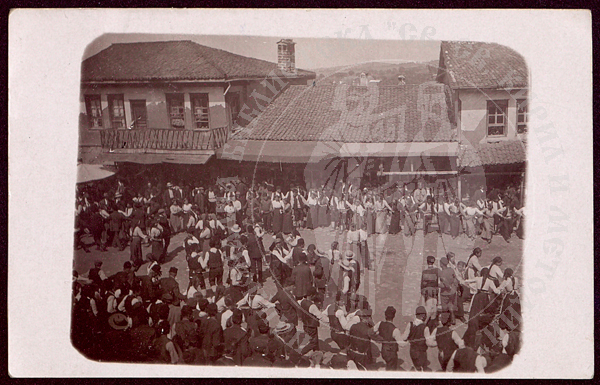
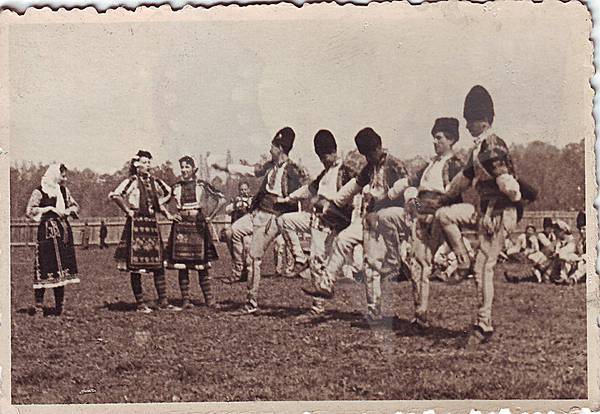
This photograph preserves a moment of community folk celebration and provides direct visual evidence of how regional dance was performed, dressed, and organized in the early twentieth century — data that written or literary sources cannot supply. For dancers and historians, the image is valuable precisely because it was not staged for theatrical effect; it shows how the tradition actually looked in lived practice. The photograph also documents the ethnographic gaze of the era — how Europeans chose to record and represent their own folk traditions during a period of rapid modernization.
What you are looking at
A sepia-toned photograph captures a folk dance performance or gathering outdoors in an open field, with bare trees visible in the distant background suggesting autumn or early spring. The composition centers on a group of dancers arranged in loose formation, most wearing traditional or regional dress — long skirts, vests, and embroidered or patterned garments that suggest Eastern European or Central European origin. Several figures wear tall headdresses or hats. The dancers occupy the middle ground; at left, two or three figures in darker dress (possibly musicians or observers) stand apart. The photograph's depth of field and composition suggest this is a documentary or ethnographic record rather than a staged theatrical performance, though the gathering of multiple dancers in coordinated dress indicates a planned event or celebration.
The dancing
The dancers stand and move in small clusters rather than in tight geometric patterns. Most are upright or in motion with arms raised, extended, or gesturing outward — the postures suggest active, celebratory movement rather than the controlled vertical carriage of classical dance. Several figures appear to be mid-step or mid-gesture, captured in dynamic poses. The grouping is loose and organic; there is no evidence of the synchronized, mirrored hold or frame characteristic of ballroom or courtly dance. The dress and deportment suggest participants of varied social standing or age, typical of community folk celebrations.
The dance depicted
This appears to be a regional or national folk dance, most likely from Central or Eastern Europe — possibly Hungarian, Romanian, Serbian, Polish, or Ukrainian based on the style of dress and headdresses visible. The outdoor setting, the informal grouping, the mix of ages and dress, and the documentary quality of the photograph all point to a recorded folk tradition or celebratory gathering rather than a theatrical performance. Without more specific geographic or textual context, the exact dance form cannot be identified with confidence, but the evidence strongly supports classification as folk or regional social dance. The headdresses worn by some figures are particularly significant markers of regional or ethnic identity.
How it was made
This is a gelatin silver or albumen photograph, printed in sepia tones, on card stock with a decorative scalloped edge — a format consistent with early-to-mid twentieth-century photography, possibly 1910s–1930s. The paper's aged appearance and tone are consistent with prints from that era. The photograph's outdoor lighting is diffuse and natural, suggesting daylight in an open field. The image quality and depth suggest a hand-held or tripod-mounted camera. As a photograph, this work served documentary or ethnographic purposes, likely created to record disappearing folk traditions or to illustrate national or regional cultural identity — a practice that was widespread in Europe during the early twentieth century.
About this work
This sepia photograph documents a folk dance celebration or gathering in an outdoor setting, capturing multiple dancers in traditional regional dress engaged in what appears to be spontaneous or loosely coordinated movement. The image is a record of community-based folk tradition rather than theatrical performance, created at a time when European photographers and ethnographers were systematically documenting regional and national dance practices. The documentary quality, the informal grouping, and the specificity of dress all mark this as an image of living cultural practice rather than a staged or choreographed work. It belongs in a dance archive both as evidence of how folk traditions were performed in the early twentieth century and as an artifact of the documentary impulse that shaped how modern societies recorded and preserved dance.
How to look at it
Notice the variety of dress and headdress — the tall, distinctive hats or crowns worn by some figures are regional markers and deserve close attention, as they often indicated specific towns, social status, or occasions. Look at the arm positions and the way bodies are oriented: the dancers are not in closed partnership or geometric formation, but rather in a looser, more organic grouping, with arms often raised or extended outward — characteristic of many folk traditions where individuals contribute to a collective pattern rather than following a single choreographed sequence. The outdoor setting and the presence of what appear to be non-dancing figures at left suggest this is a social or celebratory event, not a formal performance.
The period
The early twentieth century saw an intense European interest in documenting folk traditions and regional dances as modernization and industrialization threatened to erase them. Photography, still a relatively new medium, became a tool for ethnographic and cultural preservation. Many European nations conducted systematic surveys of folk dance and costume, driven both by nationalist sentiment (the desire to establish distinctive national culture) and by genuine anthropological interest. This photograph sits within that broader project — it was created to record and preserve a dance form that was understood to be at risk of disappearing. The scalloped-edge card mounting is consistent with formal photographic documentation of the era.
Where it lives
The photograph is held in the Europeana digital collection, a federated repository of cultural heritage materials from European institutions. Europeana does not specify the original holding institution or accession number in its standard metadata.
Dance in this work
Questions about this work
Where is this dance from?
The photograph does not include identifying text or geographic markers. The style of dress — long skirts, embroidered vests, and distinctive headdresses — suggests Central or Eastern Europe, possibly Hungary, Romania, Serbia, Poland, or Ukraine, but the exact region cannot be determined from the image alone. The Europeana record provides no additional geographic information.
When was this photograph taken?
The catalogue record lists the date as unknown. The style of the photograph — the sepia tone, the cardboard backing with a scalloped edge, and the quality of the print — are consistent with early-to-mid twentieth-century photography, likely 1910s–1930s, but this is an estimate based on the photograph's technical and material characteristics, not a confirmed date.
Is this a staged performance or a real folk celebration?
The evidence strongly suggests this was a real gathering rather than a theatrical staged piece. The informal grouping, the mix of dancers and apparent non-dancers, the outdoor field setting, and the documentary quality of the photograph all indicate this is a record of an actual folk celebration or community event, not a performance arranged for the camera.
What do the headdresses tell us?
In folk traditions across Europe, headdresses were often highly specific to region, community, or occasion. The tall or distinctive hats and crowns visible in this photograph were likely markers of local identity, marital status, or the nature of the celebration. They are one of the most informative visual elements in the photograph, but without additional context, their specific meaning cannot be determined.
More Folk/Country artwork