28 works in this view — arrow keys or swipe to move between them.
Dance in Art
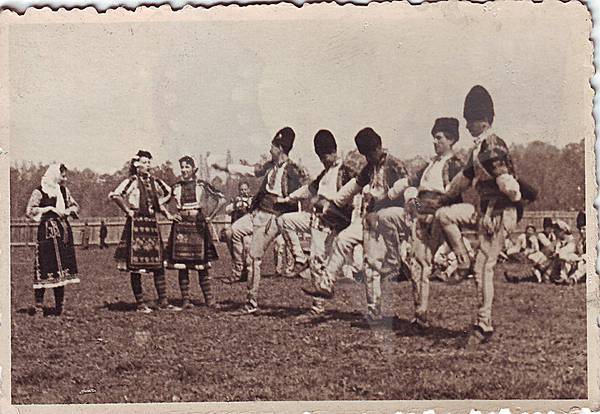
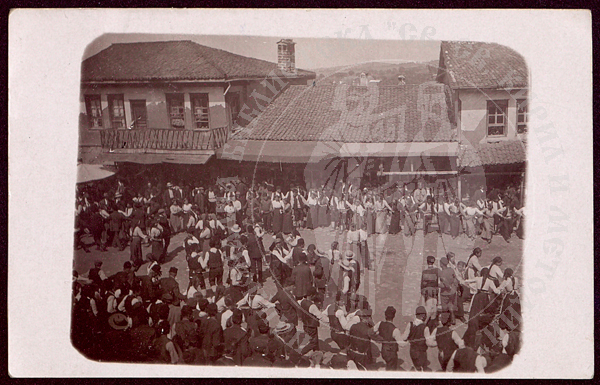
Folk dance in Perushtitsa
Unknown artist
- Dance:
- Folk/Country
- Rights:
- Not recorded. Do not assume this image is free to reuse — check the source record.
This photograph is one of the few surviving visual records of Balkan village dance as a lived social practice rather than a performed or reconstructed tradition. It shows us the scale of participation, the community investment, and the generational transmission that made folk dance central to village life—information that cannot be recovered from costume collections, music recordings, or later stage reconstructions alone. For historians and dancers alike, it represents irreplaceable evidence of how the dances were actually danced: who participated, how many, and in what setting.
What you are looking at
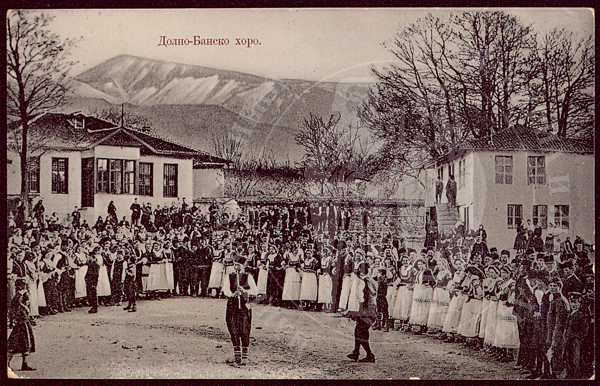
A photograph documents a large community gathering in what appears to be a Balkan village square, with a densely packed crowd of men, women, and children occupying the central space between traditional buildings. The scene is shot from an elevated vantage point, looking down on the assembly. The architecture—low-roofed houses with wooden shutters and a church or tower visible in the background—and the style of dress establish this as rural southeastern Europe, likely Bulgaria given the catalogue title. The photograph is monochromatic and shows the characteristic tonality and surface quality of early-to-mid twentieth-century documentary photography, with some fading and creasing visible. The gathering appears to be a significant local event, with participants in traditional folk costumes arranged informally across the square, suggesting an occasion of collective celebration rather than routine daily activity.
The dancing
The crowd displays the characteristic stance and orientation of participants in a folk celebration: bodies are upright and mobile rather than seated, with figures distributed across the space in loose clusters rather than formal ranks. From this distance and angle, individual footwork is not clearly visible, but the overall body language suggests movement and social engagement rather than static assembly. The mix of figures—men in traditional embroidered vests and white shirts, women in long skirts and patterned fabrics, children woven throughout—indicates this is a community-wide event in which multiple generations participate. The density of the crowd and the way participants orient toward one another suggests the group is engaged in or about to engage in collective movement.
The dance depicted
The catalogue identifies this as a folk dance gathering in Perushtitsa (Perushtitza), a historic village in central Bulgaria known for its strong folk traditions. The specific dance cannot be identified from this distance and angle, but the scale and setting—a village square, the full community participation, the traditional dress—are consistent with Bulgarian village celebration dances (horo or similar circle and line formations). Such gatherings typically involve collective participation in circle or chain dances, often accompanied by musical instruments and continuing for extended periods. The photograph captures the assembly phase of such an event, the moment before or during the formation of the group dance.
How it was made
This is a photograph—a silver gelatin or similar photographic print from the early twentieth century, based on the tonality, image quality, and physical condition visible. The print shows the surface cracking and tonal degradation typical of period photographic emulsions, particularly where the paper has been creased or folded. The elevated perspective and documentary framing suggest this was taken by a photographer with ethnographic or journalistic intent, possibly as part of a regional survey or archive project. The technical limitations of the period—fixed focal length, long exposure time, dependence on available light—constrain both the sharpness and the compositional detail, but they also confer authenticity on the record: what we see is what was genuinely happening in that moment, without the constructed poses typical of studio photography.
About this work
This is a documentary photograph of a community gathering centred on folk dance in a Bulgarian village in the early twentieth century. It records not a stage performance or ethnographic reconstruction, but a living practice: the village assembling to dance together in their own square, in their own clothes, in daylight. The photograph is valuable precisely because it is unglamorous and unlabeled—we see the actual scale of participation (much larger than a staged group), the actual diversity of age and dress, and the actual setting, which is neither picturesque nor arranged for the camera. It belongs in a dance gallery because it documents how folk dance functioned in its original context: not as specialist entertainment or artistic expression, but as a binding social practice that involved entire communities across generations.
How to look at it
Observe the crowd's distribution across the space and the way participants orient toward one another—this tells you that the dance is not staged or contained to a single area, but involves the whole community in a loose but coordinated formation. Notice the mix of ages, body sizes, and styles of dress: this is not a group of trained dancers or performers, but ordinary people. Look at the buildings framing the square and at the light: this is ordinary daylight and ordinary space, not prepared or decorated. The photograph's documentary style—distant perspective, no compositional artifice, plain record of what was happening—is itself a choice that conveys respect and authenticity.
The period
This photograph was made during a period of intense European interest in folk traditions, prompted by romantic nationalism and ethnographic collecting. Early twentieth-century Bulgaria was part of the Ottoman Empire until 1908, and folk culture had become a site of national identity assertion and preservation. Photographers and collectors were systematically documenting Balkan village life during this period, often with state or institutional backing. The photograph reflects this broader archival impulse: the impulse to record and preserve folk practices before industrialization and modernization transformed or erased them. At the same time, this was an era when folk dance and folk art were being elevated into national symbol and aesthetic category—becoming 'important' in a way they had not been before.
Where it lives
The work is held in Europeana, the European digital library, which aggregates digitized cultural materials from institutions across Europe. The physical source collection is not specified in the available record.
Dance in this work
Questions about this work
What dance is being performed?
The specific dance cannot be identified from this photograph, but it is most likely a horo (circle or line dance) or similar collective village dance form. Bulgarian folk traditions include many such dances, typically performed in celebrations and community gatherings. The scale and setting of the gathering—the full village, the square, the mix of ages—are consistent with traditional horo practice.
Where is Perushtitsa and why does it matter?
Perushtitsa (also spelled Perushtitza) is a historic village in central Bulgaria, historically known for the strength of its folk traditions and handicrafts. It was an important center of Bulgarian national identity during the Ottoman period. The village's folk dance traditions remained vital into the twentieth century and were documented by ethnographers.
What era was this photograph taken?
The catalogue record does not specify a date, but the photographic technique, print quality, and style of dress visible in the image are consistent with the early twentieth century, likely the 1910s–1930s. The photograph appears to be a later print from an earlier negative, based on its condition.
Why is this a document of folk dance and not just a village gathering?
The title specifies folk dance, the traditional dress and outdoor setting are consistent with a celebration-dance occasion, and the scale and orientation of the crowd suggest collective participation in an organized event rather than random assembly. In Balkan village culture, such gatherings were primarily occasions for dancing, and the photograph appears to document the dance gathering itself.
More Folk/Country artwork