36 works in this view — arrow keys or swipe to move between them.
Dance in Art · 1850
Feierabendtanz
Unknown
- Medium:
- Oil Painting
- Dance:
- Folk/Country
- Era:
- Mid 1800s (Polka Era)
- Source:
- Wikimedia Commons
- Rights:
- Public domain — free to use, share and adapt.
- Recorded as:
- Public Domain
Feierabendtanz preserves a record of how ordinary people danced in rural communities before industrialization and recording technology made such scenes archivable in other ways. It shows dance not as an art form requiring training or a stage, but as an embedded social practice—the spontaneous celebration of the body and community at the boundary between labor and leisure. For dance historians, it is evidence of the repertory, setting, costume, gender dynamics, and social meaning of folk dance in the period when such traditions were beginning to be documented and aestheticized by urban artists.
What you are looking at
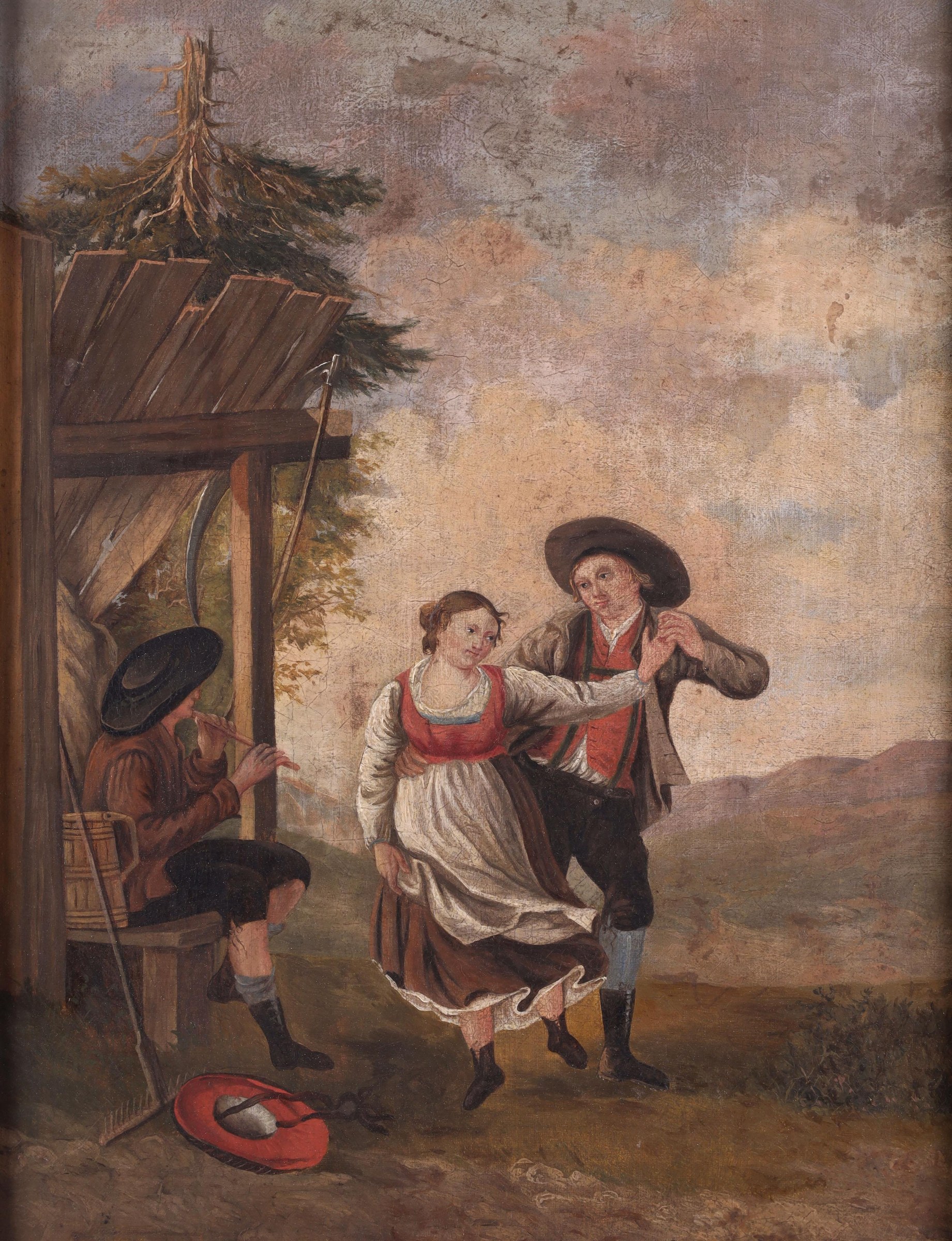
A rustic outdoor dance unfolds before a wooden structure with ivy or climbing plants, set in a hilly landscape under overcast sky. Three figures dominate the composition: a young man in brown coat and dark hat gestures with animated arms toward a young woman in the center, who wears a cream linen skirt with red bodice and apron, her body caught mid-motion in response to him. A third figure, smaller and younger, sits or crouches at the left edge near the building, watching. The ground is bare earth; a red object (possibly a hat or fabric) lies in the foreground. The painting's muted palette of browns, ochres, and grays is punctuated by the warm reds of the woman's dress and the man's clothing, drawing focus to the two active dancers. The light is diffuse and cool, suggesting either early morning or an overcast day, which emphasizes the informal, working-day character of the scene.
The dancing
The man stands in an open, gestural pose with both arms raised or extended, one arm reaching toward the woman's shoulder in what appears to be a guiding or encouraging gesture; his weight appears mobile and his posture energetic. The woman is in mid-step or mid-turn, her body angled away from direct frontality, her arms positioned in a natural, unforced way that suggests response rather than formal technique. Neither figure adopts a closed ballroom hold or the rigid frame of formal dance training. The child's presence—passive and observant—emphasizes this as an informal, vernacular moment rather than a staged performance.
The dance depicted
This is a Feierabendtanz (literally 'after-work dance'), a German or Central European folk social dance that took place in rural communities after the workday ended. The painting captures the character of such dances: informal, outdoors or in modest settings, danced by ordinary people in work clothes and holiday dress. The man's animated gesture and the woman's responsive movement suggest a courtship dynamic typical of folk dance traditions, where the male dancer often led and encouraged movement from his partner. The style is neither ballet nor ballroom but social folk dance, characterized by natural body mechanics and the joyful exuberance of community celebration.
How it was made
Oil on canvas mounted on panel (as noted in the catalogue record), executed with attention to light and atmospheric effect rather than precise detail. The artist uses a limited, earthy palette to evoke the rural setting and natural light, with loose brushwork in the landscape that contrasts with more careful rendering of the figures' faces and clothing. This is an easel painting made for sale or collection rather than a public mural or fresco, suggesting it was created for a middle-class audience interested in genre scenes of rural or peasant life—a category popular in 19th-century European art.
About this work
Feierabendtanz is a genre painting of rural Central European folk dance, depicting the informal social moment when workers celebrated the end of the workday through dance. The painting captures not a formal performance but a fleeting instant of courtship and community pleasure: a young man invites a young woman to dance, his gesture both commanding and playful, while a child watches from the sidelines. The work sits within a 19th-century artistic tradition of Romantic interest in peasant life and authentic folk culture, offering viewers—who were likely urban and educated—a window into a world of unmediated joy and natural gesture.
How to look at it
Attend to the man's arms and posture: he is not holding the woman in a formal frame, but rather gesturing toward and around her, suggesting invitation and encouragement rather than constraint. Notice the woman's response—her body is mobile and off-balance, captured in the act of stepping or turning, not posed. The red of her garments catches the eye and links her to the red object in the foreground, grounding the dance in the material world of rural work and celebration. The third figure's stillness and watching posture frames the action as a social moment being witnessed and participated in by the community, not a performance for an external audience.
The period
The early 19th century (the catalogue suggests early 1800s, though the era label oddly cites 'Late 1800s Victorian Ballroom,' a mismatch worth noting) was a period of intense Romantic interest in folk culture, peasant life, and the 'authentic' or 'natural' as counterweights to industrial urbanization and formality. German and Central European artists in particular documented rural customs and festivals as part of nationalist cultural projects and Romantic ideology. Meanwhile, formal ballroom dancing—waltz, quadrille, contra dance—was becoming codified and spreading through social classes in cities. The Feierabendtanz belonged to an older, local tradition that was beginning to be perceived as picturesque or endangered, making it a subject for artistic preservation and sentimentalization.
Where it lives
The work is sourced from Wikimedia Commons and appears to be in a private collection or public institution not identified in the current record. It is catalogued as an unsigned oil on canvas mounted on panel from the early 19th century, consistent with the practice of German and Central European artists documenting regional customs and folk traditions.
Dance in this work
Questions about this work
What is a Feierabendtanz?
A Feierabendtanz is a German folk dance tradition, literally meaning 'after-work dance,' that took place when laborers—typically rural workers, servants, or tradespeople—gathered after the end of the workday to celebrate with music, food, and social dancing. These were informal, community events, often outdoors or in modest indoor spaces, and were common across Germanic regions. They served as crucial moments of social bonding, courtship, and the temporary suspension of work hierarchy.
Is this a real historical dance or romantic invention?
Feierabendtänze were real social practices, documented in numerous period accounts, paintings, and later ethnographic records. However, by the time this painting was made in the early 19th century, urban artists were beginning to depict such dances as picturesque or historically significant, often infusing them with Romantic sentiment and idealization. The painting may capture genuine folk practice, but it is also a constructed image made for urban viewers—a representation of 'folk authenticity' rather than a neutral record.
Why is the child in the picture?
The child's presence emphasizes the community and family-centered nature of folk dance. Unlike formal ballroom dancing, which was age-segregated and governed by etiquette, Feierabendtänze were intergenerational social events where children witnessed, learned, and participated alongside adults. The child's watching posture also gives the viewer a surrogate—we too are positioned as observers of an intimate social moment.
What is the red object on the ground?
It is likely a hat, apron, or other discarded garment, indicating the informality and spontaneity of the scene. In folk dance traditions, dancers sometimes removed or adjusted clothing during dancing; the object may signal the physical exuberance and freedom of the moment, contrasting with the restraint and control valued in formal ballroom dance.
More Folk/Country artwork