31 works in this view — arrow keys or swipe to move between them.
Dance in Art · 1850
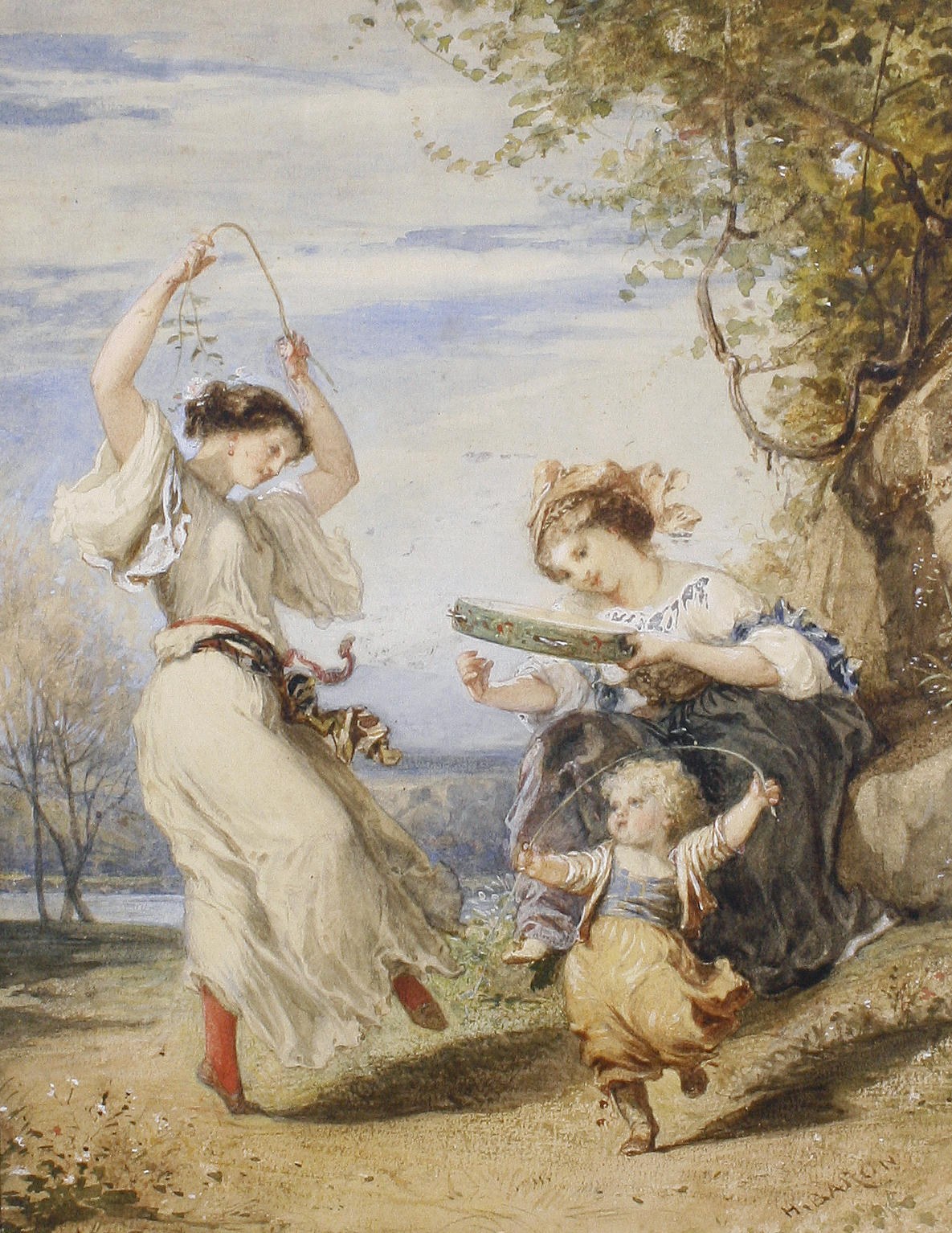
Henri Charles Antoine Baron - Filles italiennes dansant
Henri Charles Antoine Baron
- Medium:
- Oil Painting
- Era:
- Mid 1800s (Polka Era)
- Source:
- Wikimedia Commons
- Rights:
- Public domain — free to use, share and adapt.
- Recorded as:
- Public Domain
The painting shows how nineteenth-century artists used dance—especially rural and folk dance—as a vehicle for Romantic ideals about nature, childhood, and authentic (non-metropolitan) life. The presence of the musical pipe grounds the dance in a real cultural practice, yet the neoclassical drapery and Romantic composition reveal the artist's own aesthetic distance from the subject he portrays.
What you are looking at
A woman and two children dance together outdoors on a sandy path beside a river or lake, framed by mature trees with drooping branches. The woman, dressed in a pale neoclassical gown with a high waist and a rust-red girdle, holds a leafy vine or garland above her head in both hands, her body angled in a graceful contrapposto. A girl to her right, in a darker dress with blue accents, holds what appears to be a musical pipe or flute and gazes downward in concentration. A small boy in golden-yellow breeches and a white shirt stands between them, his arms raised. The distant landscape beyond shows a calm expanse of water and hazy sky. The painting employs soft watercolor tonalities—pale blues, creams, and warm earth tones—to suggest a Romantic idyll, the leafy canopy creating dappled light and shadow across the figures.
The dancing
The woman is the focal point, her raised arms and lifted chin establishing an upright, expansive frame. Her left leg appears to bear weight while her right foot extends lightly, suggesting movement through space rather than a static pose. The girl holds the pipe with both hands at an angle, her head bowed in the attitude of a player, while the boy's raised arms frame his small body in an open, unguarded gesture. The three figures are arranged in loose proximity rather than formal contact, suggesting a spontaneous, playful interaction rather than a structured dance hold.
The dance depicted
This appears to depict a folk or pastoral dance, likely Italian given the title 'Filles italiennes dansant' (Italian girls dancing). The presence of a musical pipe suggests an accompanied improvisation or country dance rather than a ballroom form. The woman's vine garland, the river setting, and the Romantic treatment of childhood innocence point to an idealized vision of rural festivity. The figures' loose arrangement and the girl's engagement with the pipe suggest a tarantella or similar Italian folk dance, though the artist seems more interested in capturing the *idea* of carefree rural dance than its technical particulars. The costumes—especially the neoclassical drapery of the woman—belong to Romantic painterly convention rather than historical accuracy.
How it was made
This is an oil painting, likely executed with the delicate, translucent technique and soft color harmonies typical of mid-nineteenth-century European salon painting. The watercolor-like quality—the pale washes, the attention to atmospheric effect, the way light dissolves into shadow—suggests an artist trained in both media or one working in a style that blurs the boundary between them. This technique was ideal for circulating in reproduction and for appeal to educated middle-class collectors who valued sentiment and finish over dramatic subject matter.
About this work
Henri Charles Antoine Baron's *Filles italiennes dansant* is a Romantic vision of Italian rural life, capturing three figures—a woman and two children—in a moment of spontaneous, music-accompanied dance on a riverbank. The painting belongs to the nineteenth-century European tradition of orientalizing and exoticizing Southern European subjects, treating Italian folk culture as a source of natural grace and unselfconscious joy. For the dance historian, it is a useful document of how metropolitan European artists imagined rural dance: not as technique or tradition, but as an expression of innocent pleasure in nature and music. The work circulated through the salon and reproductive print market, making it a specimen of how dance imagery shaped middle-class sentiment about rural authenticity and childhood.
How to look at it
Notice the woman's vine garland and her gaze lifted toward it—the artist has chosen a moment of self-aware grace rather than unthinking exuberance. Observe the girl's absorption in the pipe: her downcast eyes and focused posture suggest the artist understood that music and dance are not mere backdrop to a scene but an engagement that demands attention. The composition uses the drooping trees and water to frame the figures and suggest a timeless, suspended moment. The soft, almost monochromatic palette—creams, pale blues, golden yellows—creates an air of nostalgia and distance, as if the scene belongs to memory or dream rather than observed reality.
The artist
Henri Charles Antoine Baron (1819–1885) was a French painter and printmaker known for historical and genre scenes, particularly of Italian and Spanish subjects. He worked in the academic tradition and exhibited regularly at the Paris Salon. His paintings often feature figures in historical costume or folk dress set in picturesque landscapes, reflecting the mid-nineteenth-century taste for orientalism and picturesque rural subjects. He was technically skilled and worked across oil, watercolor, and reproductive print media, which accounts for the soft, translucent finish of this work.
The period
The painting dates to 1850, a moment when European Romanticism was at its peak and academic art was beginning to turn toward realist and naturalist subjects. Italian folk culture, in particular, held enormous appeal for Northern European artists and collectors as a source of authenticity, sensuality, and connection to classical antiquity. The idealized female and child figures, the Arcadian setting, and the associatiation of music and dance with natural grace were all conventional Romantic tropes. At the same time, the salon painting market—for which this work was clearly made—valued technical finish, sentimental narrative, and escapist subject matter, positioning this image as an artifact of middle-class taste and aspiration.
Where it lives
The work is catalogued as an oil painting dated 1850, attributed to Henri Charles Antoine Baron. The catalogue record does not identify a holding collection; the image is sourced from Wikimedia Commons, suggesting it may be in public domain or held in an institution that permits free reproduction.
Dance in this work
Questions about this work
Is this a real Italian dance or a Romantic invention?
The musical pipe and the loose, playful arrangement of bodies suggest a connection to real Italian folk tradition, likely a tarantella or similar improvisational form. However, the neoclassical costumes and the soft, idealized treatment are Romantic conventions imposed by the artist rather than historical documentation. The woman's garb, in particular, belongs to European artistic fashion rather than rural Italian dress.
What is the woman holding?
A vine or garland, possibly ivy or grape vine, which she raises above her head in a graceful arc. This is both a literal prop (vines grow near rivers) and a symbol of fertility, joy, and connection to nature—all values central to Romantic ideology about rural life.
Why is the girl playing a pipe?
The pipe grounds the scene in real cultural practice: folk dances were traditionally accompanied by live music, often from simple instruments like pipes or bagpipes. The girl's focused posture and downturned gaze suggest the artist understood that playing music and dancing were coordinated activities, not a woman providing decoration while men dance.
What does the title 'Filles italiennes dansant' tell us?
The French title, meaning 'Italian girls dancing,' tells us the work was made for a French or Northern European market and was marketed as a glimpse into exotic (i.e., Southern European) life. 'Girls' is accurate for the child but somewhat reductive for the woman, reflecting the Romantic tendency to infantilize the rural or non-metropolitan subject.
More dance artwork