32 works in this view — arrow keys or swipe to move between them.
Dance in Art · 1862
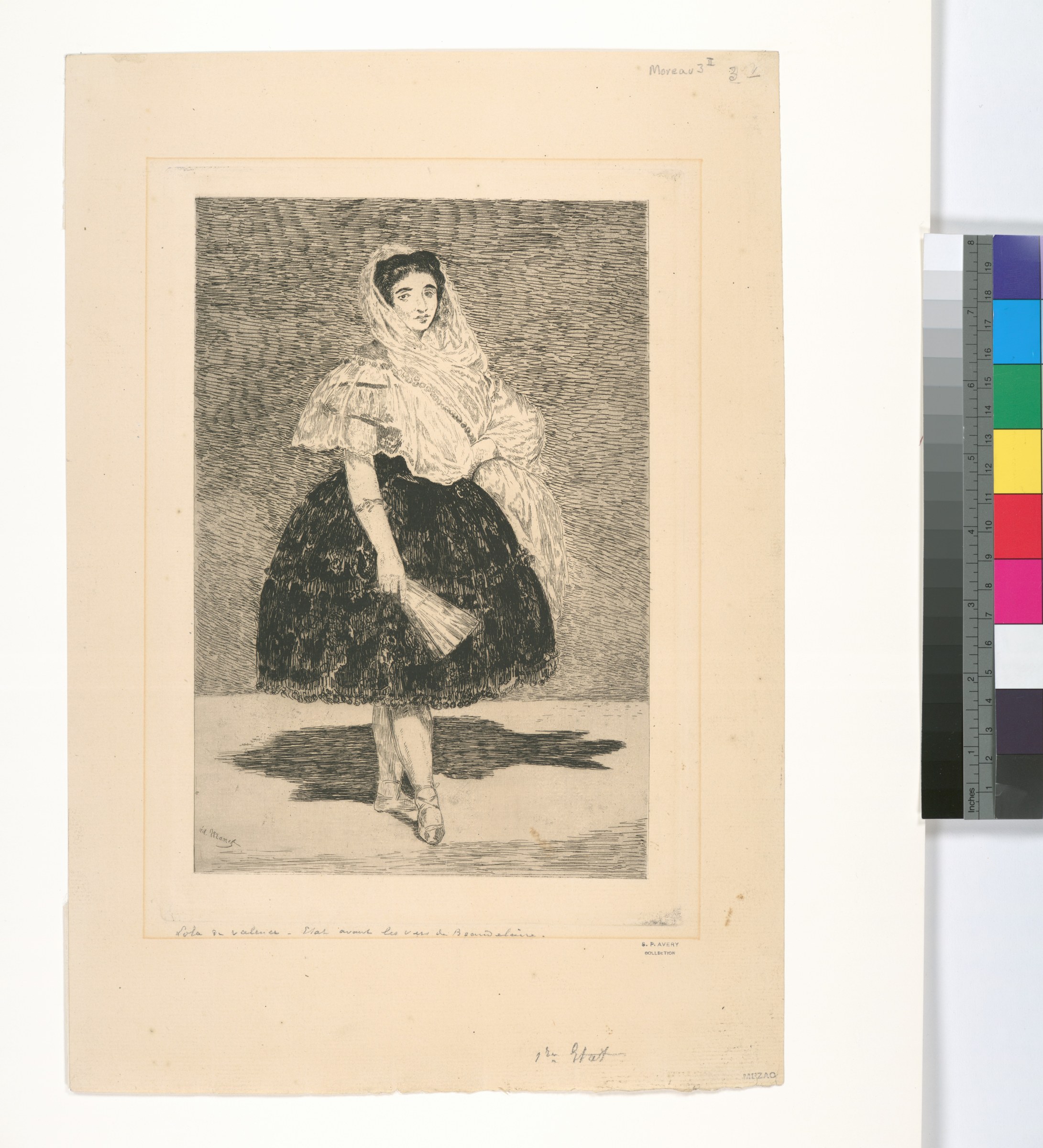
Lola de Valence (NYPL b13472279-483332)
Unknown (NYPL collection)
- Medium:
- Oil Painting
- Era:
- Mid 1800s (Polka Era)
- Source:
- Wikimedia Commons
- Rights:
- Public domain — free to use, share and adapt.
- Recorded as:
- Public Domain
The work provides visual evidence of how mid-nineteenth-century European audiences encountered non-European or exotic dance through the theatre, and what costume and styling signified theatrical 'Spanishness' or Latin American identity in this period. As a named portrait of a professional woman dancer active in commercial theatre, it documents the celebrity and visibility of women performers in this era.
What you are looking at
A young woman stands alone against a softly hatched background, her body turned slightly to the viewer's right. She wears a white lace or embroidered shawl draped over her shoulders and head, falling loosely down her back, and a full black skirt of heavy fabric that extends to her ankles. Her posture is upright and composed, weight settled on both feet with a slight forward lean. The figure is rendered in fine parallel lines characteristic of engraving or etching, with careful attention to the fall of fabric and the play of light across her pale upper body against the darkness of her skirt. The setting is minimal and undefined—the artist has concentrated entirely on the figure herself, rendered at approximately three-quarter length.
The dancing
The dancer stands in a neutral position with her body aligned vertically, neither in active movement nor in a formal dance posture. Her arms hang naturally at her sides, one hand emerging from beneath the shawl. Her head is held level, her gaze directed slightly downward and to the side, creating an inward, composed expression. The stance suggests a moment of stillness or presentation rather than active choreography—a figure posed for observation rather than caught mid-movement.
The dance depicted
This appears to be a portrait of a dancer in costume rather than a representation of dance in action. The woman is identified in the title as Lola de Valence, and the work documents her appearance and stage dress. She wears what is likely her performance costume: the combination of the ornate white shawl and dark full skirt suggests Spanish or Latin American theatrical dress of the mid-nineteenth century, consistent with the popularity of Spanish and Cuban dancers in European concert halls and theatres during this period. Without visible movement, specific choreography, or partner engagement, the work cannot be assigned to a particular dance style; it functions as a costume and character study rather than a dance narrative.
How it was made
This is an engraving or etching, executed in fine parallel lines (hatching and cross-hatching) to create tonal depth and fabric texture. The technique allowed for wide circulation through multiple impressions, and the refined execution suggests this was a work of some commercial and artistic significance. The use of engraving—a printmaking medium far more accessible and reproducible than oil painting—indicates this was intended as a published portrait, likely sold separately as a theatrical or celebrity print. The catalogue record lists the medium as oil painting, but the visual evidence of parallel line work throughout strongly suggests a print medium.
About this work
This is a mid-nineteenth-century engraved portrait of a professional dancer, Lola de Valence, rendered in her stage costume. The work documents the appearance and dress of a performer active in European theatres during a period of intense fascination with Spanish and exotic performance. The engraving format and refined execution indicate this was a published portrait—the kind of theatrical print that circulated among audiences and collectors to commemorate celebrated performers of the era. As a document of dance costume and the theatrical persona surrounding a named performer, it belongs to a substantial visual archive of nineteenth-century professional dance.
How to look at it
Attend to the costume details: the specificity of the white shawl and its placement, the weight and darkness of the skirt, and the shoes barely visible at the hem. These are the markers that locate this performer within a particular theatrical tradition and geography. The artist's choice to render her in stillness and composure—rather than in mid-movement—emphasizes her as a figure to be observed and desired, a creature of the stage rather than an active dancer. The refinement of the engraving technique itself signals this is a prestigious portrait, not a quick sketch.
The artist
The catalogue record attributes the work to unknown, and the signature on the plate is not legible in this image. The refined execution and scale suggest this was a professional engraver working in or near a major publishing centre with access to theatrical markets. The work belongs to a substantial tradition of celebrity and theatrical portraiture in engraved form during the nineteenth century.
The period
The work dates to 1862, a period of high popularity for Spanish and Latin American-inflected performance in European theatres. The decade saw growing interest in 'exotic' dance and music among middle-class audiences, and the rise of the professional female dancer as a celebrated public figure. The theatrical portrait engraving was a major medium for disseminating images of performers and building fan bases; these prints were relatively inexpensive and widely distributed. Romanticism's lingering fascination with the unfamiliar and sensual, combined with new technologies of theatrical publicity, created strong demand for images of individual performers in costume.
Where it lives
The work is held in the New York Public Library collection and was accessed via Wikimedia Commons. It is catalogued with minimal identifying information, though the title and the artist's signature (if legible) are present on the plate. The NYPL reference number is b13472279-483332.
Questions about this work
Who was Lola de Valence?
The catalogue provides only her name; she was a professional dancer active in the 1860s and known enough to be commemorated in a published engraved portrait. The costume suggests she performed Spanish or Latin American-inflected dance in European theatres, likely in Paris given the style and circulation of this print.
Why is she standing still if this is a dance image?
This is a theatrical portrait rather than a representation of choreography in action. It documents her appearance and costume, presenting her as a performer to be seen and admired. The stillness and frontality are conventions of portrait art, not indications of the movement she performed on stage.
Is the medium really oil painting as the record states?
The visual evidence strongly indicates this is an engraving or etching, executed in fine parallel lines of the kind used in print media. The catalogue record may be in error, or the term 'painting' may be used loosely to describe any pictorial work. The technique, scale, and subject matter are all consistent with mid-nineteenth-century theatrical portraiture in print form.
More dance artwork