33 works in this view — arrow keys or swipe to move between them.
Dance in Art · 1862
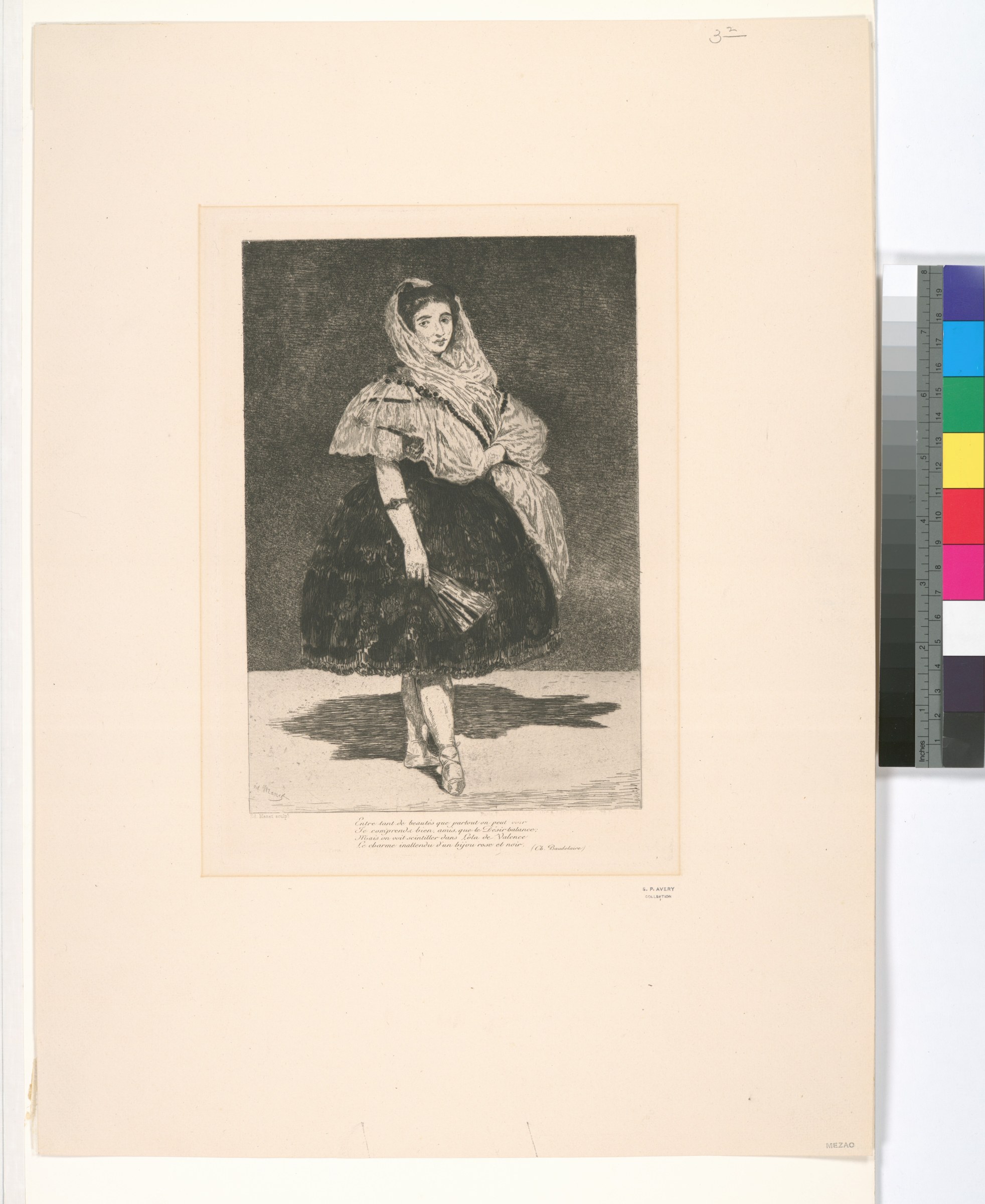
Lola de Valence (NYPL b13472279-483333)
Unknown (NYPL collection)
- Medium:
- Oil Painting
- Era:
- Mid 1800s (Polka Era)
- Source:
- Wikimedia Commons
- Rights:
- Public domain — free to use, share and adapt.
- Recorded as:
- Public Domain
This image preserves a visual record of how Spanish and Latin American dance was presented and understood in European popular culture during the 1860s, and it documents the costume and bearing of a specific performer or type figure important enough to merit engraved reproduction. For historians of nineteenth-century dance portraiture and gender representation, the combination of costume detail, romantic pose, and printed circulation reveals how theatrical identity was constructed and marketed to the public.
What you are looking at
A young woman stands alone against a dark background, her body turned three-quarters toward the viewer. She wears a voluminous dark skirt that falls to mid-calf, paired with a fitted dark bodice. Over her shoulders hangs a flowing white shawl or rebozo, draped loosely and caught mid-movement; the fabric suggests a swaying or turning motion. Her head is crowned with an elaborate white headpiece or mantilla, and her face is pale and delicate. She looks downward, her expression serene or melancholic. The pose suggests a moment suspended in a dance or promenade—the weight appears to rest on one leg, the body poised as though between steps. The background is uniformly dark, creating stark contrast with the white textiles and the dancer's face. Below the figure, French text in a decorative script references themes of passion and desire.
The dancing
The woman stands in a three-quarter contrapposto pose, with her weight seemingly on her back leg and her torso angled toward the viewer. Her arms hang loosely at her sides, one hand visible and relaxed. The head is held upright but the gaze is cast downward in a pose of modest reserve or introspection. The draped white fabrics—shawl and mantilla—create a sense of movement and volume around the upper body, though her lower body remains still. There is no partner visible; this is a solitary figure study.
The dance depicted
This appears to be a portrait of a theatrical or social dancer, likely from the Spanish or Spanish American tradition, rendered as a moment of repose rather than active performance. The mantilla, rebozo, and dark skirt are consistent with Spanish or Latin American dress of the mid-nineteenth century, suggesting a figure from *bolero*, *quadrille*, or salon dance contexts. The costume and the romantic, melancholic mood—enhanced by the downward gaze and the inscription below—point toward a named dancer or a type figure from European salon or theatrical culture of the 1860s. The pose is neither balletic nor obviously demonstrating a specific step; instead, it captures a moment of stillness and introspection, which was a common and valued moment in Romantic-era theatrical portraiture.
How it was made
This is an engraving or etching, identifiable by the parallel line work visible throughout the composition and the controlled gradation of tone from white (the mantilla, shawl, and face) to deep blacks (the skirt and background). The technique creates precise detail in the facial features and delicate texture in the textiles. The inscription beneath suggests a printed publication intended for a broad audience—not a unique oil painting but a reproducible image, likely circulating in a journal, album, or collection of theatrical or celebrity portraits. This reproductive medium allowed the image to reach beyond a single patron or venue.
About this work
This is a mid-nineteenth-century engraved portrait of a woman identified as or associated with Spanish or Latin American dance culture, posed in an attitude of theatrical repose. She is shown in costume—mantilla, rebozo, and dark skirt—in a moment of stillness rather than active motion. The work sits within a tradition of celebrity and salon portraiture, using reproductive engraving to circulate images of named or notable performers or figures to a print-consuming public. The melancholic, downward-gazing pose reflects Romantic-era aesthetics and distinguishes this from purely documentary costume or performance imagery.
How to look at it
Attend to the pose: the artist has chosen a moment of stillness and introspection rather than a moment of active movement, reflecting a Romantic-era preference for capturing the dancer's interiority and emotional state rather than the mechanics of the dance itself. The mantilla and rebozo are rendered in precise detail and light tones that draw the eye upward and around the face, while the dark skirt grounds the figure in shadow. Note how the drapery suggests movement even as the body is still—a common device in nineteenth-century portraiture to imply grace and vitality while maintaining composure.
The artist
The artist is not identified in the catalogue record. The technique and style are consistent with mid-nineteenth-century European engraving practice, and the inscription in French suggests a Parisian or French publication context. Without attribution, the work should be understood as a product of the commercial reproductive print industry rather than a named artistic vision.
The period
The 1860s saw intense European fascination with Spanish and Latin American dance, music, and exoticism, fueled by colonial and commercial contact and by Romantic-era aesthetics that valued passion, melancholy, and 'foreign' sensuality. Bolero, quadrille, and other Spanish or Cuban-inflected dances were fashionable in European salons and theaters, and images of performers circulated widely in printed form. This engraving reflects that appetite for the visual and narrative documentation of theatrical and salon identity, particularly of women performers and figures who embodied exotic or romantic appeal.
Where it lives
The work is held in the New York Public Library collection and accessed via Wikimedia Commons. The catalogue reference numbers (M-N 3(IV/V); G. 23(III/III); H. 33(III/III)) suggest it is part of a documented series or album of prints, though the specific publication context is not recorded here.
Dance in this work
Questions about this work
Who was Lola de Valence?
The catalogue record identifies this as 'Lola de Valence,' but does not provide biographical information. She was likely a notable performer of Spanish or Spanish American dance in mid-nineteenth-century European theaters or salons, famous or celebrated enough to warrant engraved reproduction. The name and costume suggest a Spanish performer or performer known for Spanish dance repertoire.
What dance is she performing?
The image does not depict active dance movement. Instead, it captures a moment of repose—a pose or attitude that would have been seen as graceful and characteristic of a Spanish or Latin American dancer of the period. The costume is consistent with bolero, quadrille, or salon dances of Spanish or Cuban origin, which were fashionable in Europe during the 1860s.
Why is this image important for dance history?
It documents how European audiences understood and consumed images of Spanish and Latin American performers in the nineteenth century, and it preserves details of costume, pose, and presentation that reveal the aesthetic and narrative values attached to 'exotic' and 'foreign' dance during the Romantic era. Such prints were mass-produced and widely circulated, making them primary evidence of popular taste and the commodification of theatrical identity.
More dance artwork