49 works in this view — arrow keys or swipe to move between them.
Dance in Art
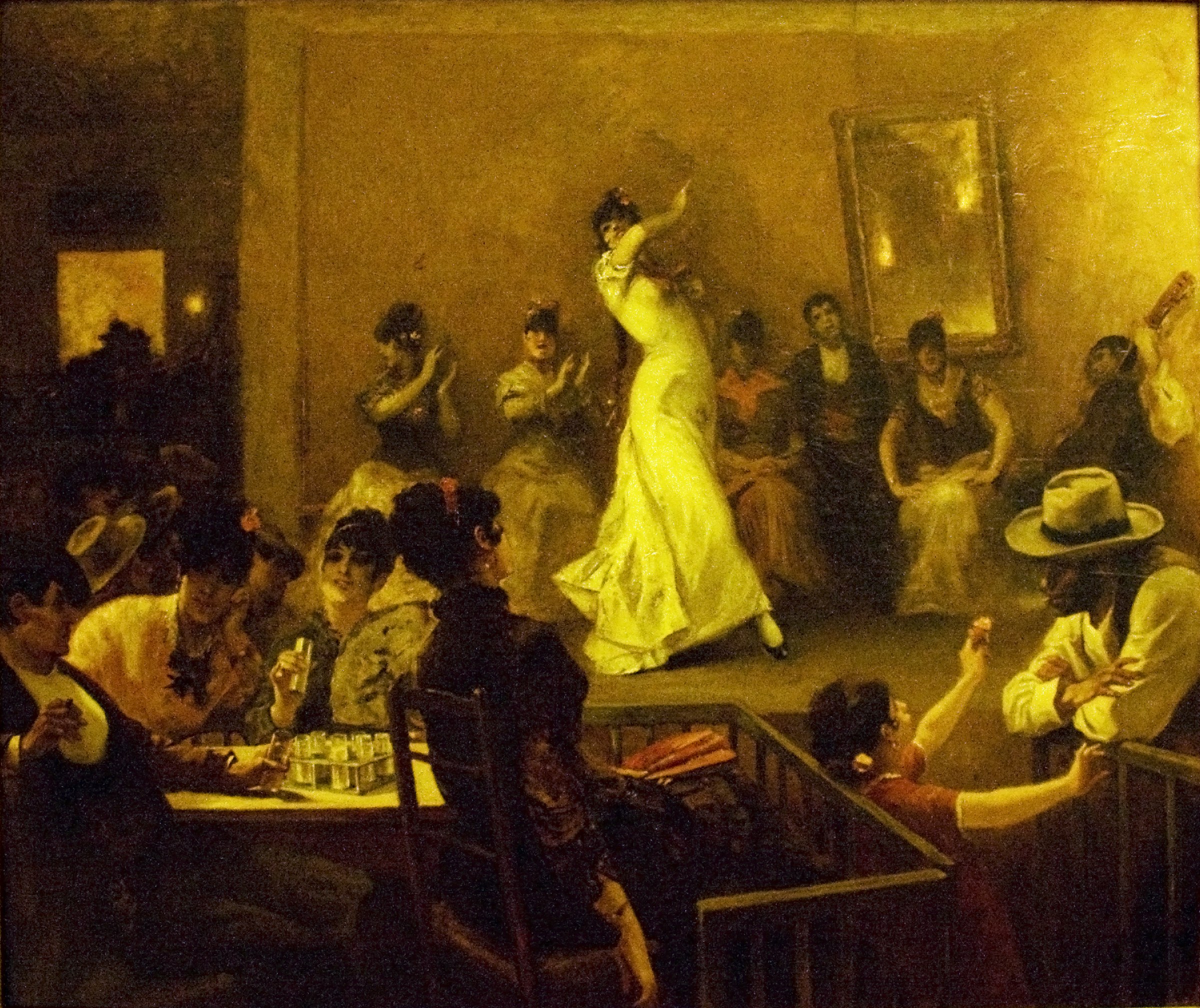
Café del Buzero, Sevilla
Constantin Meunier
- Medium:
- Oil Painting
- Source:
- Wikimedia Commons
- Rights:
- Public domain — free to use, share and adapt.
- Recorded as:
- Public Domain
This work documents the café as a performance venue for Spanish dance in the late 19th century, showing how popular dance functioned as social entertainment outside formal theater contexts. For historians of flamenco and Spanish dance, it provides visual evidence of staging, costume, and audience composition in that era. For art historians, it exemplifies the period's interest in capturing transient moments of ordinary social life and entertainment.
What you are looking at
A woman in a luminous white or pale yellow dress dances elevated on a low platform or table, her body caught in a moment of dynamic movement with one arm raised. She is surrounded by a loose gathering of figures in dark clothing—men in hats and coats, women in period dress—who watch from standing positions around the room. The setting is an interior space with yellow-ochre walls, doorways visible in the background, and what appears to be casual furnishings. The lighting is warm and stagey, concentrated on the dancer, which creates a sense of intimate spectacle. The composition suggests a moment of spontaneous or semi-formal entertainment in a tavern, café, or domestic space rather than a formal theater. The mood is one of social gathering and performance, with clear spatial separation between the solitary dancer and the clustered onlookers.
The dancing
The central dancer's body is in an open, vertical extension with her raised arm suggesting a rotational or celebratory movement; her posture appears grounded yet dynamic. Her dress, with its pale color and apparent weight, moves with her body. The surrounding figures are positioned as passive spectators, some with arms at their sides, others gesturing casually. No tight partner holds or formal frames are visible. The dancer is isolated spatially from the group, elevated and central, which emphasizes her agency as performer rather than participant in paired social dance.
The dance depicted
The setting and costume suggest Spanish flamenco or a related Iberian popular dance tradition from the late 19th or early 20th century. The title references 'Buzero' (likely referring to a tavern or café setting in Seville) and the theatrical isolation of the dancer on a raised surface is consistent with how flamenco was performed in café settings. However, the pale dress, the casual spectatorial arrangement, and the lack of visible rhythmic or postural markers specific to flamenco make confident identification difficult. This could also depict bolero, jota, or another Spanish regional or folk dance adapted for café entertainment. The woman's elevated posture and the onlookers' arrangement suggest individual showcase performance rather than couples' social dance.
How it was made
The work is oil on canvas. The artist's technique employs warm, ochre-dominated tonality with strong use of shadow to define the interior space and create atmospheric depth. The figure of the dancer is rendered in lighter, more saturated tones that make her the focal point. The loose brushwork and attention to light effects—particularly the warm glow on the dancer and the darker shadowed areas—suggest Impressionist or Post-Impressionist influence, which was current in European art of the 1880s–1900s. This technique allows for the suggestion of movement and transient social moments rather than static poses.
About this work
This oil painting depicts a solo female dancer performing in what the title identifies as a Sevillian café or tavern (Café del Buzero). The dancer, dressed in a pale gown and elevated on a platform, performs for an gathered audience of men and women in everyday dress. The work captures a moment of informal public entertainment in a Spanish social space, rendered in warm, atmospheric tonality that emphasizes the theatrical relationship between performer and spectator. The painting belongs to a broader tradition of late 19th-century European art documenting popular leisure and performance practices, particularly café culture and the vernacular dances that animated it.
How to look at it
Attend to the isolation and elevation of the dancer—she is literally and figuratively set apart from the group, positioned as spectacle rather than as a social equal participating in a dance with a partner. Notice how the light is concentrated on her pale dress, which makes her the undeniable focus. The casual, watching postures of the surrounding figures establish the informality of the setting and their role as audience rather than participants. The composition emphasizes the moment of performance itself, the solitary exhibition, rather than the mechanics or steps of the dance.
The artist
Constantin Meunier (1831–1905) was a Belgian painter, sculptor, and printmaker associated with Realism and Social Realism. He is best known for depicting industrial labor, workers, and scenes of ordinary people in their social and occupational contexts. His work often focused on the dignity and character of working and lower-class life. A visit to Spain or an interest in Spanish culture and performance would be consistent with his broader practice of documenting vernacular life, though further research into his travel and specific commissions would be needed to confirm the context of this work.
The period
In the late 19th century, Spanish dance—particularly flamenco and regional dances—was becoming aestheticized and documented by European artists and photographers. At the same time, café culture and public entertainment venues were central to urban social life across Europe. The café was a site where folk and popular traditions met urban audiences, and artists were increasingly interested in capturing these spaces and moments. Meunier's work aligns with broader Realist and Impressionist interest in leisure, performance, and the social fabric of modern life, as well as with growing European fascination with Spanish and Iberian culture.
Where it lives
The work is identified as sourced from Wikimedia Commons, with no holding collection recorded in the available catalogue data. The catalogue record is minimal, with the title, artist name, medium, and era left unmarked.
Dance in this work
Questions about this work
Is this flamenco?
The setting, title, and the woman's dynamic posture and pale dress are consistent with Spanish café performance of the late 19th century, and flamenco is the most likely candidate. However, the painting does not include the sharp postural, rhythmic, or costume markers that would confirm it definitively. It could represent bolero, jota, or another regional Spanish dance tradition. The title's reference to a Sevillian café makes flamenco a strong probability, but the painting alone is not conclusive evidence.
Who was Constantin Meunier?
Meunier was a major Belgian Realist painter and sculptor (1831–1905) known for depicting working-class life, industrial labor, and ordinary people in their social contexts. He traveled and documented vernacular practices across Europe, which may explain his interest in Spanish café culture and performance. His broader practice emphasizes the dignity and character of popular life and entertainment.
What is a Café del Buzero?
The title suggests a tavern or café in Seville, Spain—a public space where entertainment and performance took place. In the 19th and early 20th centuries, such venues were primary sites for flamenco and other Spanish dance traditions. Audiences gathered informally to watch individual performers, much as depicted here. The 'buzero' may refer to a specific establishment or a general type of café; further research into Sevillian establishments of the period would clarify.
More dance artwork