49 works in this view — arrow keys or swipe to move between them.
Dance in Art · 1770
Chodowiecki Basedow Tafel 18 c Z
Daniel Nikolaus Chodowiecki
- Medium:
- Oil Painting
- Era:
- 1700s (Enlightenment/Minuet Era)
- Source:
- Wikimedia Commons
- Rights:
- Public domain — free to use, share and adapt.
- Recorded as:
- Public Domain
This work is evidence that folk and country dancing were considered worthy of serious artistic documentation by enlightened printmakers. It shows how 18th-century artists understood rural dance—not as primitive or quaint, but as an ordered social practice worth recording in detail—and preserves concrete information about posture, costume, and community participation in an era before photography.
What you are looking at
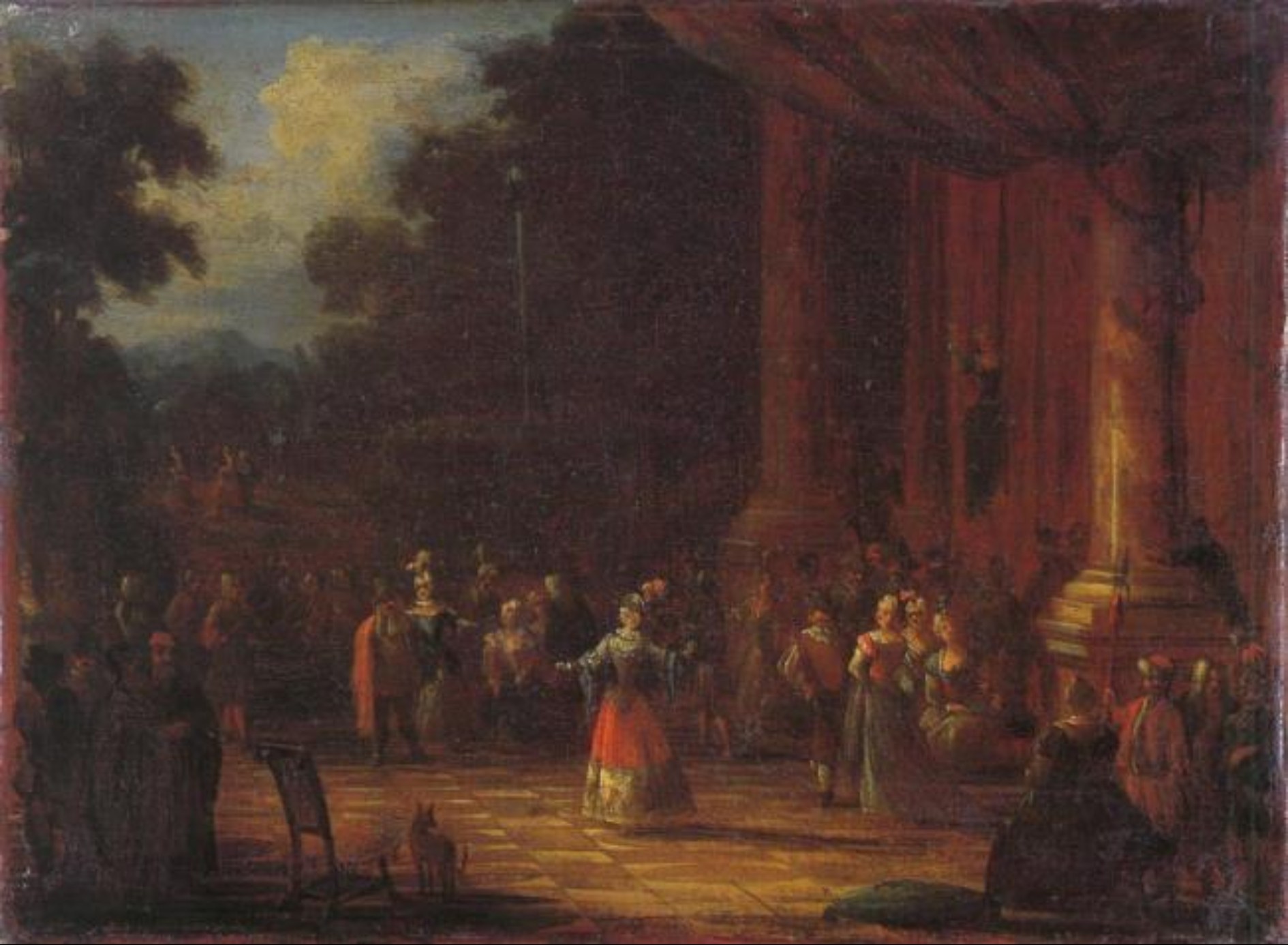
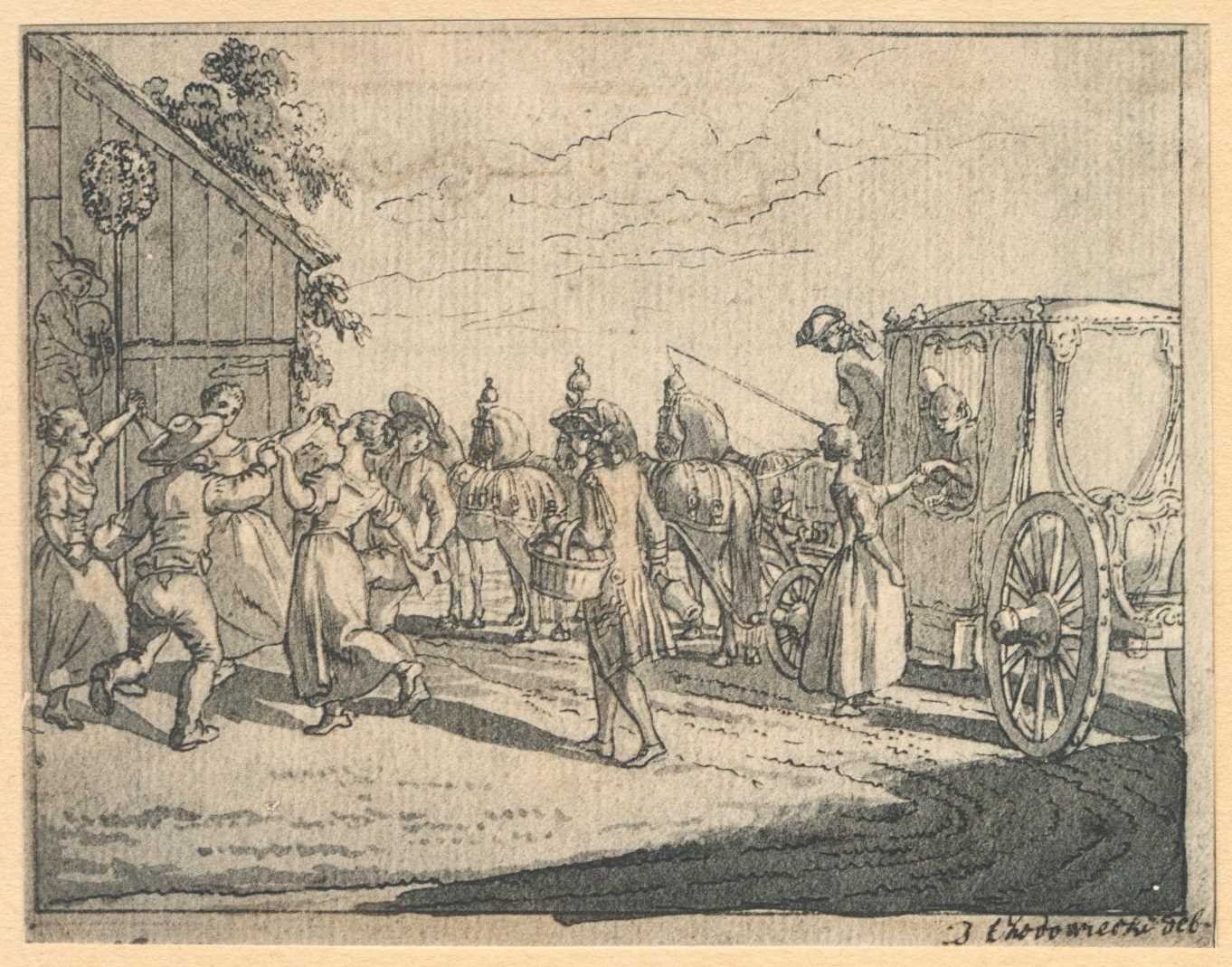
A rural festival unfolds in an open courtyard or village green, framed by a colonnade on the left and a decorated carriage on the right. The composition is animated with numerous figures—musicians, dancers, onlookers, and attendants—arranged in loose groups across the middle ground. A band of musicians occupies the left side, playing wind and string instruments beneath the arcade. In the center, couples and individuals move in the open space, their bodies in various attitudes of motion. The carriage on the right, ornately decorated with scrollwork, contains observing figures and serves as a focal point. The scene is rendered in a light, naturalistic engraving style with careful attention to costume and social hierarchy: the dancers wear the simple, practical dress of rural folk—women in long skirts and bodices, men in breeches and coats—while seated figures in the carriage wear finer garments. The setting is sunny and open-air, suggested by the sketched clouds overhead and the clear spatial recession.
The dancing
The dancers move in an unstudied manner, with bodies held upright but relaxed, consistent with social country dance rather than theatrical performance. Several couples appear to be in contact—clasped hands or light holds at the arm—while others dance solo or in groups. The arm positions are natural and varied rather than formal or codified. The women's long skirts are animated by movement, caught at different phases of turn or step. Weight distribution appears grounded and practical rather than weightless or elevated.
The dance depicted
This is a depiction of a German or Central European rural festival dance, labeled in the catalogue as 'Ländliches Fest' (Rural Festival). The dress, setting, and informal grouping suggest folk or country dancing of the late 18th century—likely a mixture of couple dances and group figures typical of village celebrations. The presence of musicians and the open-air setting confirm this is a social and communal occasion rather than court or theatrical dance. The artistic tradition of documenting rural life was strong in Northern European pedagogy and natural philosophy of this period.
How it was made
This is an engraving (or finely worked etching) on paper, rendered in black ink with light wash or hatching to suggest tone and recession. The technique allows both fine detail in the dress and instruments and looser, more suggestive rendering of bodies and movement. The print was likely made for circulation—either as a standalone study or as part of an illustrated series—rather than a unique or precious object. Engravings of this type were the dominant medium for documenting social custom and natural studies in the 18th century.
About this work
This is a study from the Chodowiecki-Basedow series, a comprehensive pedagogical and anthropological survey of contemporary German life and manners published in the mid-18th century. The work documents rural festival dancing in the era of the Enlightenment, when naturalistic observation of folk custom was valued both as moral instruction and as ethnographic record. It sits at a crucial moment in European attitudes toward dance—the informal, embodied knowledge of rural communities was beginning to be noticed and preserved by educated artists and scholars, even as court and theatrical dance followed their own increasingly formal conventions.
How to look at it
Notice the careful attention to social gradation: the musicians are positioned lower and to the side; the dancers occupy the open center; the carriage holds observers in finer dress. The artist has frozen a moment of general activity rather than a single formal figure or couple, capturing the social nature of festival dancing. Observe how the bodies are distributed across the space—not in a line or formation, but in clusters and pairs, suggesting improvisation and participation rather than choreography. The engraving technique allows both sharp detail (in costume and instruments) and softer suggestion of movement and atmosphere.
The artist
Daniel Nikolaus Chodowiecki (1726–1801) was a German-French engraver and draughtsman based in Berlin, renowned for his prolific output of small-scale, meticulously observed scenes of daily life, custom, and moral instruction. He worked in close collaboration with the educator Johann Basedow, creating the illustrated 'Elementarwerk' (Elementary Works, 1774), a comprehensive visual encyclopedia of human activity and natural knowledge intended for children and the general public. Chodowiecki's style combined fine technique with an ethnographic eye; his thousands of engravings are invaluable records of 18th-century manners, dress, and social practice across Europe.
The period
The 1770s saw a growing European interest in recording and codifying knowledge of natural and human phenomena—the age of Linnaeus, Buffon, and the Encyclopédists. In dance, this was a period of transition: formal court dance and ballet were becoming increasingly codified and theatrical, while rural and vernacular dancing remained largely unwritten and unstudied. Enlightenment educators and naturalists, however, began to see folk custom as data worthy of collection and preservation. Simultaneously, the Minuet Era was at its height in courtly circles, creating a sharp contrast between documented high dance and the observed reality of village practice.
Where it lives
This work is identified as Tafel (Plate) 18c from the Chodowiecki-Basedow pedagogical and anthropological series, likely from the 'Elementarwerk' or a related collection. The source is recorded as Wikimedia Commons. The series was widely printed and distributed across Europe.
Dance in this work
Questions about this work
What is a 'Ländliches Fest' and how is it different from court dancing?
A 'Ländliches Fest' or rural festival was a communal celebration in a village or country setting, with music and social dancing as central activities. Unlike court dancing, which followed strict rules of formation, hold, and step, rural dancing was more improvisational, participatory, and varied. Men and women of all ages could join in; the purpose was celebration and community bonding rather than display or instruction in refinement.
Why did Chodowiecki and Basedow document rural dances?
As Enlightenment educators and naturalists, they believed that careful observation of human life across all social classes yielded valuable knowledge. Rural customs, including dance, were seen as authentic expressions of human nature and community practice. Documenting them served both pedagogical and ethnographic purposes—teaching children about the diversity of human activity and preserving knowledge of how people actually lived.
Is this a painting or a print?
This is an engraving (or finely worked etching), a printmaking technique that allowed wide circulation. Unlike paintings, which were unique objects, engravings could be reproduced and distributed to many buyers. This made them the ideal medium for Enlightenment educational projects and for documenting social custom for a broad audience.
Can you tell what dance this is from the postures and movements?
The specific dance cannot be identified with certainty from the image alone. The loose postures, varied groupings, and lack of codified step suggest a general country or village dance practice rather than a named form. The presence of a band and the outdoor setting confirm this is a social festival rather than theatrical or court dance, but the actual figures being danced remain unknown.
More dance artwork