43 works in this view — arrow keys or swipe to move between them.
Dance in Art · 1770
Chodowiecki Basedow Tafel 61 a Z
Daniel Nikolaus Chodowiecki
- Medium:
- Oil Painting
- Dance:
- Minuet
- Era:
- 1700s (Enlightenment/Minuet Era)
- Source:
- Wikimedia Commons
- Rights:
- Public domain — free to use, share and adapt.
- Recorded as:
- Public Domain
This plate is one of the very few visual documents of minuet *instruction* rather than performance, showing how the dance was actually taught and corrected in real time. For historians of dance pedagogy, costume, and the social rituals of the 18th-century household, it offers concrete evidence of posture, arm carriage, and the role of the master in maintaining standards of technique and decorum.
What you are looking at
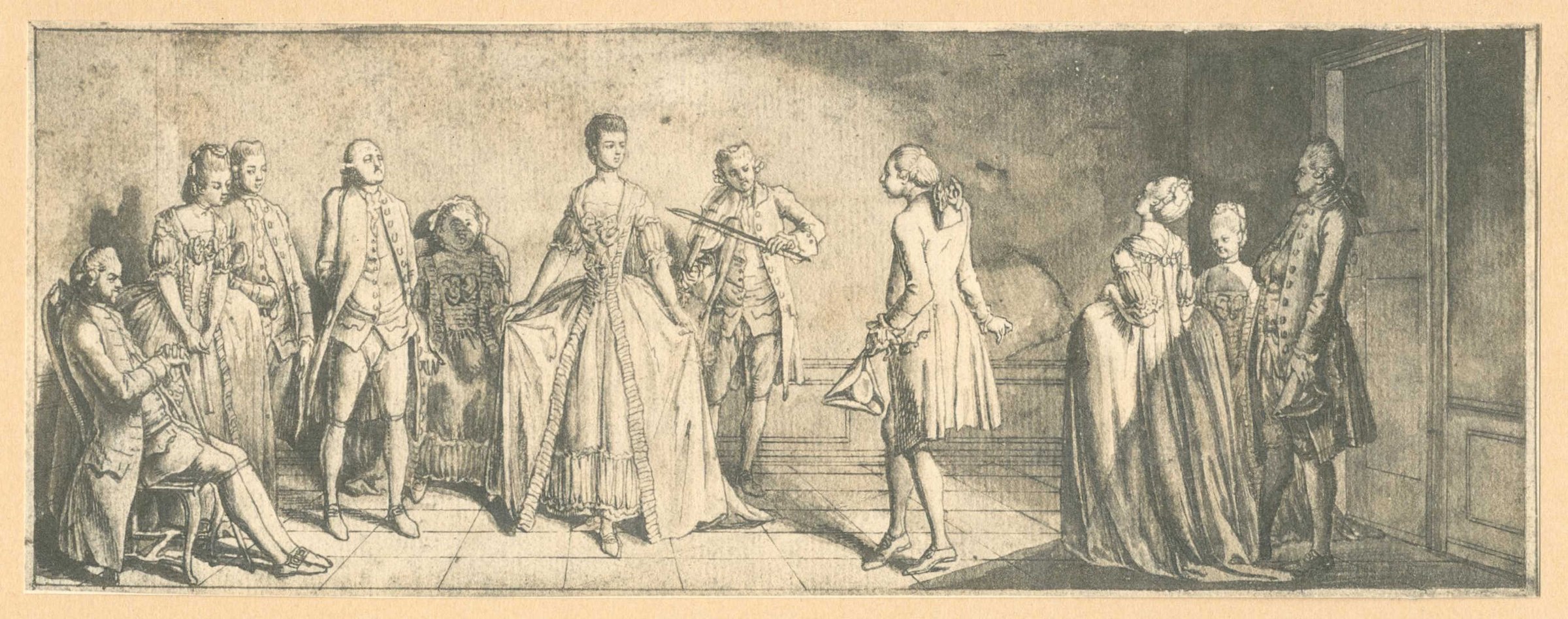
An interior room with high walls hosts a formal minuet lesson or demonstration. A central female figure in a pale, high-waisted gown stands in profile, one arm extended, while a male instructor—seated on the left in darker dress—observes or directs. Around them stand roughly a dozen onlookers in 18th-century court dress: men in breeches and coats, women in full skirts, all arranged as if attending an instruction or social event. The composition is shallow and frieze-like, pressed against the picture plane; a doorway visible at right suggests a formal interior. The light is even and studio-like, characteristic of an engraved or drawn record rather than observed life.
The dancing
The central female dancer stands nearly upright, weight forward on one leg, with the opposite arm raised to about shoulder height in an open, extended line. Her posture is upright and controlled—characteristic of minuet carriage. The male figure seated at left gestures with one arm raised, likely demonstrating or correcting. The surrounding figures stand at rest or in casual conversation, framing the action without participating. No couples are shown in closed hold or active partnership; this is pedagogical observation rather than social dancing.
The dance depicted
This is unambiguously a minuet lesson, as confirmed by the German caption 'Die Menuettprobe' (The Minuet Trial/Rehearsal) preserved in the record. The image shows the formal instruction mode of the minuet during the late 18th century: a solo dancer executing steps or positions under the eye of a master, with pupils or members of the household attending. The minuet at this period was a codified, highly formal dance; this scene captures its pedagogical and social function rather than its performance in a ballroom. The upright posture, extended arm, and meticulous stance all accord with written descriptions of minuet technique from dance manuals of the 1750–1780 period.
How it was made
This is a copper engraving (or possibly etching), recognizable from the fine parallel lines of shading, crisp linear definition, and the uniform tonality typical of 18th-century reproductive print-making. It is one plate in the Basedow Tafel series, an encyclopedic illustrated work intended for educational circulation; the print has the technical precision and clarity required for wide reproduction. The linear medium allowed the artist to render costume detail and spatial relationships with exactness, making it a reliable visual record of minuet teaching practice and dress.
About this work
This engraved plate documents a minuet lesson in an 18th-century household or academy, showing the formal transmission of courtly dance through direct instruction and observation. The minuet, though often depicted in ballroom scenes or in painting, is here shown in its pedagogical context—the site where technique, posture, and social propriety were actually acquired. The work belongs to the Basedow Tafel, a comprehensive illustrated encyclopedia of German pedagogy and social practice, and thus reflects Enlightenment-era confidence that all knowledge—including dance—could be observed, recorded, and systematized for rational improvement.
How to look at it
Notice the rigidity and geometric precision of the central dancer's posture: this is not entertainment but demonstration, a freeze-frame of correct position. Observe the male instructor's seated position and raised arm—he is actively teaching, not merely watching. The ring of onlookers creates a quiet, formal setting very different from the sociable chaos of ballroom dancing; this is a lesson, and decorum prevails. The artist has chosen to capture the moment of correction or instruction, not the momentum of the dance itself, which tells us that the work's value lay in recording *how* the minuet was taught rather than how it was performed.
The artist
Daniel Nikolaus Chodowiecki (1726–1801) was a Berlin-based engraver and painter, born in Danzig to a Huguenot family, who became one of the most prolific and versatile illustrators of the German 18th century. He worked extensively for Johann Bernhard Basedow's *Elementarwerk*, a progressive educational encyclopedia, contributing hundreds of engravings documenting domestic life, pedagogy, and social custom. His style combined Dutch-influenced precision with a keen eye for social genre; his work is valued both as art and as historical documentation of daily life during the Enlightenment.
The period
The minuet was the supreme ballroom dance of the 18th century and a marker of gentility and good breeding across Europe. By the 1770s, when this engraving was made, the minuet was already codified into a highly formal, almost ritualistic practice, taught by dancing masters and performed with elaborate precision in aristocratic and upper-middle-class drawing rooms. The Basedow Tafel appeared during the height of the Enlightenment pedagogy movement, when rational observation and systematic illustration were being applied to every domain of knowledge and skill—including dance. This plate reflects that era's conviction that social accomplishment could be analyzed, taught, and improved through careful study.
Where it lives
The work is identified as a plate from the Basedow Tafel (specifically Tafel 61, section a), an illustrated encyclopedia compiled by Johann Bernhard Basedow and engraved by Chodowiecki and others in Berlin from the 1770s onward. The source is given as Wikimedia Commons; no current holding institution is recorded in the catalogue.
Dance in this work
Questions about this work
What is the Basedow Tafel and why does it matter?
The *Elementarwerk* (or Basedow Tafel) was an ambitious educational encyclopedia published in Berlin starting 1774, designed to illustrate all knowledge and practical skills needed for enlightened citizenship. It included hundreds of engravings of daily life, education, work, and social practice. For dance historians, it is invaluable because it documents not elite performance but how ordinary genteel households actually taught and practiced social dances.
How does this differ from other 18th-century images of the minuet?
Most paintings of the minuet show it being danced socially in a ballroom—with multiple couples, spectators, musicians, and festive energy. This engraving strips away all of that and shows the minuet at its source: alone, in a teaching space, with the master present and the dancer concentrating on technique. It is a rare image of dance as skill acquisition rather than social performance.
What does the dancer's posture tell us about minuet technique?
The upright carriage, extended arm, and controlled weight distribution all confirm what we read in written dance manuals of the period: the minuet was danced with formal elegance, with the body held erect, arms open and lifted, and movement restrained and precise. There is no flirtation or exuberance here—only deportment.
More Minuet artwork