49 works in this view — arrow keys or swipe to move between them.
Dance in Art · 1904
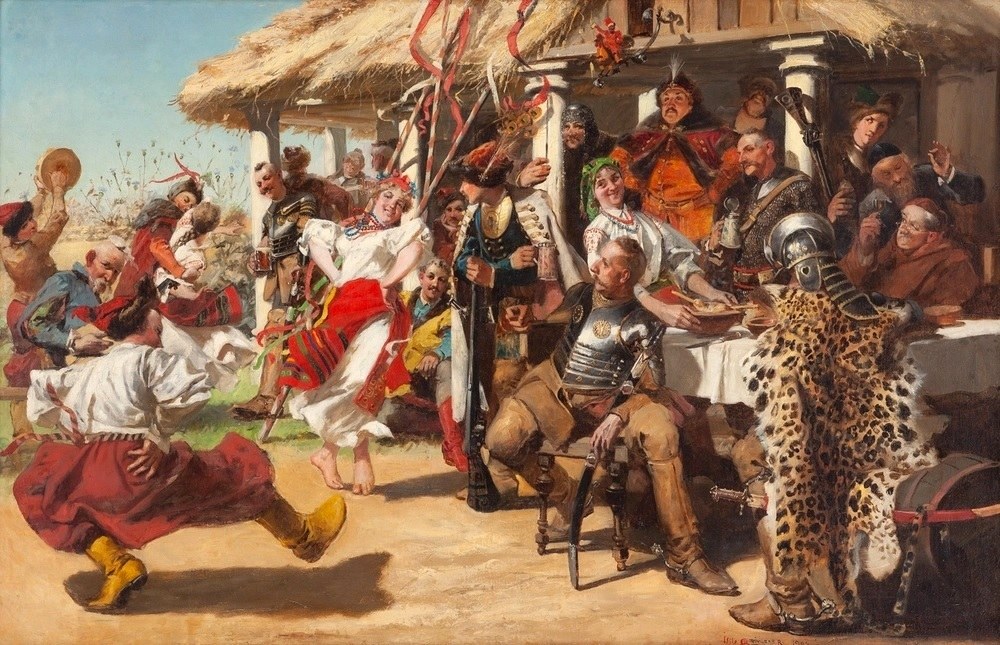
Jan Czesław Moniuszko - Biesiada przed karczmą 1904
Jan Czesław Moniuszko
- Medium:
- Oil Painting
- Era:
- 1900-1920 (Ragtime/Early Jazz)
- Source:
- Wikimedia Commons
- Rights:
- Public domain — free to use, share and adapt.
- Recorded as:
- Public Domain
This work documents a non-codified, socially liberatory form of movement — the folk or carnival dance that exists outside the ballroom and concert hall. For historians of vernacular dance and the social history of the body, it is rare visual evidence of how unschooled, ecstatic movement was perceived and valued by European artists and audiences in the early 20th century. The image asks what becomes visible when the body is allowed to move without the constraint of form or propriety.
What you are looking at
A lively outdoor gathering before a tavern, rendered in oil with vivid color and crowded composition. The scene appears set in a Polish or Eastern European village, with a thatched-roof building on the right and figures densely packed across the foreground and middle ground. A woman in red skirts dominates the left foreground, caught mid-leap or violent movement, her body twisted and limbs splayed. Behind and around her, dozens of onlookers in period dress — soldiers in armor and plumed helmets, noblemen in jeweled coats, women in white headdresses and colored gowns — watch intently. A leopard or spotted big cat stands tethered in the right foreground, adding exotic menace to the scene. The lighting is bright and clear, with strong shadows cast by the afternoon sun, emphasizing the theatrical nature of the moment. Red and white ribbons or banners hang from a wooden frame above the crowd.
The dancing
The central female dancer's body is radically extended — one leg kicks upward, her torso arches backward, her arms flung wide in a posture of ecstatic abandon or frenzy. Her movement is solitary and uninhibited, contrasting sharply with the static poses of the surrounding crowd, who form an audience rather than participants. She wears a voluminous red skirt that swings with her motion, and yellow shoes or stockings are visible. No partner supports or frames her; she moves alone, uncontained by the formal holds or pairings of ballroom dance. The other figures stand, sit, or lean — some pointing, some gesturing — in attitudes of attention or amazement rather than dance.
The dance depicted
This does not depict a formalised theatrical or ballroom dance. The image appears to show a wild, ecstatic folk or carnival moment — possibly a traditional Polish or Eastern European festival dance, or a moment of frenzied celebration at a village feast. The woman's movement is explosive and asymmetrical, closer to trance dance, carnival ecstasy, or ritualized folk expression than to the codified steps of 19th-century social dance. The title *Biesiada przed karczmą* ("Feast Before the Tavern") suggests a moment of spontaneous, unschooled revelry rather than learned choreography. The exotic presence of the leopard and the exotic costumes hint at a moment of transgression or theatrical licence — a carnival or masquerade moment where normal social order is suspended.
How it was made
Oil on canvas, with richly saturated color and dense, energetic brushwork. The composition is crowded and slightly chaotic, using overlapping figures and varied scale to create depth and the sense of a throng. The artist's technique here emphasizes narrative and spectacle over formal balance; the eye is pulled to the red-dressed figure's movement but held within the larger chaos of the scene. Oil paint allowed the artist to render fine detail in costume, armor, and jewelry while maintaining the overall vigour of the composition. The work appears designed for viewing in an interior gallery setting — it is a historical or ethnographic genre scene rather than a decoration or portable miniature.
About this work
Jan Czesław Moniuszko's *Biesiada przed karczmą* depicts a moment of wild, ecstatic movement at a village feast, capturing not a learned dance but the uncontained joy and possible transgression of a folk celebration. The solitary, explosive figure of the dancing woman — her body twisted in a leap, her skirts flying — dominates a scene crowded with onlookers in costume, suggesting a moment when normal social rules are suspended and the body is freed from formal constraint. The painting sits at the intersection of ethnographic interest (in Polish or Eastern European folk customs), carnival theatre, and the 19th-century fascination with the body in extremity. It is a work about the power of movement to transgress and transform, rendered in the vivid, narrative style of late 19th-century European salon painting.
How to look at it
Look first at the solitary female figure's posture: the artist has chosen the moment of maximum extension and release, when the body is most visibly uncontained. Notice that she is not dancing *with* anyone — no partner, no formation, no mutual frame — but rather *for* an audience of onlookers who are frozen in attitudes of spectatorship. The moment chosen is one of ecstatic display, and the crowd's stillness makes the woman's movement more violent by contrast. Pay attention to how the artist uses color — the red skirts, the jeweled coats of the soldiers, the white headdresses — to structure the chaos and pull the eye toward the transgressive centre. The leopard, tethered but present, suggests that what is being witnessed is a kind of licence or permitted wildness.
The artist
Jan Czesław Moniuszko (1865–1935) was a Polish painter known for large historical and ethnographic genre scenes set in Polish and Eastern European village life. He was part of the late 19th-century movement toward documenting folk customs and traditional life as modernity threatened to erase them. His work often combined vivid narrative, rich costume detail, and a sense of theatrical spectacle, drawing on academic salon painting traditions while depicting subjects — peasant life, folk festivity, village gatherings — that were considered marginal to high art. He worked primarily in oil and was exhibited across European salons.
The period
The painting dates to 1904, a moment when European artists and intellectuals were intensely interested in folk culture, peasant life, and non-Western or pre-modern forms of expression as sources of authenticity and vitality supposedly lost to industrial modernity. The Romantic and Post-Romantic fascination with the "folk" as repository of truth and feeling was at its height. In dance history, this was the era of the Russian Imperial Ballet's dominance, but also of growing anthropological and ethnographic interest in non-codified movement forms. The exotic leopard in the scene suggests influence from colonial and orientalist spectacle — the idea that transgression and wildness could be theatrically staged and observed.
Where it lives
The work is recorded as an oil painting dated 1904 by Moniuszko and sourced from Wikimedia Commons. The holding collection is not recorded in the catalogue.
Dance in this work
Questions about this work
Is this a real dance or a made-up scene?
The painting appears to depict a real moment of folk festivity — likely a Polish or Eastern European village feast or carnival — rather than an invented narrative. However, what is shown is not a learned, codified dance but an ecstatic, unschooled moment of movement within a festive gathering. The artist has chosen to freeze a moment of maximum wildness and release, which may be exaggerated or theatricalised for effect.
Why is there a leopard in the scene?
The presence of the exotic big cat is unusual and suggests this may be a special occasion — a feast with theatrical or carnival elements that included exotic spectacle. Alternatively, the leopard may be a symbol of wildness, danger, or transgression, suggesting that the dancing woman is being positioned alongside other sources of threat or fascination.
What kind of dance is this?
This is not a ballroom, theatrical, or formalised folk dance in the codified sense. It appears to be a moment of ecstatic, carnival, or ritual movement — the kind of unschooled, uncontained dancing that happens at feasts and celebrations when social restraint is lifted. It is closer to trance or possession dance, or carnival revelry, than to the structured steps taught in dance schools.
More dance artwork