49 works in this view — arrow keys or swipe to move between them.
Dance in Art · 1886
City flowers LCCN2011661371
Unknown
- Medium:
- Lithograph
- Era:
- Late 1800s (Victorian Ballroom)
- Source:
- Wikimedia Commons
- Rights:
- Public domain — free to use, share and adapt.
- Recorded as:
- Public Domain
The work is historically important as evidence of how dance—particularly the waltz—functioned as a visual marker of women's social position and courtship availability in Gilded Age America. For students of dance history, it shows how ballroom dancing was understood not as an art form or physical skill, but as an essential ritual of feminine display and social conformity. The satirical register is crucial: the artist is not celebrating women's grace in dance, but rather critiquing the reduction of women to decorative objects, using the waltz couple as shorthand for this commodification.
What you are looking at
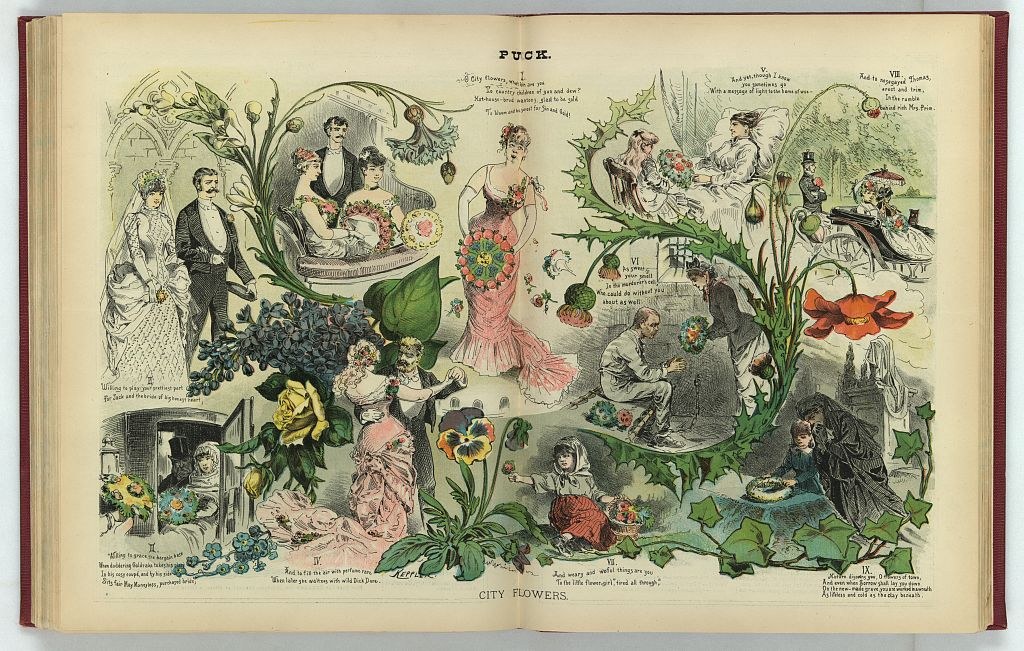
This is a chromolithograph centerfold from Puck magazine treating women and flowers as parallel subjects. The composition is dense with vignettes: at left, women in evening dress attend social functions; a woman in a pink gown dominates the center, surrounded by oversized blooms; at right, scenes of women in domestic and professional contexts. Large botanical specimens—hollyhock, iris, dahlia, what appears to be an amaryllis—are interspersed throughout the design as if the women themselves are varieties of cultivated flower. The figures are rendered in the magazine's characteristic style: fine line work for faces and fabric, with selective color applied to the flowers and some garments. The composition is deliberately artificial and allegorical rather than naturalistic; the women do not occupy a coherent space but instead populate a decorative field. Throughout are small text captions that, according to the record, contain verses unflattering to women—reading these is essential to understanding the image as satire rather than celebration.
The dancing
The central female figure wears a pink ballgown and stands in a conventional pose of social display, one arm raised with a flower in hand. Several surrounding figures are shown in social dance positions: one couple appears to be waltzing or in a closed ballroom position (left side), another woman in a theater box gestures as if applauding or conversing. The poses are mannered rather than energetic; these are women on display at leisure, not executing complex movement. Body weight is typically shifted to one leg in a demure S-curve—the fashionable silhouette of the 1880s. Where dance appears, it is confined, formal, and observed rather than vigorous.
The dance depicted
The image depicts social ballroom dancing of the Gilded Age, specifically the waltz and related drawing-room dances that were central to respectable courtship and society gatherings. A waltz couple is visible at left in closed position. The dances shown are not meant to be technically displayed but rather to situate women within their proper social sphere—theater, drawing room, and ballroom as sites of courtship and matrimony. The satirical intent suggests criticism of women's limited social roles and the commodification of women as ornamental objects, figured through the flower metaphor.
How it was made
This is a chromolithograph, a color printing process that allowed for complex polychromatic designs and was ideal for the mass circulation of satirical and humorous weekly magazines. The technique required separate stone plates for each color, allowing fine detail and gradation. Chromolithography made Puck affordable and visually striking for a middle-class American readership. The medium's capacity for both delicate line work and bright, flattened color is evident here: the women's faces and clothing are rendered with fine draftsmanship while the botanical subjects display vivid greens and pinks. The signature 'Keppler' indicates the designer of the composition; such political and social satire was a central function of the medium in the 1880s.
About this work
This is a satirical illustration from Puck, a leading American humor magazine, treating women and ornamental flowers as parallel subjects of cultivation and display. Published on January 6, 1886, it uses the waltz and other ballroom dances as a visual shorthand for women's prescribed social roles in Gilded Age America. The dense, decorative composition and accompanying verse present a critique—however blunt—of women's restriction to ornamental functions and marriageability. As a chromolithograph, the work reached a mass audience and reflects the visual language through which gender politics were conducted in American popular media of the period.
How to look at it
The viewer should first note the composite structure: this is not a single dance scene but a dense field of allegorical vignettes, unified by the flower-woman metaphor. Look for the couple in closed position (left side), which is the clearest representation of ballroom dancing; note their formal, constrained posture. Then read the smaller scenes—women in boxes at theater, women in domestic settings—to understand how dance and ballroom culture are one among several sites of feminine display. The verse captions are essential; without them, the image might read as a celebration of feminine grace, but they are integral to the satire. The choice to render the women with the same careful attention as the botanical specimens is deliberate and pointed.
The period
The 1880s saw the waltz at the height of its respectability and dominance in American ballroom culture, though it retained associations with both propriety and transgression—its close hold had once scandalized society but was now thoroughly normalized among the respectable classes. Simultaneously, the Gilded Age witnessed intense cultural anxiety about women's roles: the "New Woman" was emerging as an economic and educational force, yet social ideals continued to confine women to domestic and ornamental functions. Puck magazine, founded in 1876, became a major vehicle for satirizing these contradictions. The 1880s also marked the height of chromolithography as a popular art form, enabling magazines to reach a mass audience with visually sophisticated political commentary.
Where it lives
This is a centerfold from Puck magazine, volume 18, number 461, dated January 6, 1886. Puck was a weekly satirical magazine with a mass circulation in the United States, and this work would have reached thousands of middle-class readers. It is held by the Library of Congress and is available through Wikimedia Commons.
Dance in this work
Questions about this work
What is the connection between the women and the flowers?
The artist uses flowers as an extended metaphor for women in society: both are cultivated, ornamental, valued for their beauty, and ultimately passive objects on display. The title 'City Flowers' puns on the notion of urban women as specimens of a particular kind—refined but rootless, decorative but disposable. The accompanying verses make clear this is satire, not celebration.
Is the dance in this image meant to be realistic or symbolic?
The dance is entirely symbolic. The waltz couple and the isolated gestures in theaters and drawing rooms are not meant to show how people actually danced, but rather to mark the spaces—ballroom, theater, home—where women's social value was determined. The constrained postures reflect both the technical formality of ballroom dancing and the broader social constraints on women's bodies and behavior.
Why does Puck magazine include a waltz scene in a critique of women?
The ballroom and the waltz were central rituals of courtship and social display for respectable women in the Gilded Age. By including dance among other scenes of feminine display—theater attendance, domestic labor, bridal status—the artist argues that all these activities reduce women to ornamental objects. The waltz was not being attacked as a dance form, but rather as one among many enforced rituals of feminine conformity.
What does the satire in the verse add to the image?
The verses, which the catalogue notes are 'not very flattering to women,' are essential context. They transform what might otherwise read as a celebration of feminine beauty into a pointed critique of women's limited social roles. The juxtaposition of refined, decorative imagery with scathing commentary is typical of Puck's satirical strategy.
More dance artwork