35 works in this view — arrow keys or swipe to move between them.
Dance in Art · 1622
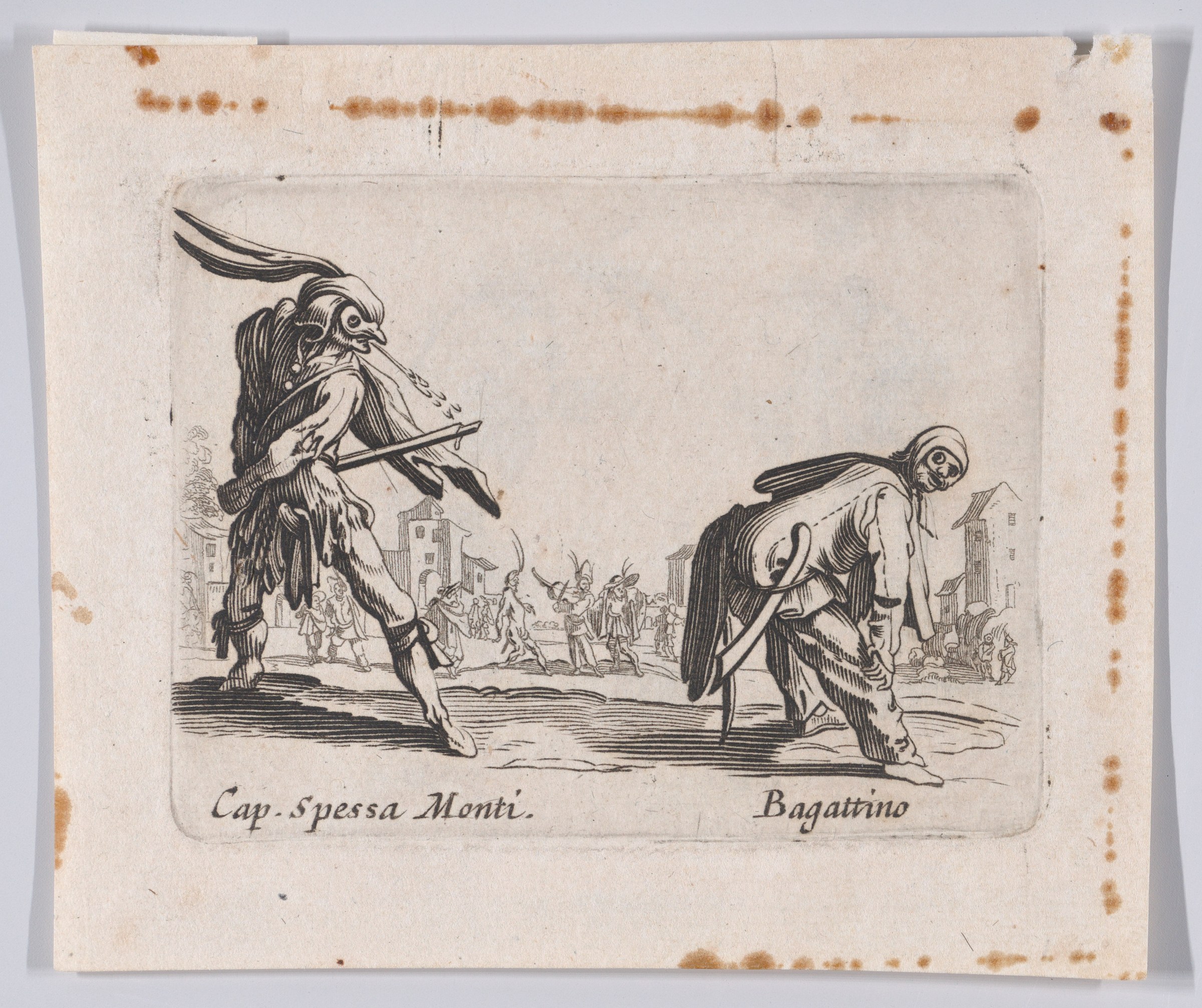
Copy of Capitano Spessa Monti and Bagattino, from Balli di Sfessania (Dance of Sfessania) Met DP890481
Jacques Callot
- Medium:
- Oil Painting
- Era:
- Pre-1700 (Renaissance/Baroque)
- Source:
- Wikimedia Commons
- Rights:
- Public domain — free to use, share and adapt.
- Recorded as:
- CC0
Commedia dell'arte was a foundational training ground for centuries of European performers, including dancers and choreographers; understanding the physical vocabulary and character types visible here is essential to interpreting early modern theatre and dance. This engraving is one of the few ways we can see how these characters were actually embodied and presented, making it a rare window into popular movement practices that left no notation behind.
What you are looking at
Two grotesque figures dominate a sunlit plaza, their exaggerated physiques and distorted features marking them as comic characters from the commedia dell'arte tradition. The larger figure on the left, labeled *Cap. spessa Monti*, wears draped cloth and a feathered headdress, wielding what appears to be a cooking implement or ladle as a prop of comic authority. The smaller figure on the right, *Bagatrino*, bends forward in a posture of deference or mockery, also wearing draped garments and a headdress. Behind them, a town square fills with tiny figures—townspeople, musicians, and onlookers—establishing this as a public performance or street spectacle rather than a formal theatrical stage. The engraving technique creates sharp contrasts between the figures in the foreground and the busy architecture and crowd beyond, suggesting movement and energy radiating from the two performers outward.
The dancing
Both figures are rendered with distended abdomens and spindly limbs characteristic of commedia stock types. The Capitano on the left stands with legs apart in a posture of swagger and command, while Bagatrino's forward-leaning stance—hips bent, back curved—reads as submission, obeisance, or exaggerated comic supplication. Neither figure is posed in a formal dance hold; instead, their grotesqueness and the gap between them emphasizes the physical comedy of the interaction rather than technical dancing. The asymmetry and caricatured anatomy suggest these are character types defined by physicality and mimicry rather than trained balletic movement.
The dance depicted
These are stock characters from the *commedia dell'arte*, the improvisational Italian theatre tradition that flourished from the 16th through 18th centuries. The *Capitano Spessa Monti* is a variant of the braggart soldier character—pompous, vain, and usually a butt of jokes—while *Bagatrino* represents a zanni or servant figure, nimble and scheming. The image does not depict formal dance in the sense of a choreographed suite or court entertainment; instead, it documents the physical comedy and gestural vocabulary of street performance. However, commedia actors were highly skilled physical performers, and the exaggerated postures here represent the enlarged, theatrical body language that would have accompanied music, song, and rhythmic movement in actual performance. The setting in a town square confirms this was popular street theatre, not elite court spectacle.
How it was made
This is an engraving—a print made by incising lines into a metal plate and taking impressions from it. The fine parallel hatching visible throughout creates tone and shadow, particularly in the drapery and the figures' distended forms. Engraving allowed for precise detail and wide circulation; this sheet was likely one of a series documenting commedia characters, meant to be collected, sold cheaply, and pinned up or bound into albums. The technique's ability to capture both grotesque exaggeration and architectural detail made it ideal for documenting popular performance types that would have been transient and geographically scattered. The wear and foxing visible on the sheet suggests this is an old impression, handled and preserved for centuries.
About this work
This engraving is a visual record of commedia dell'arte, the improvisational street and stage theatre that shaped European performance for two centuries. It documents not a single performance or moment but rather two archetypal characters—the bombastic soldier and the clever servant—in their typical interaction: swagger, submission, comic business. The image sits at the intersection of theatre history, social history, and the history of the body: it shows us how physical comedy was constructed, codified, and circulated in the age of print. For dance history, it matters because commedia performers were dancers in the broadest sense—actors trained in heightened physical expression, timing, and the vocabulary of gesture. This print is part of a much larger documentation of popular movement practices that survive in prints and descriptions far more often than in formal dance notation.
How to look at it
Attend to the distortion: the swollen belly, the thin legs, the exaggerated height difference between the two figures. This is not naturalistic representation but caricature designed to be read from a distance, as street performance would have been. The postures—the Capitano's legs-apart stance and the servant's crouch—are frozen mid-action, capturing the moment of maximum comic contrast. Notice how the print captures movement through stillness: the sense of dominance and submission, of energy and scheming, comes not from motion blur or sequential poses but from the equilibrium and strain visible in each figure's body. The tiny figures in the background remind us that this performance is public, watched, part of a social event, not a private moment.
The artist
Jacques Callot (1592–1635) was a supremely influential printmaker based in Lorraine and Italy who specialized in theatrical and popular subjects. He developed a distinctive etching technique that allowed for fine detail and great versatility, and he documented commedia characters multiple times across his career—most famously in the *Balli di Sfessania* series, from which this image comes. Callot's prints were widely collected and copied; his theatrical imagery shaped how later artists understood and depicted performance. He was equally celebrated for prints of battles, processions, festivals, and beggars, and his technical virtuosity and eye for movement—the tilt of a hat, the angle of a prop, the economy of line—made him a model for printmakers for centuries.
The period
The early 17th century saw commedia dell'arte at the height of its international influence; troupes travelled across Europe and the form shaped elite court entertainments as well as street performance. Simultaneously, prints—particularly Callot's—were becoming the primary means by which theatrical forms were documented and circulated across regions that had no common language or court. In this same period, formal dance was being codified: ballet was developing at the French court, and dance masters were beginning to publish notation systems. The contrast is telling: elite dance was documented in notation and theoretical texts; popular performance was documented in prints that captured character, energy, and the lived body rather than steps.
Where it lives
The record identifies this as a copy of a work from the *Balli di Sfessania* series; it is sourced from Wikimedia Commons, which typically holds images from public collections or published facsimiles. The original series was published in the early 1620s and survives in many impressions and copies, suggesting it was popular and widely distributed.
Questions about this work
What is commedia dell'arte?
Commedia dell'arte was improvisational theatre performed by professional actors, widespread in Europe from the 16th to 18th centuries. Actors played stock character types—the braggart soldier, the clever servant, the old man, the lovers—and improvised dialogue, gags, and physical comedy around known scenarios. The form was performed in street squares, fairgrounds, and courts, and it valued physical skill, timing, and the ability to read and engage an audience. Many stock characters, costumes, and movements survived for centuries.
Who were the Capitano and Bagatrino?
The Capitano is a stock character type: a military man (or man pretending to be one) who is cowardly, boastful, and ridiculous. Bagatrino is a servant or zanni figure, nimble, scheming, and often the Capitano's rival or tormentor. In performance, their interaction typically involved mockery, physical comedy, and the servant outwitting the master—a pattern that audiences expected and enjoyed.
Why did Callot print these characters?
Callot documented theatrical and popular subjects that fascinated collectors and that artists used as reference. The *Balli di Sfessania* series was likely made for sale to artists, theatre companies, and educated collectors interested in Italian popular theatre. Prints circulated knowledge: they let people in other countries see what commedia characters looked like, how they moved, and what stories could be told with them.
Is this dance?
Not in the formal sense of ballet or court dance, but yes in the broader sense of trained physical performance. Commedia actors were highly skilled at movement, gesture, timing, and the stylized use of the body. They danced when music called for it, but primarily they were actors whose physical vocabulary was exaggerated, rhythmic, and carefully controlled—a kind of movement literacy that shaped professional performance.
More dance artwork