36 works in this view — arrow keys or swipe to move between them.
Dance in Art · 1622
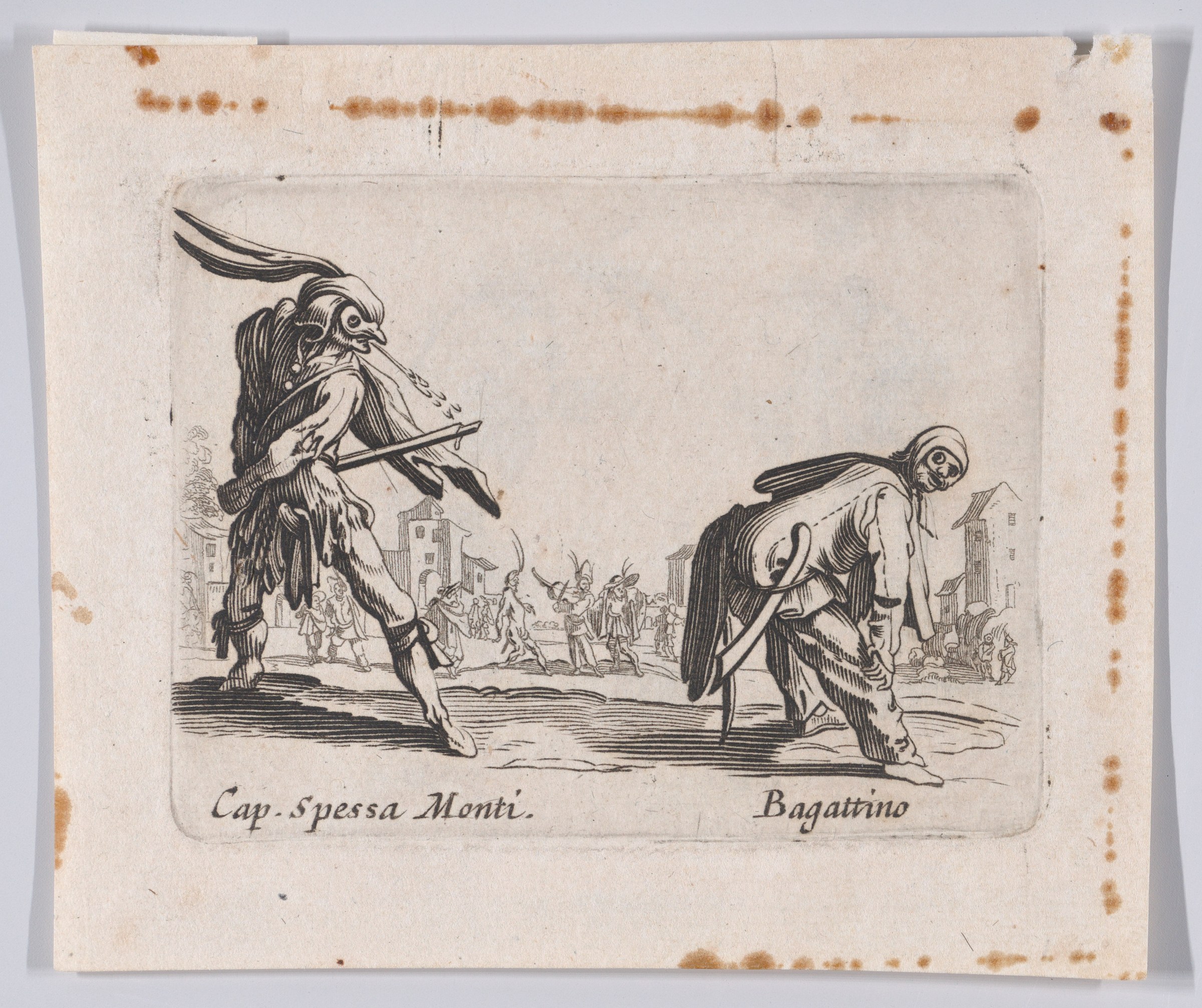
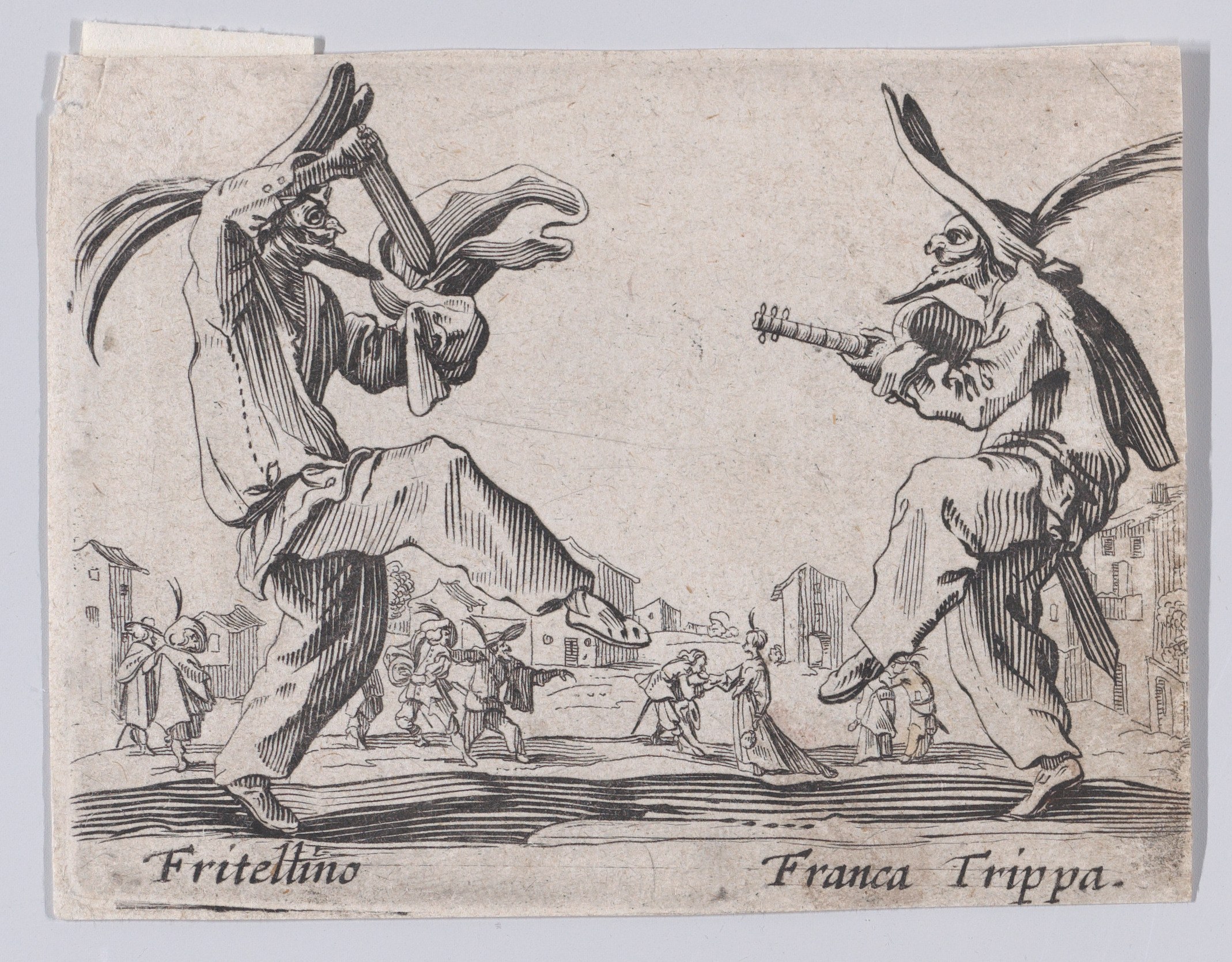
Copy of Franca Trippa and Fritellino, from Balli di Sfessania (Dance of Sfessania) Met DP890479
Jacques Callot
- Medium:
- Oil Painting
- Era:
- Pre-1700 (Renaissance/Baroque)
- Source:
- Wikimedia Commons
- Rights:
- Public domain — free to use, share and adapt.
- Recorded as:
- CC0
The *Sfessania* series is one of the primary visual documents we have for popular, non-courtly dance in the early 17th century, showing a tradition that would otherwise be largely invisible in historical records dominated by court entertainments. The identification of specific character-types (Fritellino, Franca Trippa) and the emphasis on grotesque physicality, instrumental music, and street settings establishes that early modern dance culture was far more diverse and physically exuberant than the formal dances that dominate surviving dance manuals.
What you are looking at
Two grotesque winged figures dominate the composition, hovering above a street scene rendered in miniature below them. The figure on the left (labeled Fritellino) wears a pointed hat and holds what appears to be a stringed instrument or lute; the figure on the right (Franca Trippa) also wears a tall headdress and plays a wind instrument, possibly a recorder or pipe. Both have exaggerated, caricatured features—long noses, prominent chins—and their bodies twist in animated poses with wings spread and limbs extended in emphatic gestures. Their elaborate, voluminous clothing billows around them. In the middle distance, a street or plaza is filled with small figures engaged in various activities: some appear to be dancing or moving in groups, others stand in clusters or pairs, with buildings framing both sides of the scene. The composition uses stark black line work on a cream-colored ground, typical of the engraving technique.
The dancing
The two main figures adopt exaggerated, theatrical poses with arms raised and extended, bodies twisted at the torso in ways that suggest animation and movement rather than naturalistic anatomy. Their gestures are emphatic and gestural rather than balletic—the left figure's arm position suggests instrumental playing or conducting, while the right figure's pose is similarly dynamic and communicative. The smaller figures in the street scene below are rendered with less detail but appear to be engaged in social movement and interaction, some in pairs or small groups. The scale and positioning of the grotesque figures dominating the composition suggest these are allegorical or character types presiding over the social scene.
The dance depicted
This engraving documents the *Balli di Sfessania* (Dances of Sfessania), a series of comic, acrobatic, and often grotesque character dances that were popular in Italian street performance and commedia dell'arte during the early 17th century. Fritellino and Franca Trippa are named character-types from this tradition—stock figures recognizable to the period's audience. The *Sfessania* dances were performed by itinerant entertainers, troupes, and street performers; they were less formal than court dances and emphasized physical exaggeration, buffoonery, and novelty. The presence of musicians (indicated by the instruments held by the main figures) and the gathered crowd in the street setting confirms this as documentation of popular, participatory street entertainment rather than courtly or theatrical dance.
How it was made
This is an engraving—a print made by incising lines into a metal plate (likely copper), which are then filled with ink and printed onto paper. The medium is characteristic of Jacques Callot's practice and allowed for fine linear detail, dramatic contrast between black and white, and the production of multiple impressions from a single plate. Engravings circulated widely in the 17th century, making them an important vehicle for disseminating images of contemporary costume, social life, and entertainment across Europe. The technique's reliance on confident, continuous line work is evident in the rendering of the grotesque figures' features and the architectural elements.
About this work
This engraving is one of a series documenting the *Balli di Sfessania*, a form of popular street and commedia dell'arte dance performance that flourished in Italy in the early 1600s. It captures a moment of street entertainment, with two grotesque musician-dancers presiding over a scene of social gathering and movement. The work is valuable as both a visual record of how these dances were performed—with emphasis on physical exaggeration, instrumental accompaniment, and participatory crowd engagement—and as evidence of the kinds of entertainment available to ordinary people in early modern Italian cities. It represents a tradition of popular performance that existed in parallel to the more formal and documented court dances of the same period.
How to look at it
Attend to the deliberate contrast between the two scales of the composition: the enormously magnified grotesque figures in the foreground, with their exaggerated features and emphatic gestures, and the tiny, detailed street scene below. This compression of scale is not accidental but communicative—it suggests the outsized character and visual spectacle of these performances, the way they dominated public attention. The instruments held by the main figures and the clusters of figures below indicate that this was a participatory, social form of entertainment involving music and movement together. Notice too how the artist has frozen these characters in arrested, theatrical poses rather than naturalistic movement—the twisted torsos, raised arms, and spread wings all suggest the explosive, surprising physicality of commedia dell'arte.
The artist
Jacques Callot (1592–1635) was a highly influential Florentine-born engraver and printmaker who worked in Italy and France. He is famous for his dynamic compositions, fine linear technique, and documentation of contemporary social life—carnival scenes, military camps, street performers, and beggars. His prints circulated widely and established conventions for depicting movement and crowd scenes that influenced artists across Europe. The *Balli di Sfessania* series, created early in his career, showcases his interest in capturing the physical grotesquerie and social vitality of popular entertainment.
The period
The early 17th century saw a flourishing of commedia dell'arte and street performance traditions in Italy, parallel to the formalization of court dance and the development of ballet in France. While the aristocratic world was codifying dance into measured, dignified forms, street performers and traveling troupes maintained traditions of physical comedy, acrobatic spectacle, and musical accompaniment that privileged surprise and exaggeration. The *Sfessania* dances represent a vital popular culture of the body that coexisted with—and sometimes influenced—more elite forms. Callot's series documents this tradition at a moment when printmaking was becoming a primary means of disseminating images of contemporary life.
Where it lives
The record indicates this is a copy of a work by Jacques Callot, sourced from Wikimedia Commons. The original *Balli di Sfessania* series was produced as a set of engravings in the 1620s; copies and later printings are common, as the plates circulated widely. No specific holding collection is identified in the catalogue record.
Dance in this work
Questions about this work
Who were Fritellino and Franca Trippa?
They were stock character-types in the commedia dell'arte and street performance traditions of early modern Italy. Fritellino was a zanni (comic servant) character, often portrayed as buffoonish and acrobatic. Franca Trippa's identity is less certain, but the name suggests a female character associated with comic movement. These were recognizable types to the period's audience, much like modern comic characters with consistent personalities and physical signatures.
What are the Balli di Sfessania?
The *Balli di Sfessania* (Dances of Sfessania) are a documented set of popular, grotesque, acrobatic dances from early 17th-century Italy. Sfessania may refer to a legendary or regional tradition. These dances emphasized physical exaggeration, humor, and virtuosity rather than courtly elegance, and were performed by street entertainers, commedia dell'arte troupes, and itinerant performers. They represent an important tradition of popular physical culture that existed outside the court.
What does the engraving technique tell us about these dances?
Engraving was a reproducible medium that allowed images to circulate widely across Europe, suggesting these dances had enough cultural prestige and interest to warrant documentation and dissemination. The fact that Callot chose to make a series of engravings of the *Sfessania* indicates that street performance and popular dance were considered worthy subjects for fine art documentation. This contradicts the idea that only courtly dances mattered in the early modern period.
Why are the main figures so much larger than the crowd below?
The scale contrast is compositional strategy that emphasizes the charisma and visual spectacle of the named character-dancers. It suggests their outsized importance in the scene and the way performers would have dominated public attention. This hierarchical scaling is typical of early modern prints and serves both a practical purpose (clarity) and a communicative one (importance).
More dance artwork