39 works in this view — arrow keys or swipe to move between them.
Dance in Art · 1552
Francesco Salviati 004
Francesco Salviati
- Medium:
- Oil Painting
- Era:
- Pre-1700 (Renaissance/Baroque)
- Source:
- Wikimedia Commons
- Rights:
- Public domain — free to use, share and adapt.
- Recorded as:
- Public Domain
This work documents Renaissance attitudes toward the body in motion and toward the relationship between performance and spectatorship. For historians of dance, the painting provides evidence of how Renaissance artists understood and valued expressive movement—not as technical display but as a vehicle for emotional or spiritual intensity. The composition's dramatic isolation of the dancer, and the crowd's rapt attention, reveals how the period conceptualized the power of a moving body to command focus within a complex social scene.
What you are looking at
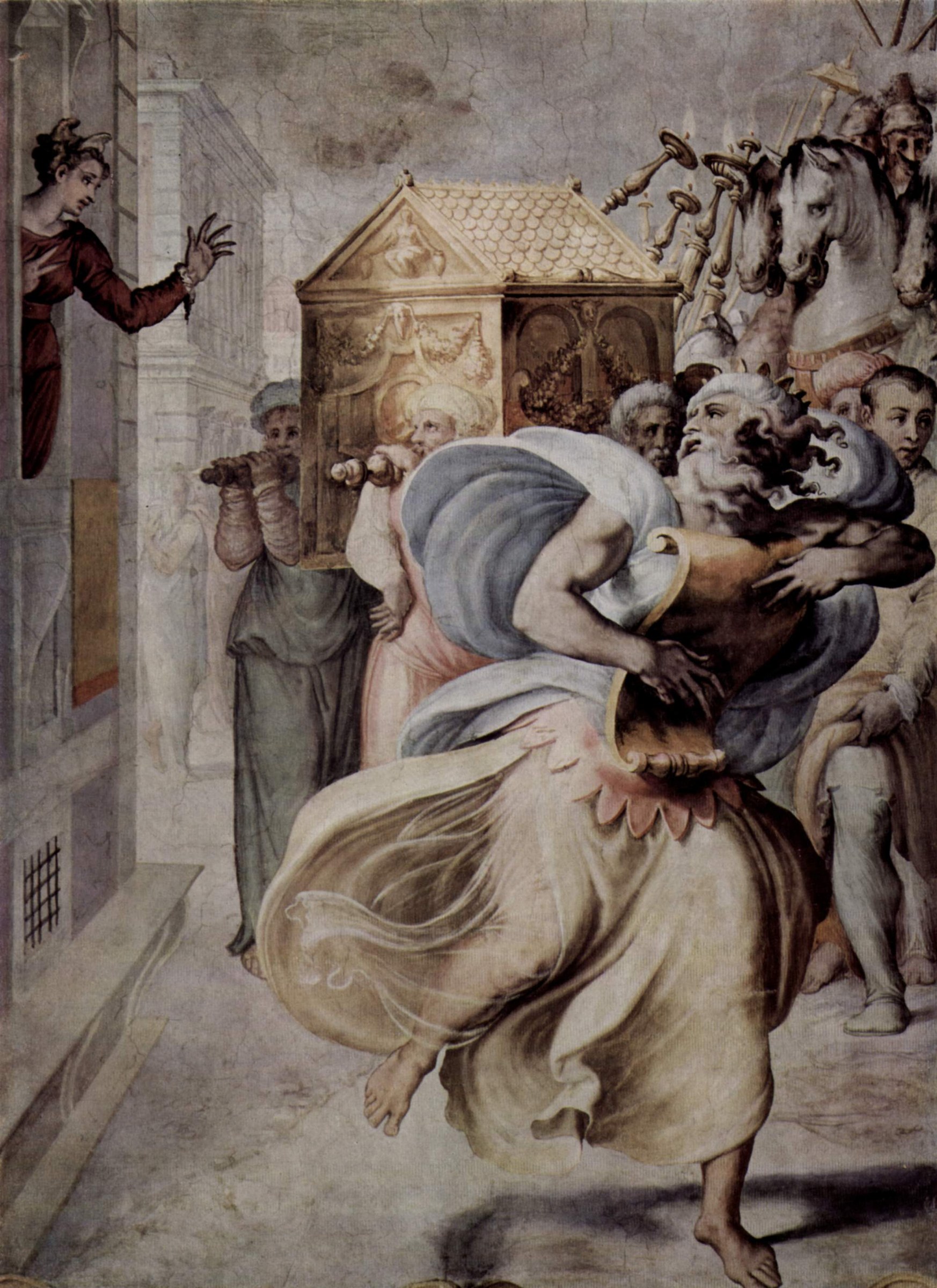
This is a densely populated interior scene set in what appears to be a classical Roman or Renaissance setting, with architecture featuring a temple-like shrine with a pitched roof visible in the background. The composition is divided between a solitary female figure in the left foreground, gesturing with raised hands toward the crowd, and a tightly clustered group of onlookers on the right. The woman in the foreground wears a flowing pale garment and head covering rendered in soft blues and whites, captured mid-movement with her body tilted and drapery swirling. The assembled crowd—rendered in more muted earth tones—watches her intently. On the far right, horses with attendants are visible, introducing a ceremonial or procession-like atmosphere. The scene is painted in the soft, warm tones characteristic of Renaissance fresco or oil technique, with careful modeling of fabric and flesh tones creating depth within the crowded composition.
The dancing
The central dancer stands in an asymmetrical, lunging stance with one leg extended and her weight shifted, arms raised and bent—a dynamic posture suggesting mid-movement or mid-leap. Her head is tilted back and her upper body curves away from the vertical. The crowd forms a static, witnessing group with upright posture and inward-focused attention, creating a strong contrast with the dancer's energetic frame. Her isolation from the crowd and their collective stillness emphasizes the performance quality of her movement.
The dance depicted
This appears to depict either a moment of inspired or ecstatic movement—possibly a Bacchic or Maenadal scene given the composition's visual rhetoric of abandonment and the gathered, amazed witnesses. The solitary dancer's dynamic, slightly unbalanced posture and upraised arms suggest either genuine religious trance or theatrical representation of ecstatic movement. The Renaissance setting and formal gathering suggest this is a court or ceremonial context. Without inscription or clearer narrative detail, the specific dance form cannot be identified with certainty, but the theatrical framing and the dancer's expressive abandon point toward either religious ecstasy or performance spectacle familiar to Renaissance court culture.
How it was made
This is an oil painting executed in the Renaissance manner, with careful attention to atmospheric perspective, fabric rendering, and the modulation of flesh tones. The warm ochre and soft blue color palette is characteristic of mid-16th-century Italian painting. The composition shows sophisticated spatial construction—the crowd recedes believably into the background, and the architectural elements frame the action convincingly. The technique allows for rich surface detail in costume and expression while maintaining the legibility of the crowded scene.
About this work
This oil painting by Francesco Salviati (1552) captures a moment of dynamic, solitary performance before an assembled crowd in a classical setting. The work sits within the Renaissance tradition of narrative historical or mythological painting, where moments of human drama—particularly moments of heightened emotion or extraordinary action—are rendered as formal spectacle. The careful composition and refined execution suggest this was a substantial commission, likely for a courtly or ecclesiastical patron familiar with humanist learning and classical subject matter. The painting belongs in a dance archive precisely because it privileges the visual drama of a single body in motion, choosing a moment of suspension and expressive gesture to hold the viewer's attention.
How to look at it
Attend first to the solitary figure in the foreground: the moment Salviati has chosen is one of suspension and off-balance dynamism, not a static pose. Notice how her raised arms and tilted head create a diagonal line of force across her body, and how the swirling drapery reinforces the sense of movement. Then look outward to the crowd's response—their stillness and focused attention frame her action as spectacle. The architectural frame and processional horses at the right suggest this is an important social or ceremonial moment, which transforms the movement from private emotion into public performance. The painting asks you to understand the moving body as a object of collective attention.
The artist
Francesco Salviati (1510–1563) was a prominent Florentine Mannerist painter, trained initially as a goldsmith and sculptor before establishing himself as a painter of complex narrative histories. He worked in Rome, Florence, and Venice, receiving commissions from papal and aristocratic patrons. His style is characterized by elegant figural compositions, sophisticated color handling, and an interest in dramatic spatial arrangements populated by numerous figures. He was known for frescoes and large-scale narrative paintings depicting classical and religious subjects, often with a theatrical sensibility and attention to the expressive possibilities of the human body in formal settings.
The period
In mid-16th-century Italy, dance was actively cultivated in court society and written about in emerging dance treatises (most notably Thoinot Arbeau's Orchesographie, though that was French, and earlier Italian sources). Renaissance painters increasingly depicted moments of social and ceremonial life, including dance and music-making, as part of a broader interest in humanist subject matter and in the representation of affect and movement. Salviati's generation was engaged with Mannerist principles of composition—complexity, artifice, and dramatic intensity—which allowed for sophisticated treatment of crowded scenes and heightened moments of human action. The painting's classical setting reflects the period's ongoing engagement with Greco-Roman sources as models for understanding human life and emotion.
Where it lives
This work is catalogued from Wikimedia Commons without holding information recorded. It is an oil painting dated to 1552 based on stylistic and archival evidence, though the current physical location of the original is not established in available records.
Dance in this work
Questions about this work
Is this a specific dance that Renaissance people would have recognized?
The painting does not show recognizable Renaissance social dance steps or formations. Rather, it appears to depict either an ecstatic or inspired moment—possibly mythological—or a theatrical representation of heightened emotional movement. The composition emphasizes expressive gesture and dynamic posture over the technical vocabulary of courtly dance.
Why is the dancer alone and the crowd watching?
This compositional choice frames the dancer as a performer and the crowd as witnesses, transforming an individual movement into a moment of social significance. Whether the movement is religious ecstasy, madness, or courtly performance, the isolation and focused attention suggest the artist is interested in how a moving body commands collective attention.
What does the classical setting tell us?
The classical architecture and processional horses indicate this is not everyday social dance but a significant ceremonial or mythological moment. Renaissance painters frequently used classical settings to elevate contemporary subjects or to locate narratives in an idealized past. The setting suggests the movement itself may have classical or mythological associations.
More dance artwork