44 works in this view — arrow keys or swipe to move between them.
Dance in Art · 1240
Meister Hesse 001
Meister Hesse
- Medium:
- Oil Painting
- Era:
- Pre-1700 (Renaissance/Baroque)
- Source:
- Wikimedia Commons
- Rights:
- Public domain — free to use, share and adapt.
- Recorded as:
- Public Domain
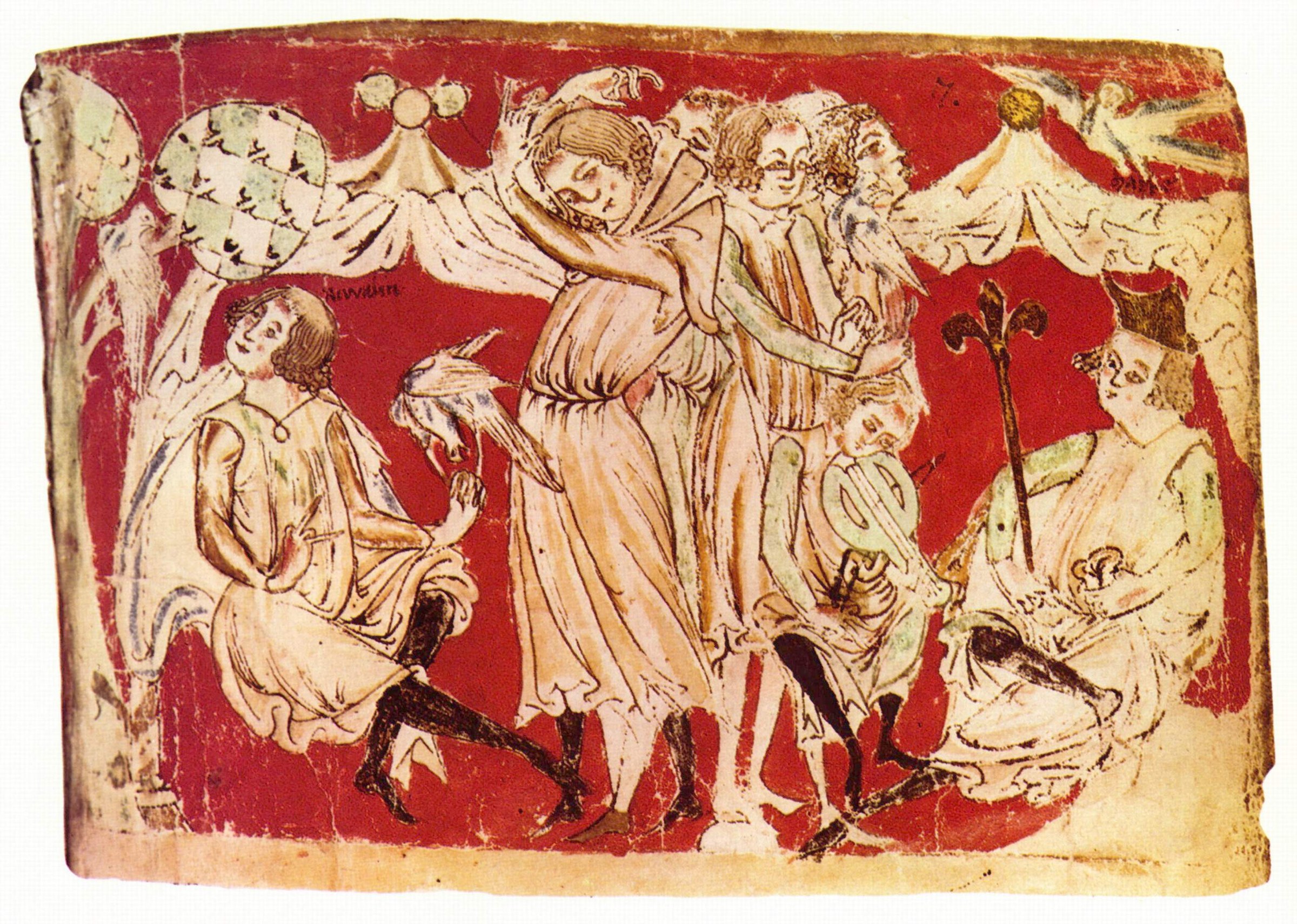
This work matters not as a dance record but as evidence of how medieval artists represented human figures in relationship: the spatial density, the variety of poses, and the gestural language here establish visual conventions that later influenced how artists would depict ballroom and courtly dance. For historians of movement representation in art, this manuscript page shows the precedent against which later Renaissance and Baroque dance imagery was composed.
What you are looking at
A celestial gathering of angels and figures in flowing robes dominates a brilliant red ground. In the center stands an older bearded man in ochre drapery, surrounded by younger figures with wings who cluster close around him in animated interaction. The composition is densely packed, with bodies overlapping and gestures radiating outward. At the left, a winged figure kneels or bends low; to the right, a crowned or mitred figure stands apart, holding what appears to be a staff or scepter. The upper portion of the composition shows additional winged figures; at the far left, a cactus-like plant with a schematic face emerges. The entire scene is rendered in sepia and ochre tones on the red ground, with black ink outlines defining the figures. The handling is delicate and precise, with fine linear details in drapery and facial features.
The dancing
Multiple figures occupy the space in varied spatial relationships: some stand upright, others bend or kneel, creating diagonal and curved lines through the composition. The central male figure appears to be the focus of attention from surrounding companions. Arms are raised, extended, or wrapped in drapery; one figure at the upper center gestures upward. The bodies are elongated and graceful, typical of medieval manuscript illustration. No formal ballroom or theatrical dance holds are evident; instead, the poses suggest movement, emotion, and interaction rather than codified dance positions.
The dance depicted
This does not depict theatrical or social dance in any recognizable tradition. The scene appears to be a religious or allegorical narrative—possibly a saint receiving instruction or revelation from angels, or an ecclesiastical figure surrounded by heavenly beings. The gestures and grouping suggest emotional exchange and spiritual communion rather than choreographed movement. While bodies are in motion and proximity, there is no evidence of a specific dance form, holds, or rhythmic structure.
How it was made
The catalogue record identifies this as oil painting, but the visual evidence strongly suggests tempera or ink on vellum or parchment—the materials and technique are consistent with medieval manuscript illumination. The fine linear precision, the opaque flat color application, the delicate hatching, and the scale all point to a manuscript page rather than panel or canvas painting. The sepia and ochre ink lines over the red ground are characteristic of 13th-century Northern European manuscript work. If this were oil, the technique and style would be highly unusual for the stated date.
About this work
This is a religious narrative scene from a medieval manuscript, most likely a liturgical or devotional work. The dense, emotionally engaged composition of angels and a central male figure, rendered with the precision and flat color typical of 13th-century Northern European illumination, suggests a moment from Christian narrative—perhaps the Nativity, an Annunciation, or the instruction of a saint. The work exemplifies the spiritual and emotional register of medieval sacred art, where proximity, gesture, and gaze convey relationship and meaning rather than narrative action. While not a depiction of dance, the work belongs in a gallery of dance in art only if interpreted broadly to include rhythmic human figuration and the movement through space and emotion that medieval artists used to compose sacred encounters.
How to look at it
Attend to the spatial arrangement: the way figures nestle and overlap creates a sense of intimate congregation rather than processional order. The gestures—raised hands, bending postures, turned heads—suggest a moment of exchange or revelation frozen in the composition. The artist has chosen to show interaction and emotion rather than formal action, using the close clustering of bodies and the direction of gaze to create meaning. The red ground, bright and insistent, makes the figures advance; their sepia outlines and ochre modeling give them a luminous, almost ethereal quality against it.
The artist
Meister Hesse is documented as a Northern European manuscript illuminator active in the mid-13th century. Little is known of his biography beyond attributions in surviving manuscripts. His practice was that of a scriptorium craftsman: producing liturgical and devotional texts for ecclesiastical and wealthy secular patrons. His style is characterized by precise linear draftsmanship, restrained use of color (often red, blue, gold, and ochre on vellum), and emotional intensity achieved through close spatial grouping and expressive gesture.
The period
The 13th century saw the flourishing of manuscript production in Northern Europe, particularly in what is now Germany and the Low Countries. The rise of Gothic style, with its emphasis on elongation, emotional expression, and spatial complexity, is visible in Meister Hesse's work. Religious drama and liturgical performance were becoming more elaborate in this period, but the visual language of manuscripts remained rooted in Byzantine and Romanesque conventions. Dance was not yet a frequent subject of manuscript illumination; sacred narrative and liturgical function dominated.
Where it lives
The work is sourced from Wikimedia Commons; no holding collection is recorded. It appears to be a page from a medieval manuscript, likely held in a European library or archive. The small format and manuscript context suggest it was part of a larger devotional or liturgical codex, now dispersed or catalogued separately.
Questions about this work
Why is this in a gallery of dance?
It is not primarily a dance depiction. However, it is included because it represents the visual language of figuration and movement that medieval and Renaissance artists developed, and which later became the vocabulary for depicting dance. Understanding how artists represented bodies in relationship, gesture, and spatial composition in sacred art provides context for how they would later depict ballroom and courtly dance.
What is the scene showing?
A religious narrative, most likely an encounter between a central male figure (possibly a saint or ecclesiastical figure) and heavenly beings (angels). The dense arrangement and intimate gestures suggest a moment of spiritual instruction, revelation, or communion. The specific narrative is not immediately clear from the image alone and would require consultation of the manuscript source.
Is this really a painting, or is it from a manuscript?
The visual evidence—fine linear precision, flat color, material scale, and technique—indicates this is a page from a medieval manuscript, likely tempera or ink on vellum, not an oil painting as the catalogue record states. This is a discrepancy worth noting and verifying against the original source.
What does the plant-like figure on the left represent?
This is unclear. It may be a stylized plant, a heraldic emblem, or a decorative margin element common in medieval manuscripts. Its schematic face-like appearance may be accidental or decorative rather than figurative.
More dance artwork