27 works in this view — arrow keys or swipe to move between them.
Dance in Art · 2019
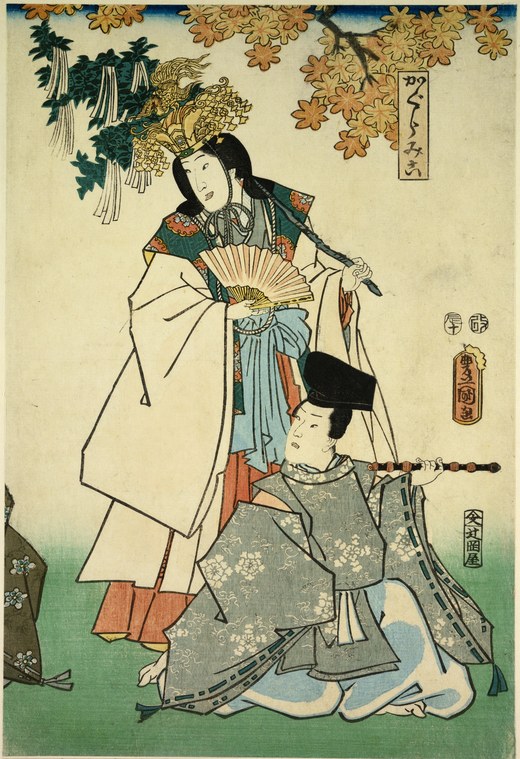
A kagura dance
Unknown artist
- Medium:
- Engraving
- Era:
- Pre-1700 (Renaissance/Baroque)
- Source:
- New York Public Library
- Rights:
- Public domain — free to use, share and adapt.
- Recorded as:
- public_domain
Kagura represents one of the world's oldest continuous sacred performance traditions, with documented history stretching back over a thousand years. This print provides direct visual testimony to kagura's theatrical conventions, formal costuming, and musical elements during a period when such images were primary documentation of living performance practice. For dancers and historians, the work illustrates the intersection of religious ritual, music, visual spectacle, and codified movement that defines Japanese performance traditions.
What you are looking at
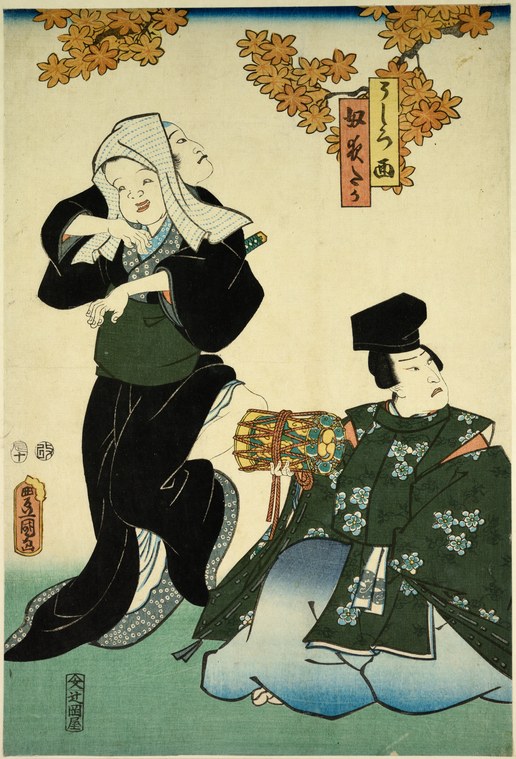
A Japanese woodblock engraving presents two figures in an intimate moment beneath flowering branches. A standing woman in an elaborate white outer robe decorated with rust and teal patterns holds a fan, her dark hair arranged formally. Below her, a kneeling man in gray formal dress plays a flute, his black hat placed beside him. The composition is vertically stacked, with the figures occupying the lower half of the frame while overhead hang branches laden with golden-brown blossoms—likely plum or cherry flowers rendered in the characteristic gold-leaf technique of Japanese prints. The background is a flat cream, with touches of green wash at the lower margin suggesting a garden setting. Cartouches in the upper right and along the right edge contain Japanese characters, typical of the print's title and artist marks.
The dancing
The woman stands with her weight evenly distributed, her posture upright and formal, holding a folded fan at waist level in both hands—a gesture of composed attention. Her elaborate outer garment falls in structured lines, indicating standing rather than active movement. The kneeling man is positioned lower in the composition, his body angled toward the woman, his arms raised to play the flute, which he holds at mouth level. His knees are firmly planted on the ground in formal seiza position. The spatial relationship between them suggests a performance or courtship ritual rather than partnered dance, with clear hierarchy established through height and positioning.
The dance depicted
This is not a depiction of dance in motion, but rather of kagura—Japanese sacred or ceremonial performance that encompasses music, song, mime, and ritualized movement. Kagura developed from Shinto religious practices and was performed at temples and courts. The flute player (likely performing a kagura melody) and the standing woman suggest a performance context rather than social dancing. The woman's pose and costume indicate her participation in a formal, codified performance tradition. However, the image captures a moment of theatrical presentation rather than active dancing, showing the aesthetic conventions and dress associated with kagura performance in the period this print represents.
How it was made
This is a woodblock engraving (likely ukiyo-e, Japanese prints for the masses) executed with the multi-block color printing technique common to 18th or 19th-century Japan. The use of gold leaf on the floral elements and the precise registration of colors—particularly the deep blues and earth tones—demonstrates the technical sophistication of the medium. Woodblock prints were produced in quantity and distributed widely, making them accessible to a broad audience and establishing them as a major vector for documenting theatrical and ceremonial performance. The technique required the carving of separate blocks for each color, and the stability of the registration here suggests skilled craftwork.
About this work
This woodblock engraving documents kagura, a Japanese sacred and ceremonial performance tradition with roots in Shinto religious practice. The print captures two figures in formal dress engaged in a ritualized performance: a musician playing flute in the lower portion and a standing woman above, both positioned within a flowering garden setting that frames the scene with gold-leaf blossoms. The work is a record of performance aesthetics and costume rather than dance movement captured in action. As a mass-produced woodblock print, it served as visual documentation of theatrical conventions and ceremonial dress for a contemporary Japanese audience, making it valuable evidence of how kagura was conceptualized, presented, and circulated in visual form.
How to look at it
Observe the extreme verticality of the composition: the artist has stacked the two figures to suggest hierarchy and the sequential, staged nature of kagura performance rather than simultaneous partnered movement. Notice how the woman's formal stance and the man's positioned kneeling create a moment of aesthetic presentation rather than dynamic action. The flowering branches overhead, rendered in precious gold leaf, establish this as a cultivated, refined performance context—not folk practice but court or temple ceremony. The cartouches indicate this is a documented, named performance rather than a generic scene.
The artist
The artist is not recorded in the catalogue. Based on the style and format, this appears to be the work of a professional ukiyo-e woodblock print artist active in Japan during the 18th or 19th century. The technical quality—particularly the gold-leaf application and color registration—indicates a maker working within the established conventions of the form, likely producing prints for commercial circulation among the urban merchant and educated classes.
The period
Kagura performance had undergone significant development by the Edo period (1603–1868), when woodblock printing became a major art form and primary medium for documenting contemporary culture. The style of dress, the refined compositional balance, and the gold-leaf technique all suggest a work from this period or slightly later. Woodblock prints of theatrical and ceremonial performers became a major genre during this time, serving both as artistic objects and as visual records of performance traditions. The elevation of kagura from exclusively temple-based religious performance to a form documented and disseminated through commercial prints reflects broader changes in how performance was valued and circulated.
Where it lives
The work is held in the New York Public Library collection. It is catalogued as an engraving from the pre-1700 period according to the current record, though the style, materials, and printing technique suggest a later dating (likely 18th or 19th century, during or after the Edo period). As a woodblock print, it represents a mass-produced object designed for circulation and ownership by non-elite audiences.
Dance in this work
Questions about this work
Is this depicting a dance?
Kagura is a sacred performance form that includes music, song, mime, and ritualized movement, but this print captures a moment of formal presentation rather than active dance. The musician and the woman are shown in posed, ceremonial positioning rather than in motion. Kagura occupies a different category than social or theatrical dance, though it shares concerns with both.
What is the significance of the flowering branches?
The branches establish a garden or temple setting and indicate a refined, cultivated context for the performance. The gold-leaf technique used to render the blossoms emphasizes the preciousness and aesthetic elevation of the moment. Such imagery often appears in depictions of court performance or ritual occasions marked by seasonal flowers.
Why is one figure standing and one kneeling?
The positioning likely reflects the roles within the kagura performance structure. The kneeling musician occupies a supporting position, while the standing woman is the focal point of the ceremony. This vertical organization was a convention in Japanese theatrical and ceremonial contexts to establish hierarchy and focus attention.
What does the record mean by 'Pre-1700 (Renaissance/Baroque)'?
This appears to be a cataloguing error. The style, printing technique, and composition are consistent with Japanese woodblock prints from the 18th or 19th century (Edo period or later), not the European Renaissance or Baroque periods. The record requires revision based on visual evidence.
More dance artwork