31 works in this view — arrow keys or swipe to move between them.
Dance in Art · 2019
The Daikagura dance
Unknown artist
- Era:
- Pre-1700 (Renaissance/Baroque)
- Source:
- New York Public Library
- Rights:
- Public domain — free to use, share and adapt.
- Recorded as:
- public_domain
For dance historians, *daikagura* represents an alternative lineage to kabuki—a living folk tradition that influenced and competed with professional theater. This image captures the genre in its moment of greatest urban popularity, showing how performers used gesture, costume, and spatial relationship to tell stories. For those studying performance archives, the print is a rare surviving record of how this now-obscure tradition actually looked to its audience.
What you are looking at
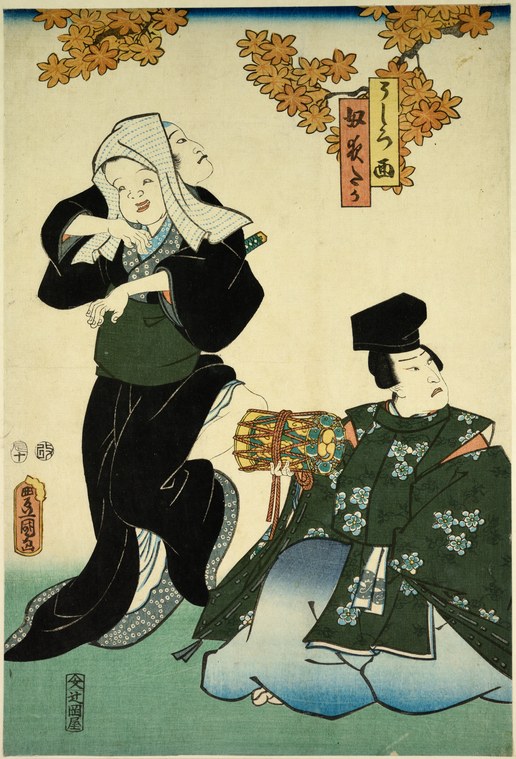
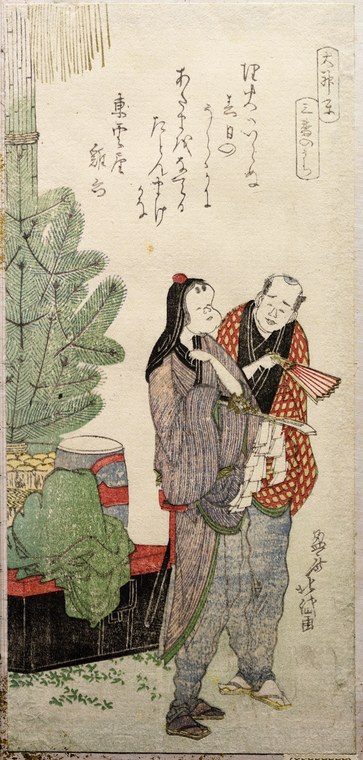
A woodblock print shows two figures in a moment of folk performance against a minimal setting. On the left stands a tall pine sapling with delicate needle work in green; on the right, a large decorative drum or vessel sits low to the ground, painted in warm earthen tones with red banding. The two performers occupy the center: a woman in a dark striped kimono with long sleeves, her body angled forward with one arm raised to her face in a gesture of surprise or emotion, her dark hair bound up; beside her, a man in a bright red patterned robe, his body leaning toward her with his arm extended. Both wear the casual indoor dress (nagajuban-style garments) of Edo-period entertainers rather than formal costume. Japanese calligraphic text in two cartouches fills the upper portion of the composition. The overall tone is intimate and narrative—a moment of interaction between two performers in what appears to be a sacred or seasonal performance context.
The dancing
The woman's posture shows her weight forward, her raised hand suggesting astonishment, alarm, or a moment of exaggerated emotional expression common to folk theater. The man leans in toward her with an extended arm, his posture equally animated. Neither figure stands in a formal dance frame; instead, their relationship is conversational and gestural. The impression is of two performers in character rather than executing codified steps, with emphasis on facial expression and upper-body movement. Their dress—loose robes without the formal structure of kabuki costume—suggests a folk rather than professional theatrical context.
The dance depicted
This is documented as a *daikagura* performance, a form of entertainment and ritual practice in Edo-period Japan that combined music, dance, acrobatics, and theatrical narrative. *Daikagura* (大歌舞伎 or 大神楽) evolved from Shinto shrine entertainments and became a popular traveling performance tradition. The image captures a moment of character interaction—possibly a comedic or dramatic exchange—rather than a codified dance movement. The presence of the drum and pine suggest a seasonal or sacred context (daikagura often performed at shrine festivals). The gestural, improvisatory quality visible here reflects the genre's roots in folk performance rather than the refined kata of kabuki or noh.
How it was made
This is a woodblock print (likely from the 18th or early 19th century, though the catalogue date conflicts with the record era label). The technique is evident in the careful color registration, the outlined figures, the decorative patterning of the robe and drum, and the use of gradated green for the pine foliage. Woodblock was the dominant medium for reproducing and circulating images of performance in Edo Japan, making prints like this primary documents of how entertainments appeared and were understood by urban audiences. The composition and perspective show the influence of the *ukiyo-e* tradition—images of the transient, visible world.
About this work
This woodblock print documents a moment from *daikagura*, a form of folk performance that combined Shinto shrine ritual, music, dance, and theater in Edo-period Japan. The image shows two performers in an intimate moment of character interaction, emphasizing gesture and expression over formal dance technique. The work belongs in a dance history context because *daikagura* was a precursor to and parallel tradition alongside kabuki, and because it represents a form of embodied performance—one that valued improvisation, seasonal ritual, and audience connection over the codified movements of trained actors. The print itself is a window into how ordinary Japanese people experienced live performance in the pre-modern era.
How to look at it
Attend to the moment the artist has chosen: not a moment of codified dance movement, but an instant of theatrical surprise or emotion—the woman's raised hand, the man's leaning approach. This compositional choice tells us that *daikagura* valued character and narrative moment over formal beauty. The minimal setting (just a drum and pine tree) anchors the performance in a festival or shrine context. Notice too the careful attention to the textures of the performers' robes and the patterning of the drum; these details would have been instantly recognizable to viewers who had seen such performances in person.
The artist
The artist is not recorded. The work's style and inscription cartouches indicate it was made by a woodblock designer working in the *ukiyo-e* tradition during the Edo or early Meiji period, when prints of actors and entertainers were a major commercial genre. The quality of the color work and composition suggest a trained artisan working within established conventions of the medium.
The period
The 18th and early 19th centuries saw *daikagura* at the height of its popularity among urban and rural audiences in Japan, particularly during seasonal shrine festivals. The tradition coexisted with and influenced kabuki theater, which was becoming increasingly formalized and controlled. In visual culture, woodblock prints of entertainers—actors, dancers, musicians—were a booming market in cities like Edo (Tokyo), driving technical innovation in color printing and composition. This print sits within that commercial, documentary tradition: it captures and sells the image of a live performance tradition to people who wanted to own a record of what they had seen or heard about.
Where it lives
The work is held in the New York Public Library collection. It is documented as part of their holdings of Japanese prints and documents of performance history, though catalogue details are sparse. The source record identifies it as a work from the pre-1700 era, though the visual evidence (woodblock technique, dress, and style) suggests a later date in the Edo or early Meiji period.
Dance in this work
Questions about this work
What is daikagura?
*Daikagura* (literally "great entertainment music") was a form of traveling performance in Japan that combined music, dance, acrobatics, and theater. It grew out of Shinto shrine entertainments and was performed at festivals and fairs from the 17th century onward. Unlike kabuki, which was controlled by the government and performed in theaters, *daikagura* remained a folk tradition, more improvisational and less bound by formal rules.
Is this print showing actual dance movements?
Not in the sense of codified steps or kata. The image captures a moment of gestural, theatrical performance—the kind of character interaction and emotional expression that *daikagura* valued. The tradition drew on dance and music, but emphasized storytelling and direct audience connection over the refined formal technique of kabuki or noh.
Who performed daikagura?
Traveling troupes of entertainers—often families or small companies—performed *daikagura* at shrine festivals, in villages, and at urban fairs. The tradition was open to non-professional performers in a way that kabuki, with its controlled licensing and urban theaters, was not. Many troupes included women, children, and musicians alongside male performers.
What is the significance of the drum in the image?
The drum likely indicates the musical and ritual context of the performance. *Daikagura* often included percussion, and the drum's presence here signals that this is a sacred or seasonal performance tied to shrine festivals rather than secular entertainment. The pine tree reinforces this connection to Shinto ritual.
More dance artwork