28 works in this view — arrow keys or swipe to move between them.
Dance in Art · 2019
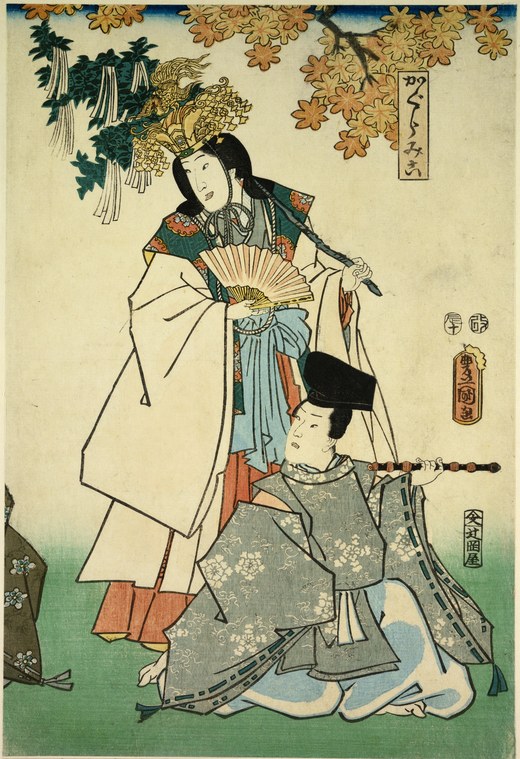
A kagura dance
Unknown artist
- Medium:
- Engraving
- Era:
- Pre-1700 (Renaissance/Baroque)
- Source:
- New York Public Library
- Rights:
- Public domain — free to use, share and adapt.
- Recorded as:
- public_domain
This work illustrates both the richness of Japanese theatrical printmaking and the challenges of interpreting unfamiliar cultural material across time and language. The catalogue mislabeling—treating a theatrical or domestic scene as kagura—is itself historically significant, showing how prints were recontextualized and sometimes misread as they moved into Western institutional collections.
What you are looking at
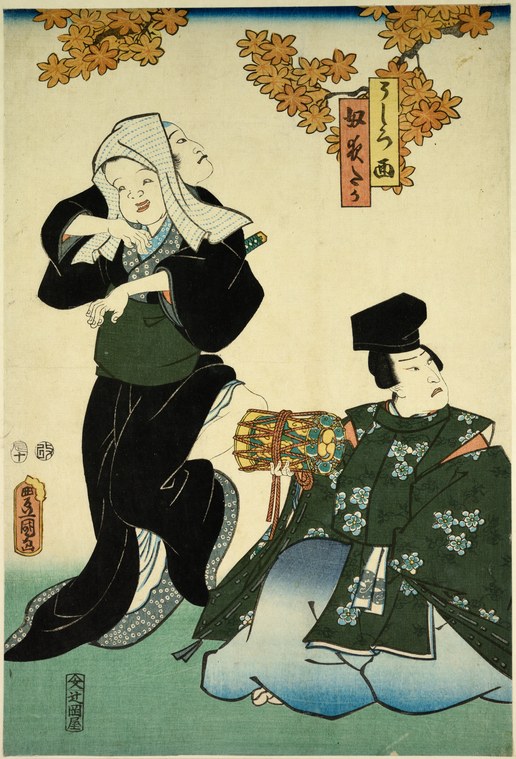
Two figures occupy a shallow stage space rendered in the Japanese woodblock style. On the left, an older woman in an elaborate black outer robe and white head covering leans forward with an animated, delighted expression, one hand raised to her face in a gesture of surprise or joy. Her pose is dynamic and informal. To the right sits a younger figure in formal green dress with a decorative patterned robe, posed more stiffly in a seated position. Between them hangs a cartouche with Japanese characters. Above, autumn foliage in warm yellows and oranges frames the composition. The background is a soft gradient from cream to pale blue. The engraving employs fine linework and color gradation typical of Edo-period woodblock prints, with careful modeling of fabric and facial features.
The dancing
The left figure's weight is pitched forward in an attitude of animated social engagement; the raised hand and open facial expression suggest she is responding to something said or done by her companion. The seated figure on the right maintains an upright, formal posture, suggesting a position of status or authority. The asymmetry of their positioning and energy creates a narrative moment rather than a static grouping. The bodies are not in contact and appear to be in conversation or social interaction rather than partnered movement.
The dance depicted
This is most likely not a depiction of kagura dance in the formal sense, despite the catalogue title. Kagura is a sacred Shinto ritual dance-drama performed by trained dancers, typically in shrine contexts, yet this print shows two figures in casual, domestic interaction—one in servant or common dress, the other in formal attire—in what appears to be an interior or stage setting. The poses and relationship suggest a theatrical or narrative moment rather than ritual performance. The work may instead represent a scene from Kabuki theatre or a print documenting a comic or romantic scene, with the cartouche possibly indicating the source text or context.
How it was made
This is a Japanese woodblock engraving (likely a 19th-century color woodprint or *ukiyo-e* print). The technique involves carving separate blocks for each color and hand-pressing paper against inked blocks, allowing for bold outlines, flat color areas, and the subtle gradations visible here. The medium was designed for mass circulation among urban audiences and could be produced in quantity, making it fundamentally different from European hand-engraved prints of the same period. The preservation of fine detail in faces and fabric patterns shows the high technical standard of Edo or Meiji-period workshop production.
About this work
This is a Japanese woodblock print, likely from the 19th century, depicting two figures in a theatrical or narrative setting. The catalogue record identifies it as a kagura dance, but the image does not show the formal, ritualistic characteristics of kagura performance; instead it captures a social or dramatic moment between figures of different status in what may be a Kabuki scene or domestic comedy. The work is a color woodprint in the *ukiyo-e* tradition, a form designed for wide popular circulation. It belongs in a dance collection not as documentation of kagura practice but as evidence of how dance, theatre, and social performance intersected in Japanese visual culture, and how European collectors and institutions (in this case the New York Public Library) categorized and sometimes misidentified Japanese prints when they entered Western collections.
How to look at it
The print captures a moment of social or dramatic interaction frozen mid-gesture. Notice the contrast between the animated, forward-leaning figure on the left and the composed, seated figure on the right: this asymmetry drives the narrative. The artist has chosen to show the older figure in a moment of emotional expressiveness—surprise, delight, or recognition—rather than a pose of formal grace. The facial expression and hand placement are the primary vehicles of meaning; this is a work about human interaction and emotion, not about the beauty of the dancing body in space.
The artist
The artist is not recorded. The style and execution are consistent with mid-to-late 19th-century Japanese color woodblock production by trained workshop artists. The cartouche with Japanese characters likely contains the artist's name or seal, the publisher's mark, and possibly a series title, but without translation or expertise these identifiers remain inaccessible in this documentation.
The period
This print was made during Japan's transition from the Edo period (1603–1868) into the Meiji era (1868–1912), when woodblock printing remained a vital medium for theatrical and popular imagery. Kabuki theatre was at the height of its cultural importance, and prints depicting theatrical scenes, actors, and dramatic moments were among the most popular subjects. In the same decades, Japanese prints began to be collected and exported to Europe and North America, sometimes with limited understanding of their original context. Western collectors and institutions often applied their own taxonomies to Japanese works, occasionally conflating different performance traditions or applying generic labels.
Where it lives
The work is held in the New York Public Library collection. It entered Western institutional collections as part of the broader 19th-century interest in Japanese prints and Japanese culture, a period when many such works were exported, purchased by collectors, and eventually donated to or acquired by public institutions.
Questions about this work
Is this actually a kagura dance?
The catalogue identifies it as such, but the image does not show the formal, sacred characteristics of kagura ritual performance. Kagura is typically a trained Shinto ritual dance performed in shrine settings by practitioners in costume and makeup. This print shows a theatrical or domestic scene between two figures in casual interaction, more consistent with Kabuki theatre or genre scenes. The title may reflect a misidentification or a broader conflation of Japanese dance forms.
Who made this print?
The artist is not recorded in the catalogue. The Japanese cartouche likely contains the artist's name or seal, but it has not been translated or identified in the available documentation. The work is characteristic of mid-19th-century Japanese woodblock production and was created by a trained artisan working in a commercial workshop tradition.
What is the technique?
This is a Japanese color woodblock print (*ukiyo-e*), made by carving separate blocks for different colors and hand-pressing paper against inked blocks. The technique allowed for mass production and wide circulation among urban audiences. The fine detail in faces and fabric and the subtle color gradations are hallmarks of high-quality Edo or Meiji workshop practice.
More dance artwork