37 works in this view — arrow keys or swipe to move between them.
Dance in Art · 1622
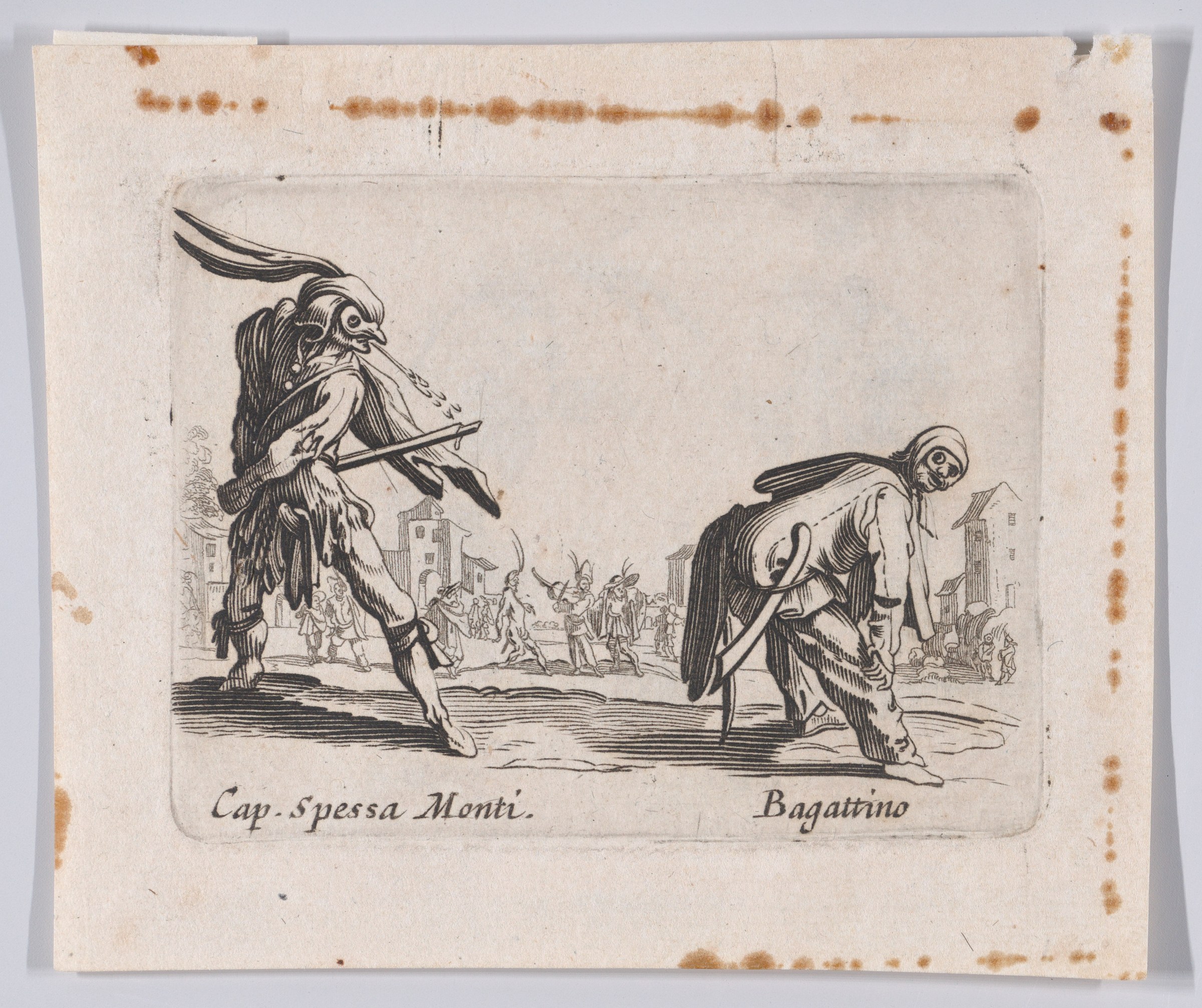
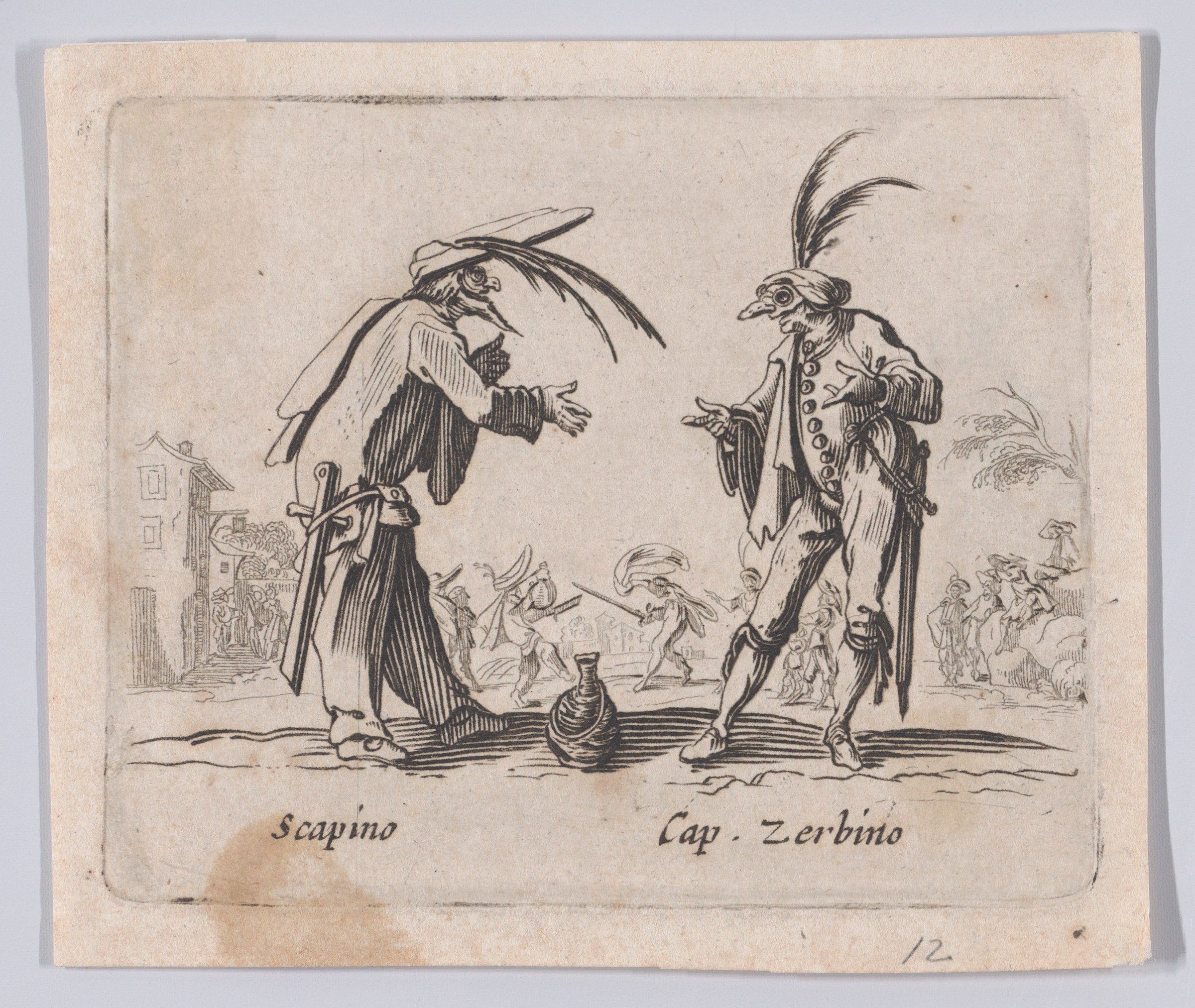
Copy of Scapino and Capitano Zerbino, from Balli di Sfessania (Dance of Sfessania) Met DP890480
Jacques Callot
- Medium:
- Oil Painting
- Era:
- Pre-1700 (Renaissance/Baroque)
- Source:
- Wikimedia Commons
- Rights:
- Public domain — free to use, share and adapt.
- Recorded as:
- CC0
This work is part of the only systematic visual record of commedia dell'arte performance we possess; there are no photographs, no film, only these prints and scattered written descriptions. For historians of movement, gesture, and performance—whether dance historians or theater historians—Callot's series is primary evidence of how bodies were used in popular entertainment. The work also demonstrates the deeply theatrical nature of early modern performance, where dance, comedy, and narrative moved fluidly between forms and audiences.
What you are looking at
Two figures in exaggerated commedia dell'arte costume dominate a shallow stage space. On the left, Scapino wears a cape and feathered hat, leaning forward in an animated pose with one arm gesturing outward. On the right, Capitano Zerbino stands in mirror-image theatricality, his plumed headpiece more elaborate, his doublet heavily decorated with buttons or jewels. Between them sits a single vessel—possibly a vase or drinking cup—establishing the scene's focal point. Behind and between the figures, a crowd of smaller figures engage in various activities: some appear to watch, others gesture or move in their own business. The background shows architectural elements on the left (a tall building with columns) and scattered figures on the right, suggesting a public square or marketplace. The entire composition is rendered in pen and ink with careful cross-hatching to create volume and shadow, using the conventions of early 17th-century engraving. The paper shows age and subtle staining.
The dancing
Both principal figures stand in the contrapposto stance characteristic of theatrical performance, weight shifted to one leg, the body animated and asymmetrical. Scapino's left arm extends in an open gesture of address or invitation; his cape swings behind him as if caught mid-movement. Zerbino's posture mirrors this openness, his arms positioned to suggest speech or demonstration. Neither figure is in a closed hold or formal dance frame; instead, they occupy separate performance spaces facing each other across the vessel between them. The crowd figures in the background are much smaller and rendered with less detail, establishing spatial recession and emphasizing the principals as the focal point of attention.
The dance depicted
This is not a depiction of formal dance steps but rather of commedia dell'arte theatrical performance—a form of popular improvised comedy that relied heavily on stylized movement, gesture, and physical comedy. Scapino and Capitano Zerbino are stock characters from the commedia tradition: Scapino (or Scapin) is the clever servant; Zerbino is the boastful military captain. The title 'Balli di Sfessania' (Dances of Sfessania) applies a dance vocabulary to theatrical performance, reflecting how fluidly these forms overlapped in early modern popular culture. The image captures a moment of confrontation or exchange between character types, with the vessel as a prop that may trigger physical comedy. No specific ballroom or court dance steps are visible; rather, the work documents the gestural and postural vocabulary of professional theatrical performance.
How it was made
This is an engraving rendered in ink on laid paper, recognizable from the fine parallel hatching lines that build tone and the crisp, linear quality of the line work. The technique allowed for precise detail in the faces and costumes while maintaining the bold compositional clarity essential to a work circulating as a print for popular consumption and instruction. Engravings of commedia dell'arte characters were among the most widely distributed images of the 17th century, reaching audiences across Europe who would never see a live performance. The catalogue record labels this as an oil painting, but the medium is clearly engraving on paper—a significant discrepancy.
About this work
This engraving documents a moment of commedia dell'arte performance, specifically the encounter between two stock character types: Scapino and Capitano Zerbino. Rather than recording a formal dance, it captures the gestural and postural language of popular theater as it was practiced and circulated in early 17th-century Europe. The work belongs in a gallery of dance in art not because it shows steps or formal choreography, but because it reveals how the boundary between dance and theater was porous in this period—how physical virtuosity, gesture, and stylized movement were shared languages across both forms, and how performance itself, in all its exaggerated physicality, was understood as a form of bodily eloquence. Jacques Callot's series 'Balli di Sfessania' is foundational documentation of how performers moved, stood, gestured, and inhabited character in the popular theater of the early modern world.
How to look at it
Attend first to the posture and weight distribution of the two principal figures: notice how the artist has captured not a frozen position but a moment of gesture and address, where the body leans, pivots, and extends to communicate character and intention. The exaggerated plumage and costume details serve the same communicative purpose as the body itself—they announce character type and social role. Look at the crowd in the background: the smaller figures suggest a public, casual context, very different from the formal court settings that would characterize contemporary ballet. The vessel between the two figures anchors the composition and likely signals the scenario or moment of comic action that would unfold in performance.
The artist
Jacques Callot (1592–1635) was a French engraver and printmaker who documented the visual culture of his time with obsessive precision. He specialized in prints depicting theatrical life, street scenes, and popular entertainments, creating images that circulated widely across Europe and shaped how people understood contemporary performance. His 'Balli di Sfessania' series, produced around 1622, consists of 24 prints cataloging the characters, movements, and stock scenarios of commedia dell'arte. The series represents one of the most important visual archives of theatrical practice from this period.
The period
In the early 17th century, commedia dell'arte was at the height of its influence, with traveling companies performing across Europe and establishing the character types and performance styles that would shape European theater for centuries. Simultaneously, court ballet was developing as a formal art in Italian and French courts, eventually becoming the basis for classical ballet. These worlds—popular street and marketplace theater on one hand, aristocratic spectacle on the other—shared physical vocabulary and character types, though they served different audiences and social functions. Callot's prints document the popular and theatrical side of this moment, capturing the movement vocabulary of performers working outside courtly institutions.
Where it lives
This work is described in the catalogue record as an oil painting held in an unspecified collection, and sourced from Wikimedia Commons. The actual medium is engraving on paper. It forms part of Callot's 'Balli di Sfessania' series, a sequence of 24 prints depicting commedia dell'arte characters and scenarios.
Questions about this work
Is this actually a dance?
Not in the formal sense of steps and choreography. This documents commedia dell'arte theatrical performance, which used stylized gesture, posture, and movement as its primary vocabulary. The title 'Balli di Sfessania' applies dance terminology to theater, reflecting how fluidly the forms overlapped: both relied on trained, virtuosic use of the body to communicate character and narrative. For historians of performance and movement, this is documentation of how bodies moved in professional entertainment.
Who are Scapino and Capitano Zerbino?
Stock characters from commedia dell'arte. Scapino is the clever, acrobatic servant—the zanni figure—known for physical comedy and scheming. Capitano Zerbino is the boastful military man, ridiculous and vain. Their encounter here, across a vessel or object that may trigger the action, is a scene type: the comedy emerges from the clash of these character types and what each represents in the social order.
Why does the catalogue say 'oil painting' when this is clearly an engraving?
This is an error in the catalogue record. The medium is engraving on laid paper, visible from the technique of parallel hatching lines and the crisp linear quality characteristic of printmaking. Oil painting would produce a different surface quality and different handling of tone. This discrepancy should be flagged for correction.
What is the vessel between the two figures?
The object serves as a compositional anchor and likely a prop that generates the comic action or scenario. Without knowledge of the specific scenario Callot intended, we cannot determine its exact function, but it establishes the spatial and narrative focus of the encounter between the two characters.
More dance artwork