49 works in this view — arrow keys or swipe to move between them.
Dance in Art · 1797
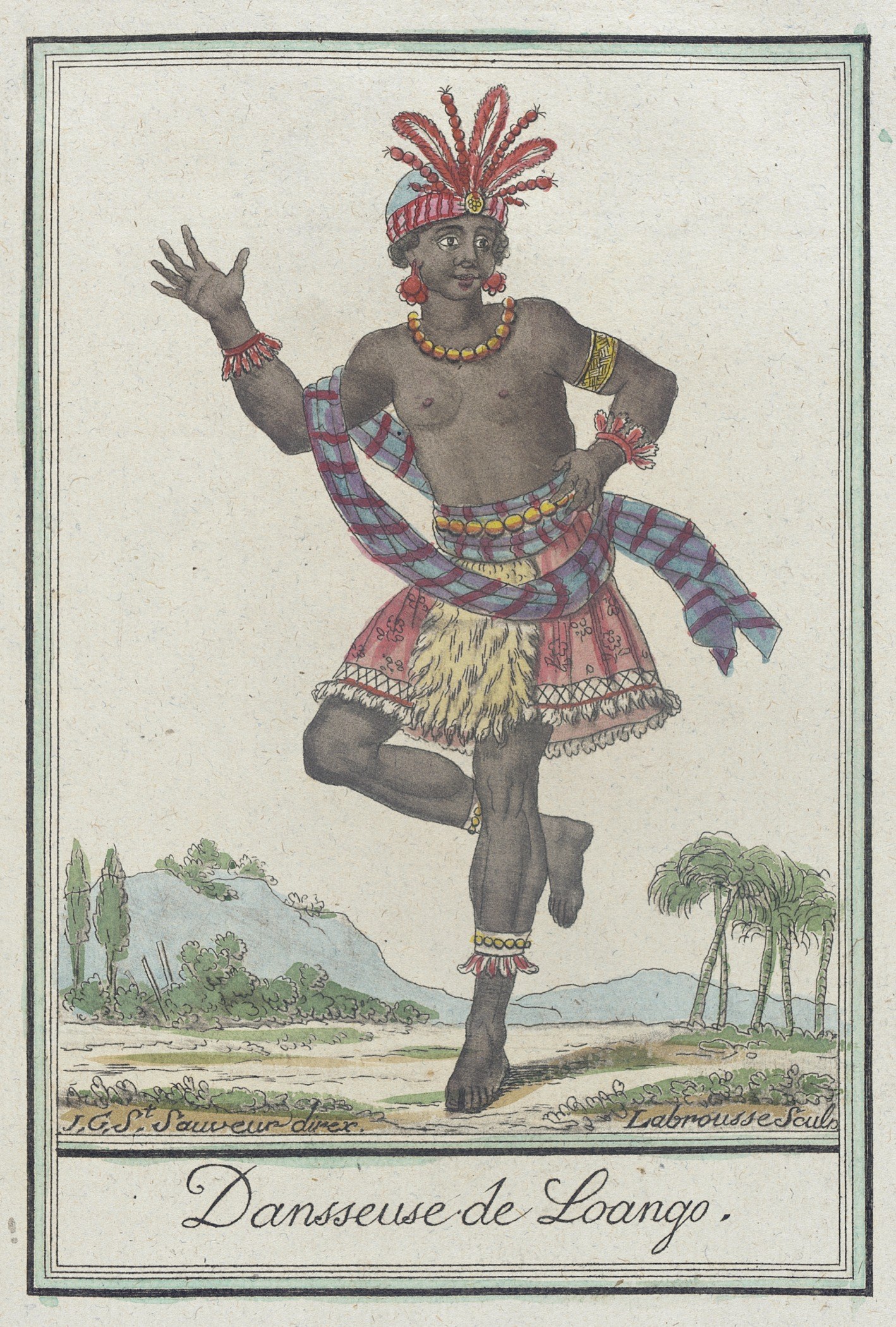
Costumes de Differents Pays, 'Dansseuse de Loango' LACMA M.83.190.315
Jacques Grasset de Saint-Sauveur (France, 1757-1810), Labrousse (France, Bordeaux, active late 18th century)
- Medium:
- Engraving
- Era:
- 1700s (Enlightenment/Minuet Era)
- Source:
- Wikimedia Commons
- Rights:
- Public domain — free to use, share and adapt.
- Recorded as:
- Public Domain
This image is essential for understanding how European artists of the Enlightenment visualized and codified non-European dance, and how those visualizations shaped European ideas about African bodies and movement for generations. For dancers and historians, it documents the moment when dance became part of ethnographic collecting and racial taxonomies—when choreography itself became evidence of cultural difference.
What you are looking at
A single male figure stands in a dynamic, energetic pose against a tropical landscape. He wears an elaborate costume: a striped fabric wrapped around his lower body with a fringed edge, a checkered sash or belt in red and blue, and ornamental bangles and armlets. His upper body is bare. He wears a striking headdress combining a striped fabric cap with a tall spray of red feathers fanned upward, and his ears are adorned with large ornamental discs. A beaded necklace sits at his chest. The figure's left leg is raised high, bent at the knee, while his right leg supports his weight; his left arm is raised with fingers spread in an expressive gesture, while his right arm extends outward. His facial expression is animated. The background shows a strip of tropical landscape with palm trees, sparse vegetation, and blue-tinted hills or water, rendered in muted greens and blues. The entire composition is framed within a double-line border typical of 18th-century engravings. The title beneath reads 'Dansseuse de Loango' in cursive script, with artist attribution visible at the bottom.
The dancing
The single figure occupies the entire composition in a moment of dynamic suspension. His weight appears concentrated on the right leg while the left knee drives upward, suggesting vigorous elevation or a jumping motion. His left arm extends upward with fingers splayed in an open, expressive gesture; his right arm stretches to the side at approximately shoulder height. His torso twists slightly, creating a diagonal line of energy. The pose conveys momentum and celebratory exuberance rather than the controlled, turned-out carriage of European theatrical dance of this period. The raised knee and airborne quality suggest a dance vocabulary rooted in propulsive, grounded movement rather than the lifted, ethereal aesthetics of contemporary European ballet.
The dance depicted
This is a representation of a Loango dancer—a person from the kingdom of Loango in present-day Congo—as understood and depicted by late 18th-century European artists. The figure is labeled 'Dansseuse' (female dancer), though the representation is stylized according to European conventions and may not reflect actual female dance practice from the region. The dynamic pose, with raised knee and spread-fingered gesture, suggests celebratory or ceremonial movement, but the image is a European ethnographic fantasy rather than a documentation of actual dance. The costume elements—feathered headdress, beaded ornaments, wraparound lower garment—were markers of exoticism for European audiences rather than necessarily authentic dress. Without access to primary sources from Loango dance practice itself, we cannot determine how accurately this depicts any actual dance form; it is almost certainly a projection of European imaginings onto African bodies.
How it was made
This is a hand-tinted engraving, as confirmed by the fine parallel lines (hatching) visible in the figure's skin and the background, characteristic of copper-plate engraving. The hand tinting—applied afterward in watercolor or gouache—adds color to what would have been a black-and-white print. Engraving was an expensive, labor-intensive medium requiring skilled craftspeople; it was used for book and portfolio illustration intended for educated, affluent audiences. The technique's precision and the refined composition suggest this comes from a larger published series on world costume or ethnography, circulated among collectors and scholars during the Enlightenment period. The engraver Labrousse and designer Grasset de Saint-Sauveur were producing systematized, illustrated inventories of global difference for European consumption.
About this work
This is one print from a late 18th-century European portfolio documenting 'costumes of different peoples,' specifically presenting a figure identified as a Loango dancer. The work belongs to the tradition of Enlightenment ethnographic imagery, in which European artists created stylized visual inventories of non-European peoples, their dress, and their supposed customs. The figure's energetic pose—raised knee, spread fingers, animated expression—was the artist's interpretation of African dance as exotic, vigorous, and celebratory, contrasting sharply with the restrained, verticalized aesthetic of contemporary European ballet and court dance.
The print circulated among educated European audiences as a form of geographical knowledge and entertainment. It represents both genuine curiosity about global human diversity and the distorting lens of colonial-era European perspective. The costume elements and the energetic pose became visual shorthand for 'African dancer' in European culture, establishing iconography that persisted well into the 20th century.
How to look at it
Attend first to the suspended moment the artist chose: the figure is captured mid-leap or at the apex of a raised-knee gesture, not at rest. This choice—to freeze dynamic, upward movement—conveys energy and celebration. Notice how the artist rendered the pose: the spread fingers and open palm are expressive and gestural rather than forming any recognizable European dance position. The bare chest and elaborate ornamental costume (headdress, necklace, bangles, wrapped lower garment) are presented as ethnographic markers. The tropical landscape background, though minimal, signals 'elsewhere' to European viewers. Consider what the artist could not or would not depict: the actual choreographic logic, communal context, or spiritual meaning of the dance itself. This is image-making in service of exoticism and classification.
The artist
Jacques Grasset de Saint-Sauveur (1757–1810) was a French artist and writer specializing in illustrated ethnographic compilations. He produced numerous costume albums and treatises on world dress and customs, working in the tradition of Enlightenment natural history and human classification. Labrousse, active in Bordeaux in the late 18th century, was an engraver who executed designs by artists like Grasset. Such partnerships were typical in the production of large, expensive illustrated books and portfolios aimed at educated collectors. Grasset's work was influential in establishing visual conventions for representing non-European peoples across multiple print media.
The period
The 1790s saw European appetite for ethnographic imagery at its height, driven by Enlightenment scientific taxonomy and the expansion of colonial contact. Dance was rarely documented for its own sake; instead, dancers appeared as evidence of climate, geography, and cultural stage in hierarchies of human civilization. European theatrical dance in the 1790s was dominated by pantomime ballet in the neoclassical style, with an emphasis on turned-out, lifted, ethereal movement codified through the Cecchetti and Vaganova methods emerging in Russia. This image of dynamic, grounded, expressive African movement would have appeared radically alien to European audiences accustomed to the aesthetic conventions of their own stage.
The print also coincides with the Haitian Revolution (1791–1804), when African and diaspora dance and resistance became politically urgent for European powers. Ethnographic portfolios like this one, while presenting themselves as neutral documentation, were part of a broader project of defining non-European peoples as objects of knowledge rather than historical agents.
Where it lives
The work is held by LACMA (Los Angeles County Museum of Art) as part of its costume and textiles collection (accession M.83.190.315). It is one print in a larger series titled 'Costumes de Différents Pays' (Costumes of Different Peoples), a portfolio produced in France around 1797 and distributed to collectors and institutions. The series was part of late 18th-century European efforts to document and classify human diversity through illustrated books and prints.
Dance in this work
Questions about this work
Is this a real depiction of Loango dance?
Likely not. This is a European interpretation filtered through the aesthetic conventions and racial assumptions of the 1790s. The artist, Grasset de Saint-Sauveur, was working from written descriptions and imaginative interpretation rather than firsthand observation or documentation. The figure labeled 'Dansseuse de Loango' represents how French Enlightenment artists visualized African dance for European audiences, not how Loango people danced or presented themselves.
Why is she labeled 'Dansseuse' (female dancer)?
The label reflects the artist's decision to present this as a female figure. However, the actual gender of the person represented, or whether gender was a meaningful category for the dance itself, cannot be determined from the image. The label may reflect European assumptions about which dances were appropriate for women to perform, rather than documentation of actual Loango practice.
What does the costume tell us?
The costume elements—the feathered headdress, beaded necklace, ornamental bangles, and wrapped lower garment—were presented by European artists as markers of exoticism and cultural difference. Some elements may derive from actual Loango dress traditions, but the assemblage and presentation are designed for European consumption. The bare chest, in particular, was a convention European artists used to signal non-European identity and to emphasize difference from clothed European bodies.
How does this movement compare to European dance of the same period?
The raised knee, spread fingers, and dynamic upward energy contrast sharply with the turned-out, lifted, ethereal aesthetic of European ballet in the 1790s. The artist captured the movement vocabulary as vigorous, grounded, and celebratory—the opposite of the restrained verticality valued in European theatrical dance. Whether this reflects actual differences in movement practice or is simply a European projection of exoticism cannot be determined from the image alone.
More dance artwork