49 works in this view — arrow keys or swipe to move between them.
Dance in Art · 1898
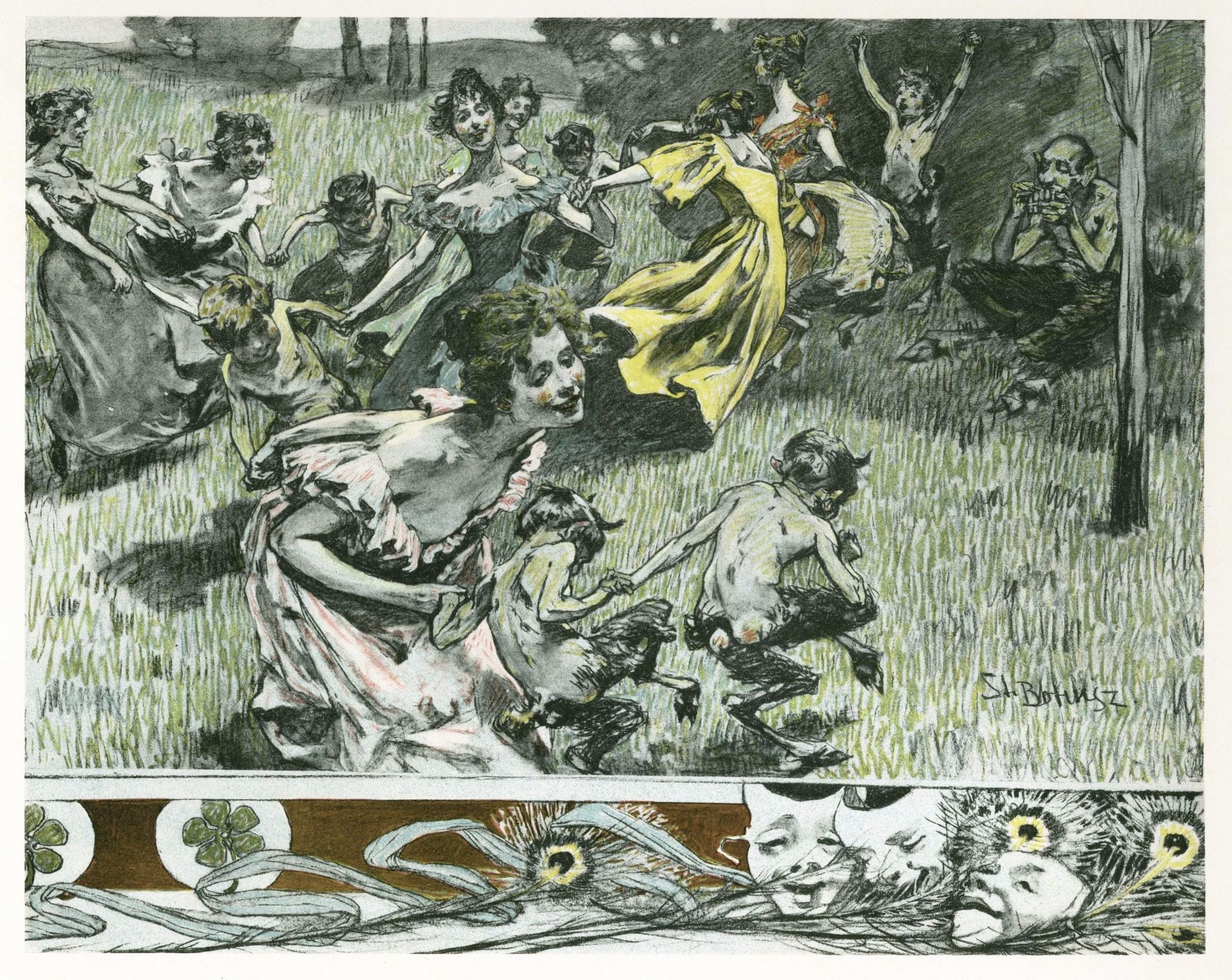
Dance 1898 Litografia by Stanisław Bohusz Siestrzeńcewicz
Stanisław Bohusz-Siestrzeńcewicz
- Medium:
- Oil Painting
- Era:
- Late 1800s (Victorian Ballroom)
- Source:
- Wikimedia Commons
- Rights:
- Public domain — free to use, share and adapt.
- Recorded as:
- Public Domain
This work documents a crucial late-19th-century visual conversation about what dance could mean: not refinement or courtship, but ecstasy, mythology, and the transgressive power of collective movement. It shows how artists used classical and Romantic imagery to stage fantasies of bodies freed from Victorian restraint, a discourse that would influence modern dance's early critique of ballroom convention.
What you are looking at
A moonlit outdoor gathering celebrates with wild, uninhibited movement. In the foreground, a woman in a pale slip reclines on grass, attended by two small fauns or satyrs in dark fur who gesture toward her with playful urgency. Behind her, a crowd of women and children swirl in motion, their pale drapery and limbs blurred with energy. One figure in bright yellow fabric dominates the middle distance, arms flung skyward in ecstatic abandon. The composition is densely packed—figures overlap and gesture toward the center of the scene, their bodies caught mid-leap or mid-sway. The setting is rural and nocturnal, rendered in green and grey crosshatching, with dark woods forming a dense backdrop. At the base of the composition, an ornamental border frames floral and theatrical masks, grounding the scene in art-historical convention rather than naturalism.
The dancing
The bodies are loose and asymmetrical, weight distributed unevenly—hips tilted, torsos twisted, arms extended at varied heights rather than in unison. No formal frame or closed hold exists; instead, bodies move in isolation or in loose proximity, reaching upward or across toward neighbors. The woman in yellow shows a particularly emphatic extension, one arm high and the other forward in an expansive, nearly balletic port de bras, while the recumbent figure in the foreground is entirely passive and horizontal. The smaller faun figures bend and angle their bodies toward the central woman in gestures that suggest persuasion or invitation rather than dance partnership. Movement reads as improvised and ecstatic rather than codified.
The dance depicted
This appears to depict a Bacchanal or mythological orgiastic scene rather than a recognizable historical dance form. The imagery—fauns, satyrs, ecstatic female figures, nocturnal setting, pastoral abandon—draws on classical precedent and 19th-century Symbolist and Romantic themes of nature worship and sensual release. The gestures and groupings suggest inspired or possessed movement, the kind associated with Dionysian rites or Romantic-era fantasy rather than a social or theatrical dance with defined steps. The work belongs to the visual tradition of representing dance as collective trance or divine madness rather than technique.
How it was made
The catalogue record claims oil painting but the image shows characteristics of a color lithograph or hand-colored lithograph: the soft, blended tones, the visible grain and crayon texture in the greens and blacks, the flatness of the color planes, and the discrete linear hatching. The medium allows for rapid, expressive mark-making and the kind of atmospheric diffusion visible here—especially in the glowing nocturnal mood. The ornamental border below, printed as part of the composition, is standard to European art prints and book illustration of the 1890s. This is likely a reproductive print intended for broad circulation in cultural journals or collected editions rather than a one-of-a-kind oil.
About this work
This is a color lithograph depicting a mythological bacchanal or satyr revels, a theme popular in Symbolist and late-Romantic European art of the 1890s. The artist renders ecstatic, uninhibited movement as the antithesis of ballroom propriety—bodies flung upward, twisted sideways, merged in a nocturnal crowd. The ornamental frame and the allegorical subject matter place it within the fin-de-siècle tradition of art for cultured print collectors, a genre that used classical motifs to explore themes of desire, nature, and freedom from social constraint. It represents dance not as technique but as abandonment, the body possessed rather than controlled.
How to look at it
Pay attention to the asymmetry and the absence of symmetry or unison: no two figures move in the same frame or hold, and most are isolated even when grouped. The artist has chosen a moment of frenzy rather than a structured step or figure. Notice the contrast between the pale, active female bodies and the dark, small faun figures—the composition plays on anxiety and desire, the large and the threatening-small. The ornamental border below recalls Renaissance and early modern print conventions, distancing the scene into allegory or fantasy even as its energy reads as immediate and visceral.
The artist
Stanisław Bohusz-Siestrzeńcewicz was a Polish artist working in the Symbolist tradition at the fin de siècle. Little is widely documented of his practice, but his work in printmaking and illustration places him within the broader European Symbolist movement, which emphasized mythological subjects, mood over narrative clarity, and the expressive potential of the graphic arts. His prints circulated through cultural journals and collected editions of the 1890s–early 1900s.
The period
The 1890s saw a profound reaction against Victorian ballroom culture among artists and intellectuals. The Symbolist and Romantic movements drew heavily on classical and mythological subjects to imagine bodies moving without constraint—dance as trance, possession, or natural force rather than learned etiquette. Simultaneously, early modern dancers like Loïe Fuller and Isadora Duncan were beginning to theorize movement as expression rather than technique, often invoking ancient Greek and Bacchic imagery. This print sits at the intersection of those conversations, using classical motif to critique contemporary social choreography.
Where it lives
The work is recorded as sourced from Wikimedia Commons, a digital repository of public-domain and openly licensed images. No holding collection or accession information is currently recorded.
Questions about this work
Is this a real dance or a fantasy?
It is a fantasy: a depiction of classical Bacchanal or satyr revels, a mythological scene rather than a historical or social dance form. However, the image reveals how artists of the 1890s used such mythology to imagine dance as ecstatic and uncontrolled—a powerful counter-image to the formalized ballroom dances of the Victorian era.
What are the small creatures in the foreground?
They appear to be fauns or satyrs, mythological beings associated with nature, fertility, and divine madness. In classical art, they attend scenes of Dionysian revelry and represent the transgressive or instinctual forces at play.
Why is this labeled 'Victorian Ballroom' when it shows nothing like a waltz or quadrille?
The era label refers to the period of creation (late 1800s Victorian era), not the dance style depicted. The work is actually a critique of or fantasy counter to ballroom culture, imagining movement as wild and unstructured rather than refined and regulated.
More dance artwork