39 works in this view — arrow keys or swipe to move between them.
Dance in Art · 1828
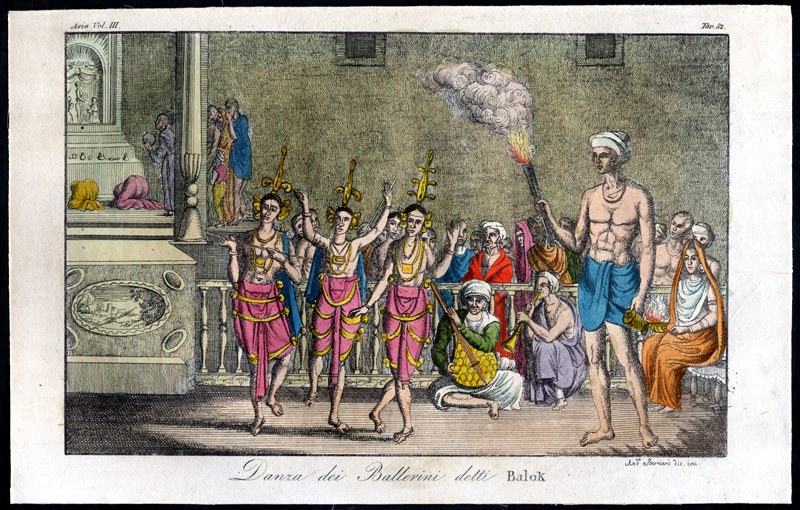
Dance of the dancers of Dance
Giulio Ferrario
- Medium:
- Oil Painting
- Era:
- Early 1800s (Waltz Revolution)
- Source:
- Wikimedia Commons
- Rights:
- Public domain — free to use, share and adapt.
- Recorded as:
- Public Domain
This work is valuable as evidence of how early 19th-century Europe imagined and represented non-European dance—a moment when ethnographic curiosity was driving visual documentation, but often through the lens of romantic historicism and classical ideals. For dancers and historians, it reveals the aesthetic and movement principles valued in a source culture as interpreted by a European engraver working from written descriptions, travel accounts, or museum collections. The leap, the synchronized precision, and the integration of ritual objects into movement all carry specific information about dance practice in a period when few other visual records survive.
What you are looking at
A classical or neoclassical architectural setting with a columned portico frames a ceremonial scene. Three male dancers in the center, shirtless and wearing short pleated skirts (likely representing ancient Greek or Roman dress) perform a synchronized movement, each holding aloft what appear to be flaming torches or ceremonial objects that trail smoke. They are caught mid-leap or mid-stride, bodies angled forward with a unified dynamic energy. To the left, a figure in draped robes observes from an elevated portico; to the right stands a large, powerfully built male figure in a turban and scanty dress, gesturing or directing the action. Women in flowing garments and headdresses occupy the right foreground, some seated, some standing in attitudes of attention or supplication. The composition draws the eye from the architectural frame inward to the dancing figures, using their central position and upraised torches to create a focal point of ritual intensity.
The dancing
The three central dancers are in a near-identical pose—bodies leaning forward with knees bent, one leg extended, arms raised high with the torches creating vertical emphasis. Their posture suggests a springing or launching movement rather than a grounded step; the uniformity of the pose across all three implies choreographed synchronization. The surrounding figures are stationary and observational, creating a clear distinction between the active dancers and the witnessing court or congregation. The large male figure's stance—broad-legged and authoritative—suggests he is a presiding or directing presence rather than a participant.
The dance depicted
The inscription identifies this as 'Danza dei Ballerini delli Balok'—Dance of the Ballerini of Balok. The work appears to depict a historical or ethnographic reconstruction of an ancient ceremonial dance, likely from a non-European source that Ferrario was documenting in his encyclopedic survey of costume and custom. The synchronized male dancers, the torch-bearing, the formal architectural setting, and the presence of both male authority and female witnesses suggest a ritual or processional dance with religious or state significance. The leaping posture and raised implements indicate a dynamic, elevated movement vocabulary far removed from the ballroom styles contemporary with the work's publication.
How it was made
This is a hand-colored engraving or lithograph, as evidenced by the linear hatching visible in the architectural background, the precise outlines of the figures, and the characteristic layering of color blocks typical of early 19th-century chromatic printmaking. The technique allowed for wide circulation and reproduction—Ferrario's *Il Costume Antico et Moderno* was a major European reference work on historical and ethnographic dress. The color separation and manual application suggest this was a luxury publication for educated readers, patrons, and collectors. The precision of the medium suits the didactic purpose: recording and displaying the specifics of unfamiliar dress, posture, and movement.
About this work
This is a documentary engraving from Giulio Ferrario's landmark 1828 encyclopedic survey of historical and contemporary costume. It purports to record an ancient or foreign ritual dance—specifically identified as the 'Dance of the Ballerini of Balok'—and presents it through the lens of neoclassical archaeology and ethnographic curiosity characteristic of the early 19th century. The work combines historical reconstruction, antiquarian interest, and visual precision to communicate both the exotic otherness and the ordered structure of non-European dance practice to a European audience.
Ferfario's work sits at an intersection of artistic and scientific documentation. Unlike theatrical depictions of dance or social snapshots, this image claims to be a faithful record of a specific cultural practice, presented without irony or critique. The synchronized male dancers, the ceremonial setting, and the apparent gender and status hierarchies embedded in the composition all reflect both the actual practice being documented and the assumptions the artist and his audience brought to viewing it.
How to look at it
Attend first to the moment of suspension the artist has chosen: the three dancers are caught in mid-leap, bodies fully extended and weight clearly airborne. This is not a resting position or a transition, but the climactic height of a springing movement. Notice how the artist has aligned all three bodies in near-identical posture, emphasizing the choreographed synchronization. The raised torches are not incidental props but structurally central to the design—they create vertical lines that echo the architectural columns and draw the eye upward, making the leap and the flame inseparable. The surrounding figures—the authoritative man, the attending women, the observer in the portico—define the dancers as performers in a ritual space, not as casual or social dancers. The engraver's technique allows sharp delineation of individual bodies while maintaining the unified energy of the group.
The artist
Giulio Ferrario (1767–1847) was an Italian antiquarian, author, and illustrator specializing in the history of costume and manners. *Il Costume Antico et Moderno* (The Dress Ancient and Modern), published in multiple editions and languages from 1820 onwards, was his life work—a monumental encyclopedic survey combining historical research, ethnographic observation, and visual documentation. Ferrario assembled the work from travel accounts, museum holdings, diplomatic correspondence, and scholarly sources, and its success made it the standard European reference for costume history throughout the 19th century. He was not primarily a dancer or movement specialist; his authority was historical and curatorial, and his depictions of dance reflect that lens.
The period
In 1828, ballroom dancing in Europe—the waltz in particular—was experiencing what historians call the 'Waltz Revolution,' transforming social dance and sparking moral controversy. Simultaneously, neoclassicism and antiquarian scholarship were at their height, and European fascination with non-European cultures was driving both serious ethnographic collecting and romantic exoticist fantasy. Ferrario's work belongs to the scholarly end of this spectrum; his detailed costume documentation served both antiquarians and artists seeking historical accuracy. However, the very act of freezing a living dance into an engraved image, and translating it through the language of neoclassical form and European artistic convention, inevitably reshaped what it documented. The synchronized leap, the torch, the architectural frame—all are Ferrario's interpretation as much as his record.
Where it lives
This engraving is from the 1828 edition of Ferrario's *Il Costume Antico et Moderno*, a published work with wide circulation in 19th-century Europe. The record notes a source attribution to eBay (July 2006), indicating this impression came from a dispersed collection; current holding location is not recorded. The work survives in multiple impressions and editions across European and American institutions.
Dance in this work
Questions about this work
What dance is this actually showing?
The inscription identifies it as the 'Danza dei Ballerini delli Balok,' which scholars have struggled to locate with certainty in documented dance traditions. It may refer to a historical Balkan dance tradition, or to a practice Ferrario encountered through written sources and reconstructed from description. The work is a learned historical interpretation rather than a direct observation, and the specifics of the source remain unclear.
Is this an accurate record of how the dance was actually performed?
Probably not in every detail. Ferrario worked from written sources, museum collections, and reports rather than from direct observation of a living tradition. The synchronized poses, the theatrical framing, and the neoclassical aesthetic all reflect European artistic conventions of his era. The dance likely existed, but the engraving presents a European antiquarian's reconstruction—authoritative in spirit but interpretive in practice.
Why are the dancers male and shirtless?
The minimal dress and male bodies align with neoclassical ideals of ancient Greek and Roman athleticism that dominated early 19th-century historical reconstruction. Whether the actual tradition involved men, women, or both, and what they wore, is unclear from the image alone. The aesthetic choices reflect Ferrario's and his audience's assumptions about how ancient or 'primitive' people danced.
What is the large man on the right doing?
His posture and central placement suggest authority—he may be a leader, priest, or dignitary overseeing the ritual. His dress (turban and scanty garments) marks him as distinct from both the European observers and the dancing figures, situating him within the foreign culture being documented.
More dance artwork