48 works in this view — arrow keys or swipe to move between them.
Dance in Art · 1900
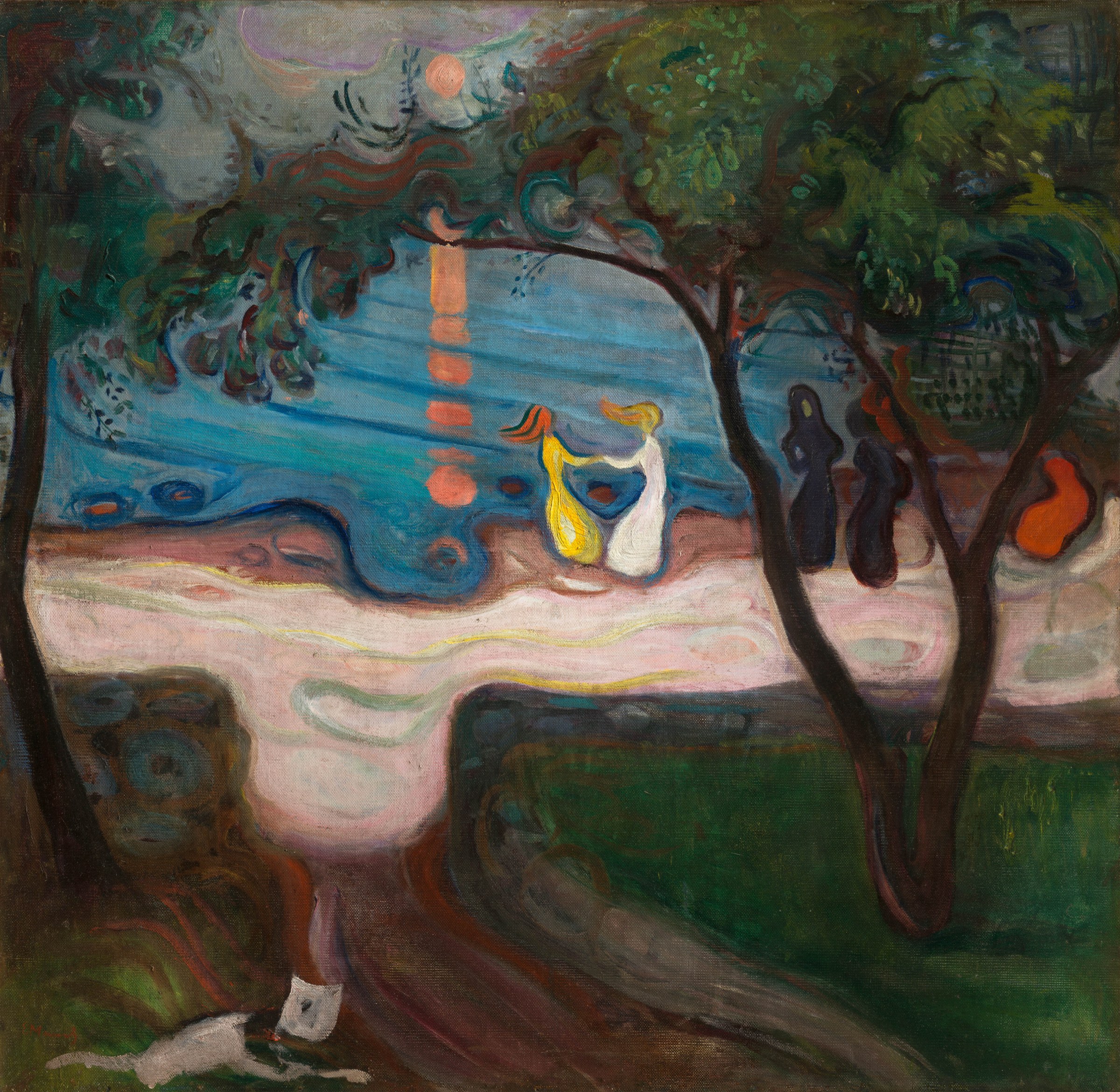
Dance on the Beach Munch
Edvard Munch
- Medium:
- Oil Painting
- Era:
- 1900-1920 (Ragtime/Early Jazz)
- Source:
- Wikimedia Commons
- Rights:
- Public domain — free to use, share and adapt.
- Recorded as:
- Public Domain
While this work does not depict dance, it is included in dance archives because it captures a moment of embodied emotion and solitude that has resonated with dancers, choreographers, and artists working with psychological and emotional themes. The painting's influence on Expressionist and Modernist performance extends beyond literal representation into the realm of mood, gesture, and the expressive body.
What you are looking at
A woman in a white dress with a yellow shawl stands alone on a beach at night, gazing at the water where a full moon casts an orange reflection. She is framed by gnarled trees on either side, their dark trunks and twisted branches creating a natural corridor that draws the eye toward her solitary figure. The beach is rendered in soft pinks and pale yellows, while the water is a vibrant blue with concentric ripples around the moon's reflection. In the background, barely visible, are two dark figures—possibly other people or shadows—and what may be a structure on the right. The sky above is mottled gray and purple, the moon itself a warm orange disk. The overall mood is dreamlike and melancholic, with the woman seeming to contemplate or mourn something beyond the picture's edge.
The dancing
The central figure stands with her weight evenly distributed, her body turned slightly to face the water, her posture upright but contemplative rather than active. Her arms hang naturally at her sides, with one hand visible holding or gesturing with the yellow shawl. There is no suggestion of partnered or group dance: she is isolated and still, a solitary observer rather than a dancer in motion. The two distant figures on the right are rendered as dark silhouettes without clear body definition, too far removed and undefined to read as dancers.
The dance depicted
This image does not depict dance in the conventional sense. The woman's stance and gesture suggest emotional introspection or mourning rather than the structured movement of any identifiable dance form. The beach setting and moonlit atmosphere invoke Romantic and Symbolist preoccupations with solitude, nature, and psychological states rather than ballroom, social, or theatrical dance. While the composition has the poignancy often associated with Romantic-era painting, there is no evidence of formal choreography, partners, or the physical engagement that would constitute dance.
How it was made
This is an oil painting with loose, expressive brushwork characteristic of early Modernism. The artist has used bold color—the intense blue of the water, the warm orange moon, the deep greens of the trees—with visible layering and blending that creates emotional intensity rather than photographic detail. The fluid application of paint allows for atmospheric effects and the conveyance of mood and movement in nature itself, even as the human figure remains relatively still. This technique was well suited to reproduction and circulation in the Modernist period.
About this work
This is a Symbolist or early Modernist painting of a solitary woman on a beach at night, contemplating the moonlit sea. The work belongs to a tradition of Romantic and post-Romantic art in which landscape, solitude, and psychological states replace narrative or action as the subject. Although it depicts a human figure in a moment of stillness and introspection, it does not represent dance or structured movement; rather, it uses the figure as a vehicle for exploring emotion and the relationship between the individual and nature. The work is significant as a meditation on isolation and longing rather than as a document of dance practice.
How to look at it
Attend to the compositional framing: the woman is centered but small, dwarfed by the natural elements around her. The gnarled trees funnel the viewer's gaze toward both the figure and the water beyond, creating a sense of longing or projection. Notice the contrast between the woman's stillness and the movement suggested by the water's ripples and the trees' twisted forms. The painting does not capture a moment of action but rather a pause—a moment of emotional intensity held within a landscape.
The artist
Edvard Munch (1863–1944) was a Norwegian Symbolist and Expressionist painter whose work explored anxiety, desire, death, and isolation. He developed a highly personal visual language in which color, distortion, and gestural brushwork conveyed inner emotional states. His subjects often include solitary or anguished figures set against dramatic landscapes or urban scenes. Although Munch was not primarily a painter of dance, his work influenced modern dance pioneers including Mary Wigman and German Expressionist choreographers who sought to visualize psychological and emotional content through the moving body.
The period
This painting dates to 1900, a moment of profound change in art and performance. Symbolism was giving way to Expressionism; in dance, the rigid conventions of ballet were being challenged by reformers like Isadora Duncan and the Russian Imperial Ballet under Diaghilev. In visual art, artists were abandoning narrative realism in favor of subjective emotional expression. Munch's work exemplifies this shift: the painting is less concerned with depicting an actual scene or event than with conveying a psychological state. The beach and moonlight are vehicles for exploring longing, melancholy, and the individual's relationship to nature and mortality—themes that would deeply influence early modern dance.
Where it lives
The work is sourced from Wikimedia Commons. No holding collection is recorded in the catalogue.
Questions about this work
Why is this painting in a dance gallery if it does not show people dancing?
This work is included because it represents a pivotal moment in the relationship between visual art and modern dance. Munch's expressive use of color, form, and gesture to convey emotion directly influenced Expressionist dancers and choreographers in the early 20th century. The painting shows how artists outside dance were grappling with similar questions about how to represent inner states, questions that dancers were answering through movement. It is a document of shared artistic concerns.
Who is the woman in the painting?
The identity of the figure is not specified and may not be knowable. In Symbolist and Modernist practice, individual identity is often less important than the emotional or psychological state being conveyed. The woman functions as a type—the solitary, longing figure—rather than as a named character or portrait subject.
What is the relationship between the central figure and the distant figures on the right?
The distant figures remain ambiguous and are rendered too indistinctly to identify with certainty. They may be other beach visitors, may represent a memory or psychological projection, or may be part of the landscape's mood rather than narrative elements. Their separation from the central figure reinforces her solitude.
More dance artwork